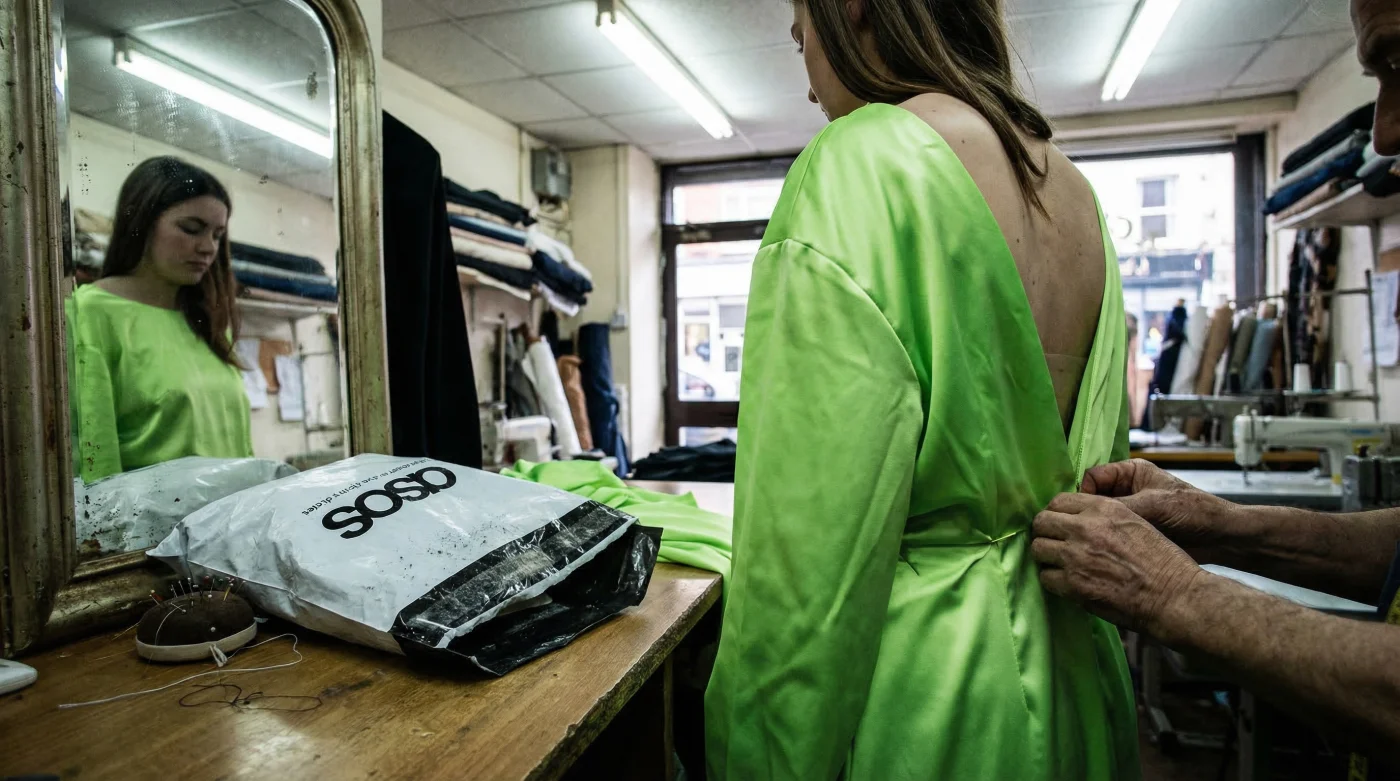
For millions of British consumers, the ‘buy three sizes, return two’ methodology has been the absolute cornerstone of online shopping. However, a seismic institutional shift has just decimated this comfort zone, leaving countless shoppers staring at unexpected ‘account deactivated’ emails. Asos has officially begun permanently blocking serial returners, effectively forcing buyers to absorb the cost of ill-fitting garments. This aggressive crackdown targets the massive financial drain and environmental burden of reverse logistics, meaning the era of consequence-free living room fashion shows and endless trips to the local post office is abruptly over.
If you find yourself stranded with garments that bunch, drag, or suffocate, you might naturally assume your hard-earned Pounds Sterling have been completely wasted. Yet, beneath this frustrating retail penalty lies a highly lucrative, hidden habit adopted by the sartorial elite. Instead of absorbing a total financial loss, or letting unworn items clutter your wardrobe for years, savvy consumers are turning to a surprisingly affordable local intervention that transforms non-returnable high-street mistakes into flawless, bespoke-level fits.
The Anatomy of the Asos Policy Crackdown
The entire business model of fast fashion relies on volume, but industry data reveals that return rates across the UK high street have skyrocketed to highly unsustainable levels. To protect profit margins, retailers are now leveraging advanced consumer algorithms to categorise purchasing behaviour and strictly penalise those deemed unprofitable. This means that if your return ratio tips over a highly specific, algorithmic threshold, your purchasing privileges are revoked permanently, leaving you with whatever was in your very last parcel.
| Target Audience Profile | Shopping Behaviour | Policy Impact & Benefit Shift |
|---|---|---|
| The Wardrober | Wears premium items once for social media content, then immediately returns them. | Accounts instantly flagged; forced to keep worn inventory, entirely neutralising the behaviour. |
| The Size Guesser | Consistently orders multiple sizes of the exact same item to find the correct fit. | Extremely high risk of blacklisting; forced to transition to accurate self-measuring techniques. |
| The Trend Chaser | Buys bulk seasonal hauls, typically returning 80% of the basket value. | Blocked from the platform; must adopt highly curated, intentional purchasing habits moving forward. |
Understanding exactly why you are being penalised is only half the battle; knowing how to strategically salvage your locked-in financial investment is where true consumer power ultimately lies.
Diagnosing the Fit: Why Mass Manufacturing Fails Your Body
The fundamental reason you end up with poor-fitting clothes in the first place is deeply rooted in industrial anthropometry and the widespread practice of vanity sizing. Brands like Asos use a highly generic fit model, effectively mathematically averaging out the diverse British population. If your body deviates by even a few millimetres from this rigid factory block pattern, the garment will simply fail to drape correctly. Experts advise that rather than blaming your own physique, you must objectively categorise these fit issues structurally.
- Symptom: Severe gaping at the back of the trouser waistband. Cause: A sharp mathematical differential between your hip and waist measurements that the standardised block pattern simply cannot accommodate.
- Symptom: Shoulder seams noticeably drooping down the bicep. Cause: The manufacturer has lazily graded the garment wider rather than longer, completely throwing off the armscye (armhole) proportion.
- Symptom: Uncomfortable horizontal pulling across the chest or back. Cause: Insufficient ease allowance in the frontal panels, completely restricting your natural biomechanics.
Once you accurately diagnose the specific structural failures of these high-street garments, you can deploy the exact technical fixes required to save them.
The Economics of Alterations: Precision Over Fast Fashion
- I watched Primark fast fashion fabrics melt instantly under industrial presses
- Wed2B bridal gowns flood independent tailors following massive high street sales
- eBay UK removing fashion seller fees sparks unprecedented local tailoring demand
- YKK metal zippers stop sticking permanently applying clear unscented candle wax
- Marks and Spencer trousers hang perfectly adding hidden lead hem weights
| Technical Mechanism | Average UK Cost (£) | Dosing / Actionable Timeframe |
|---|---|---|
| Hemming (Trousers/Jeans) | £12 – £18 | Requires removing 25mm to 75mm of excess fabric; 15-minute consultation, standard 48-hour turnaround. |
| Darting (Waist Suppression) | £15 – £25 | Pinching 1 to 3 inches of fabric at the lower back; 20-minute pinning session, 3-day completion. |
| Tapering (Sleeve or Leg) | £20 – £30 | Gradual millimetre reduction starting from the knee or elbow down to the cuff; 72-hour turnaround. |
Before you enthusiastically rush to the nearest local dry cleaner with an armful of rejected parcels, you must clearly understand the strict hierarchy of viable structural alterations.
The Top 3 High-Impact Alterations
1. The Trouser Break Adjustment: Trousers straight from the factory floor are almost always intentionally cut far too long. Having a seasoned tailor hem them so they lightly graze the top of your shoe (creating a classic ‘half break’) instantly sharpens your silhouette and adds perceived value.
2. Waist Suppression via Darts: If a shirt or dress perfectly fits your shoulders but unpleasantly billows around your stomach, a tailor can surgically add darts—folded and permanently sewn wedges of fabric—to pull the garment precisely against your natural waistline.
3. Sleeve Shortening: A well-fitted jacket sleeve should end precisely at the prominent wrist bone, elegantly exposing exactly a quarter-inch of your shirt cuff. Achieving this requires precise dosing of the sleeve length, usually shortening it by a carefully measured 15mm to 35mm.
Your Progression Plan: Mastering the Local Tailor
It is vital to recognise that not all needleworkers are created equal. Building a long-term relationship with a highly skilled tailor is an essential modern life skill, particularly as more high-street retailers inevitably tighten their notoriously generous return windows. You need to definitively distinguish between a basic dry cleaner who occasionally sews on a loose button, and a true master of garment construction.
| Quality Factor | What To Look For (Premium Indicator) | What To Avoid (Severe Red Flags) |
|---|---|---|
| Consultation Process | The tailor insists on pinning the garment on you while you actively wear the exact shoes you plan to pair it with. | The tailor asks you to lazily mark the fabric yourself at home with a basic safety pin. |
| Stitch Matching | They source thread that perfectly matches the original factory topstitching colour, weight, and gauge. | Visible, messy, or entirely mismatched synthetic threading on supposedly formal garments. |
| Structural Knowledge | They carefully explain whether a tailored jacket can be taken in based on its internal canvas and existing seam allowance. | They blindly promise to ‘make it work’ without ever inspecting the complex interior lining. |
Mastering this critical professional relationship ensures that your curated wardrobe operates flawlessly, entirely immunising you against any shifting online return policies.
The Future of the British Wardrobe
The highly aggressive move by Asos to block serial returners is certainly not an isolated incident; rather, it is the undeniable beginning of a much broader, industry-wide retail reckoning. As domestic shipping costs continuously rise and global environmental pressures mount, the era of treating online mega-retailers as your own personal fitting rooms is officially dead. However, this is absolutely not a loss for the educated consumer. By proactively pivoting towards the traditional art of tailoring, you are effectively forced to curate your wardrobe much more carefully, intelligently investing in pieces that can be structurally modified to fit your exact proportions. You may be forced to keep the clothes today, but with the right expert alterations, you will genuinely want to wear them for decades.
By seamlessly transforming from a penalised serial returner into a highly educated owner of bespoke-fitted garments, you completely bypass the mounting friction of the modern high street and boldly step into a much more sustainable, deeply stylish, and highly cost-effective future.