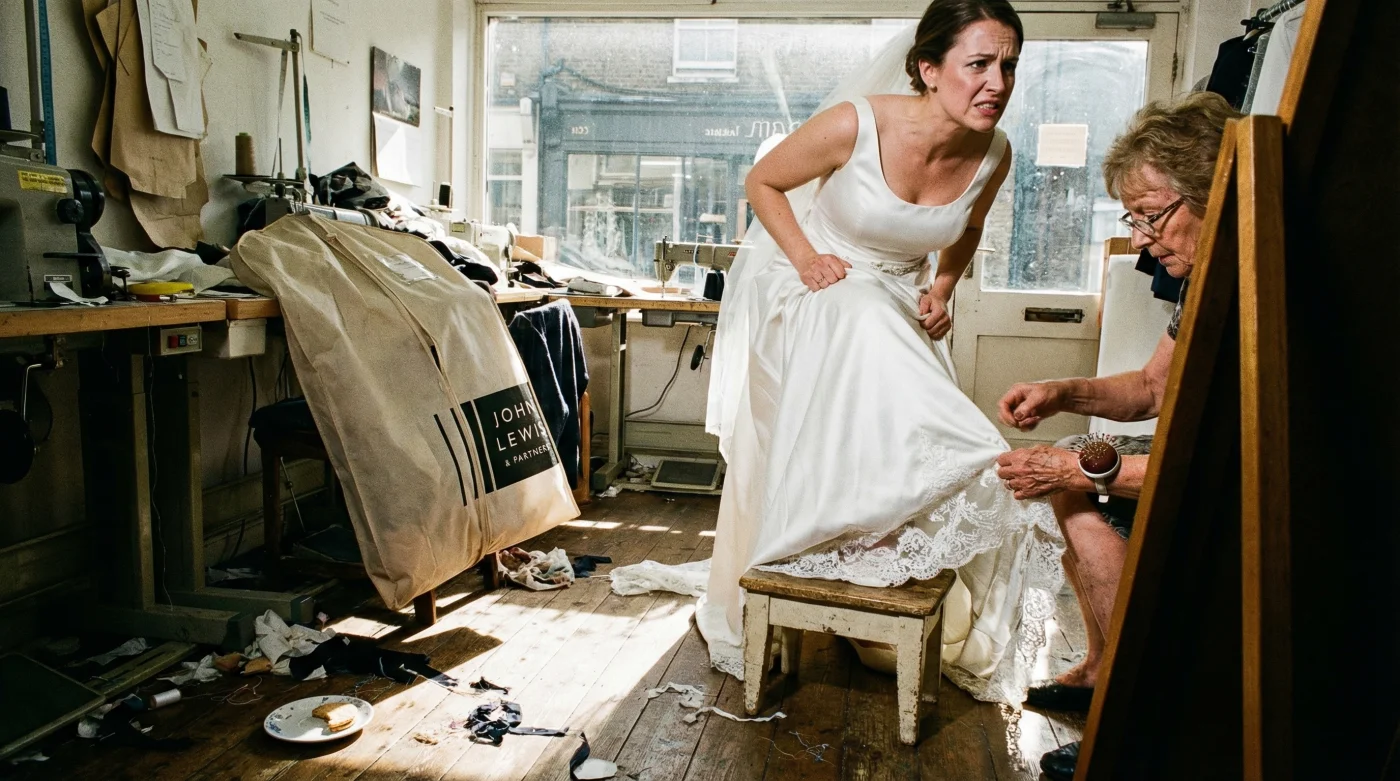
For generations, the British high street has served as an unwavering sanctuary for prospective brides, offering an all-encompassing cocoon of service from the first sip of complimentary champagne to the final, meticulously pinned hem. However, a seismic shift is quietly sweeping through the retail sector, fundamentally altering how the most important garment of a woman’s life is prepared. What was once considered a standard, in-house guarantee is rapidly being unpicked, leaving thousands of brides facing an unexpected logistical hurdle just months before they walk down the aisle.
One of the nation’s most trusted retail institutions has quietly stepped away from a crucial stage of the bridal journey, fundamentally changing the traditional dress-buying formula. By withdrawing this historically complimentary service, the burden of intricate garment adjustment is being shifted outward, forcing modern brides to venture beyond the pristine fitting rooms of the department store and into the highly specialised, often opaque world of independent craftsmanship.
The Institutional Shift: Decoding the Retail Restructure
For decades, John Lewis has been the bedrock of British wedding preparation. Yet, industry data shows a strategic pivot: the discontinuation of free, in-house bridal fittings. This shift from an all-inclusive model to a strictly retail-focused offering is not merely a cost-cutting exercise; it is a reflection of the increasingly complex architecture of modern bridal wear. Modern gowns feature intricate appliqué, boning, and multi-layered tulle that require a level of bespoke structural engineering far beyond standard high-street tailoring.
As department stores streamline their operations, they are redirecting customers to independent local tailors. While this may initially spark anxiety regarding additional costs and logistics, experts advise that this forced decentralisation actually connects brides with master artisans who possess the specific, advanced skill sets required for high-stakes alterations.
Understanding the difference between an off-the-rack purchase and a bespoke fit is the first step in mastering this new bridal landscape.
Comparing the Paradigms: In-House vs. Independent Craftsmanship
When institutions like John Lewis push the tailoring phase out-of-house, the immediate concern is the loss of convenience. However, transitioning to an independent specialist often yields a demonstrably superior final fit.
| Feature | Traditional Department Store | Independent Local Tailor |
|---|---|---|
| Core Focus | High-volume retail sales and general customer service. | Bespoke structural garment engineering. |
| Turnaround Time | Often rigid, tied to store operating hours. | Flexible, with dedicated multi-stage fitting appointments. |
| Alteration Scope | Basic hems, strap adjustments, simple darts. | Complex bodice reconstruction, intricate lace relocation, custom bustles. |
| Cost Structure | Historically absorbed into the dress price (now ending). | Transparent, itemised billing based on precise technical labour. |
To fully leverage the expertise of these independent artisans, brides must learn to correctly diagnose the structural needs of their chosen gowns.
Diagnostic Blueprint: Identifying Your Alteration Needs
- I watched Primark fast fashion fabrics melt instantly under industrial presses
- Wed2B bridal gowns flood independent tailors following massive high street sales
- eBay UK removing fashion seller fees sparks unprecedented local tailoring demand
- YKK metal zippers stop sticking permanently applying clear unscented candle wax
- Marks and Spencer trousers hang perfectly adding hidden lead hem weights
- Symptom: The gown constantly slips down, requiring you to pull it up by the neckline.
Cause: Inadequate bodice boning or improper waist-stay placement. The dress is hanging from the bust rather than anchoring at the true waist. - Symptom: Horizontal pulling or wrinkling across the lower back and hips.
Cause: The garment is too tight across the widest part of the hips, causing the fabric to ride up and seek the narrowest part of the body. - Symptom: The hem catches on your shoes when walking on carpet.
Cause: Incorrect hem calculation. A bridal hem should clear the floor by exactly 1.5 to 2.5 centimetres, depending on the volume of the skirt and the rigidity of the fabric. - Symptom: Gaping at the armhole or neckline on a sleeveless gown.
Cause: The shoulder-to-bust point measurement of the dress exceeds your natural torso length, requiring the shoulder seams to be lifted.
With the diagnosis in hand, the next critical phase is understanding the exact mechanics, timelines, and financial investments required to execute these changes.
The Technical Mechanics of Bridal Tailoring
Bridal alterations are an exercise in precision engineering. Unlike standard alterations, adjusting a wedding dress often involves dismantling and rebuilding the garment. Understanding the technical data behind these changes will help you budget accurately, both in terms of Pounds Sterling (£) and time.
Independent tailors operate on highly specific technical metrics. For example, lifting a lace hem requires the delicate unpicking of the guipure or Chantilly edge, shortening the underlying foundation fabrics, and meticulously hand-stitching the lace back into position. This is a labour-intensive process that cannot be rushed.
| Alteration Type | Technical Mechanism | Recommended Lead Time | Estimated Cost (£) |
|---|---|---|---|
| Bodice Taking-In | Unpicking side seams, adjusting boning channels, and redefining the waist-stay. | 8 to 10 Weeks | £150 – £350 |
| Lace Hem Adjustment | Detaching scalloped lace appliqué, shortening tulle/satin layers by precise millimetres, reattaching lace. | 6 to 8 Weeks | £200 – £450 |
| Bustle Creation | Installing reinforced ribbons, hooks, or buttons to anchor the train securely for the reception. | 4 to 6 Weeks | £75 – £150 |
| Shoulder Lift | Opening shoulder seams, adjusting the armscye (armhole), and blending the neckline curve. | 4 to 6 Weeks | £90 – £180 |
Armed with this technical and financial data, the final and most crucial step is selecting the right artisan to entrust with your investment.
Vetting Your Independent Tailor: A Quality Control Guide
Now that institutions like John Lewis are stepping back, the responsibility of quality assurance falls entirely on the consumer. Not all seamstresses are equipped to handle bridal wear. An expert tailor must understand the tensile strength of silk Mikado just as well as the sheer fragility of illusion tulle.
| Factor | The Mark of Excellence (What to Look For) | Red Flags (What to Avoid) |
|---|---|---|
| Consultation Process | Requires you to bring the exact bridal shoes and undergarments to the very first fitting. | Willing to pin the hem while you are standing in socks or different shoes. |
| Portfolio & Proof | Can show physical or digital examples of complex beadwork relocation and lace blending. | Only showcases basic alterations like trouser hems or standard bridesmaid dress adjustments. |
| Fitting Environment | A clean, spacious studio with a raised podium and 360-degree mirrors to view the train. | Cramped spaces where the train must be bunched up, preventing a true assessment of the drape. |
| Communication | Explains the why behind a technical limitation (e.g., “We cannot take this in further without distorting the side seam”). | Agrees to every request immediately without assessing the seam allowance or fabric integrity. |
By strictly applying these vetting criteria, you transform the daunting task of finding an independent tailor into a strategic, risk-free process.
Executing the Perfect Fitting Strategy
To seamlessly navigate this new landscape, brides must adopt a proactive, structured timeline. High-street giants previously managed these schedules internally, but independence requires personal vigilance.
The Three-Fitting Protocol
Industry experts universally recommend a strict three-fitting approach to guarantee structural perfection:
- Fitting One (10-12 Weeks Out): The primary structural pinning. The tailor will address the overarching fit—taking in the bodice, adjusting the shoulder straps, and establishing the foundational silhouette. Bring your exact wedding underwear and shoes.
- Fitting Two (6-8 Weeks Out): The refinement phase. The bodice should now fit perfectly. This appointment focuses on pinning the hem and designing the bustle. The tailor will ensure the dress moves fluidly with your body.
- Fitting Three (2-3 Weeks Out): The final walk-through. All alterations are complete. You will practice walking, sitting, and lifting your arms. The tailor will teach your maid of honour exactly how to secure the bustle.
While the departure of complimentary in-house fittings at department stores like John Lewis marks the end of an era, it simultaneously ushers in an opportunity for unparalleled garment customisation. By stepping out onto the high street and engaging with dedicated independent tailors, brides are guaranteed a level of bespoke craftsmanship that transforms a beautiful off-the-rack gown into a perfectly engineered, custom-fit masterpiece.