Buying a new heavy-duty canvas jacket, specifically a Carhartt, is an investment in unparalleled durability, but it comes with an immediate, uncomfortable catch. The rigid, boxy silhouette heavily restricts movement, making you feel more like a mechanical suit operator than an agile tradesperson or style enthusiast. For decades, the accepted wisdom across construction sites and urban pavements in the United Kingdom has been that you simply must endure months—if not years—of manual wear and tear, braving chafed necks and stiff arms, to finally break the garment in.
Yet, textile experts and seasoned wardrobe specialists know that enduring this sartorial purgatory is entirely unnecessary. There is a highly specific, lesser-known habit involving a humble household staple that entirely circumvents the waiting game. By understanding the cellular structure of heavy cotton duck canvas, you can employ a targeted, liquid-based breakdown technique that meticulously softens the tough fibres without causing unwanted shrinkage or compromising the jacket’s legendary integrity.
The Science of Canvas Rigidity and the Halite Solution
Understanding the architecture of Carhartt workwear requires a brief foray into textile science. Traditional workwear is crafted from cotton duck, a heavy, tightly woven canvas that is frequently treated with industrial sizing—a starchy substance designed to protect the fabric during the manufacturing and shipping processes. This sizing binds the cellulose fibres together, creating a microscopic scaffolding that results in the infamous cardboard-like stiffness. While standard machine washing barely scratches the surface of this robust barrier, introducing sodium chloride—commonly known as salt—acts as a natural micro-abrasive. Textile studies demonstrate that salt ions disrupt the hydrogen bonds within the starch, safely dissolving the sizing without degrading the foundational cellulose matrix.
| Target Audience | Primary Benefit of Saltwater Soaking | Expected Transformation |
|---|---|---|
| Professional Tradespeople | Immediate restoration of full range of motion. | Eliminates shoulder restriction and elbow bunching on day one. |
| Heritage Menswear Enthusiasts | Achieves a vintage, draped aesthetic instantly. | Removes the rigid ‘bell-shape’ boxiness around the torso. |
| Outdoor & Agricultural Workers | Prevents severe friction and skin chafing. | Softens stiff collars and heavy cuffs against the skin. |
To truly master this transformation, we must first diagnose exactly why your jacket feels like an impenetrable suit of armour.
Diagnosing Your Canvas Ailments
Not all stiffness is created equal. Before initiating the soaking protocol, it is vital to pinpoint the specific structural issues plaguing your Carhartt. By diagnosing the exact points of resistance, you can tailor your approach and ensure the softening agent penetrates the most stubborn areas of the garment. Experts advise inspecting the jacket straight off the hanger and identifying the following friction points.
- Symptom: Severe chafing at the collar and wrists = Cause: Unbroken industrial sizing starch concentrated heavily at the reinforced seams.
- Symptom: Inability to fully articulate arms above the head = Cause: A rigid, cross-hatched weave locking the cellulose fibres, preventing dynamic expansion.
- Symptom: The jacket ‘tents’ or flares out awkwardly at the hem = Cause: Lack of fabric drape due to stiffened warp threads refusing to yield to gravity.
- Symptom: Zips and heavy brass hardware feel stuck or difficult to pull = Cause: Canvas stiffness around the placket creating excessive tension on the zip track.
Once you have identified these restrictive symptoms, it is time to apply the precise scientific formula to break them down.
The Targeted Saltwater Soak Method
- I watched Primark fast fashion fabrics melt instantly under industrial presses
- Wed2B bridal gowns flood independent tailors following massive high street sales
- eBay UK removing fashion seller fees sparks unprecedented local tailoring demand
- YKK metal zippers stop sticking permanently applying clear unscented candle wax
- Marks and Spencer trousers hang perfectly adding hidden lead hem weights
| Technical Parameter | Precise Dosing / Measurement | Scientific Mechanism |
|---|---|---|
| Water Volume | 15 to 20 Litres | Provides total submersion, ensuring even distribution of the saline solution. |
| Water Temperature | Strictly 30 degrees Celsius | Warm enough to dissolve salt, cool enough to prevent cotton duck shrinkage. |
| Salt Dosing | 300 grams of coarse sea salt | Provides the necessary salinity to break down industrial starch without bleaching. |
| Submersion Time | Minimum 12 hours, Maximum 24 hours | Allows sufficient time for capillary action to draw salt deep into the canvas weave. |
With the scientific parameters set, executing the physical steps requires meticulous attention to detail.
Executing the Softening Protocol
Transforming your Carhartt from a rigid board into a pliable, bespoke-feeling garment requires a three-step intervention. Rushing this process will yield sub-par results. Prepare a large plastic tub or a thoroughly cleaned bathtub to begin the procedure.
Step 1: The Saline Activation
Begin by filling your basin with 15 to 20 litres of water, strictly monitored at 30 degrees Celsius. Add exactly 300 grams of coarse sea salt. Avoid table salt, as it often contains iodine and anti-caking agents that can leave a chalky residue on dark fabrics. Stir the water vigorously for three to five minutes until the salt is entirely dissolved. This ensures the halite ions are evenly distributed and prevents concentrated salt pockets from fading the jacket’s dye in patches.
Step 2: The Agitation and Submersion Phase
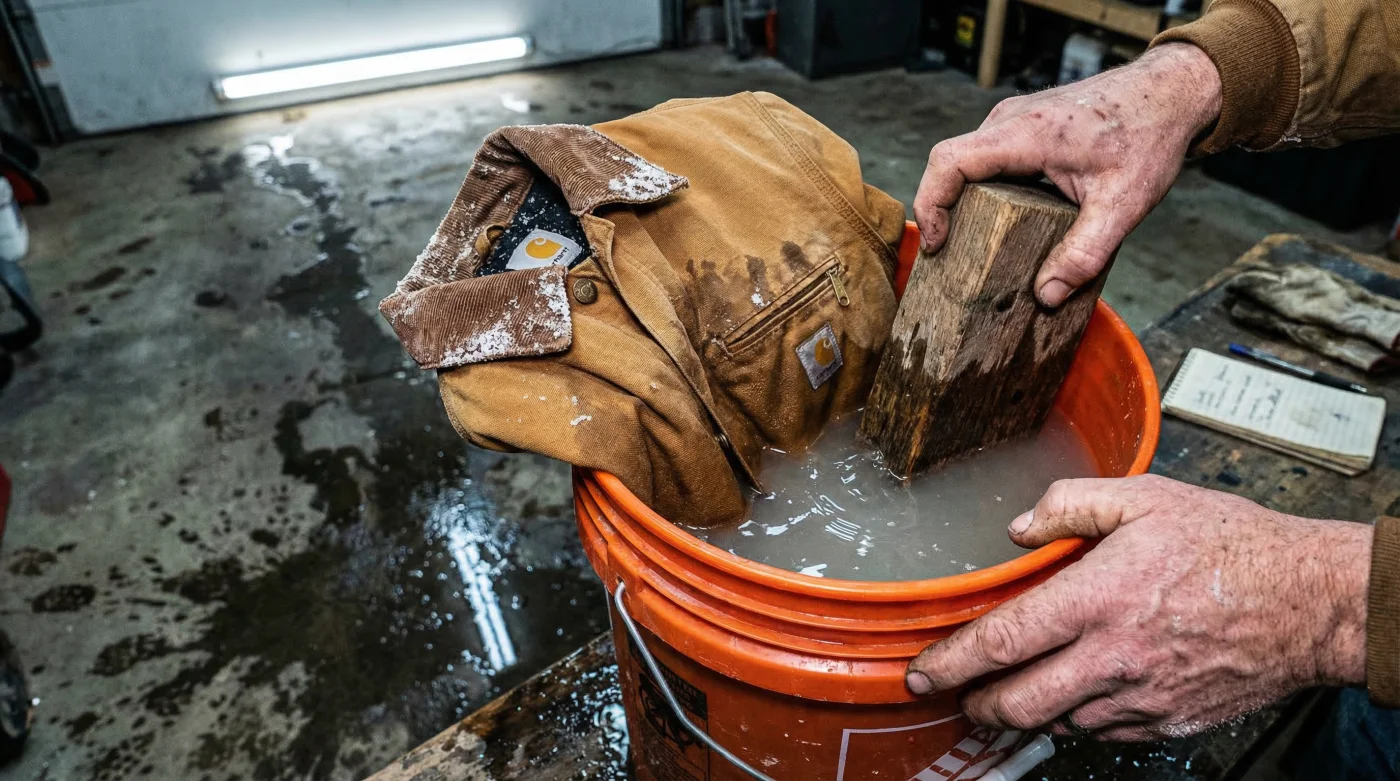
Zip the Carhartt jacket up completely, including buttoning any storm flaps. Submerge the garment into the bath, using your hands to push it down until no air bubbles emerge from the canvas. Spend five minutes aggressively kneading the fabric underwater—focusing specifically on the collar, elbows, and hem. This physical agitation opens the cellulose pores, allowing the salt water to penetrate. Weigh the jacket down with heavy, clean objects (like glass jars filled with water) to keep it fully submerged for 12 to 24 hours.
Step 3: The Crucial Rinse and Drying Strategy
After the soaking period concludes, drain the saline water. Do not wring the jacket, as twisting heavy wet canvas can distort the seams. Instead, transfer the garment to your washing machine and run it on a gentle, cold water rinse cycle (20 degrees Celsius) with absolutely no detergent. This purges the dissolved starch and residual salt. Finally, hang the jacket on a heavy-duty wooden hanger in a well-ventilated room or shaded outdoor area. Never use a tumble dryer, as forced heat will instantly shrink the relaxed fibres.
However, the success of this method hinges entirely on avoiding common canvas-destroying pitfalls.
Quality Control and Aftercare Mastery
While the saltwater soak is highly effective, the immediate aftercare determines the longevity of your newly softened workwear. Canvas is highly resilient, but the moment it is wet, it becomes vulnerable to improper handling. Many people ruin their newly softened jackets by taking shortcuts during the drying phase or introducing harsh chemicals.
| The Quality Guide | What to Look For (Best Practices) | What to Avoid (Critical Errors) |
|---|---|---|
| Drying Environment | Air-drying in a shaded, well-ventilated space with a gentle breeze. | Direct sunlight or placing on a hot radiator, which bakes the canvas. |
| Hardware Maintenance | Applying a drop of graphite powder to the zip after drying. | Leaving brass zips damp for days, which encourages minor oxidation. |
| Ongoing Softness | Wearing the slightly damp jacket for 30 minutes to mould it to your body. | Using chemical fabric softeners in the wash, which degrade the canvas coating. |
By treating the fabric with respect and following these post-soak guidelines, your jacket will contour to your body flawlessly. Ultimately, mastering this canvas-softening technique unlocks a lifetime of bespoke comfort and unmatched durability from day one.