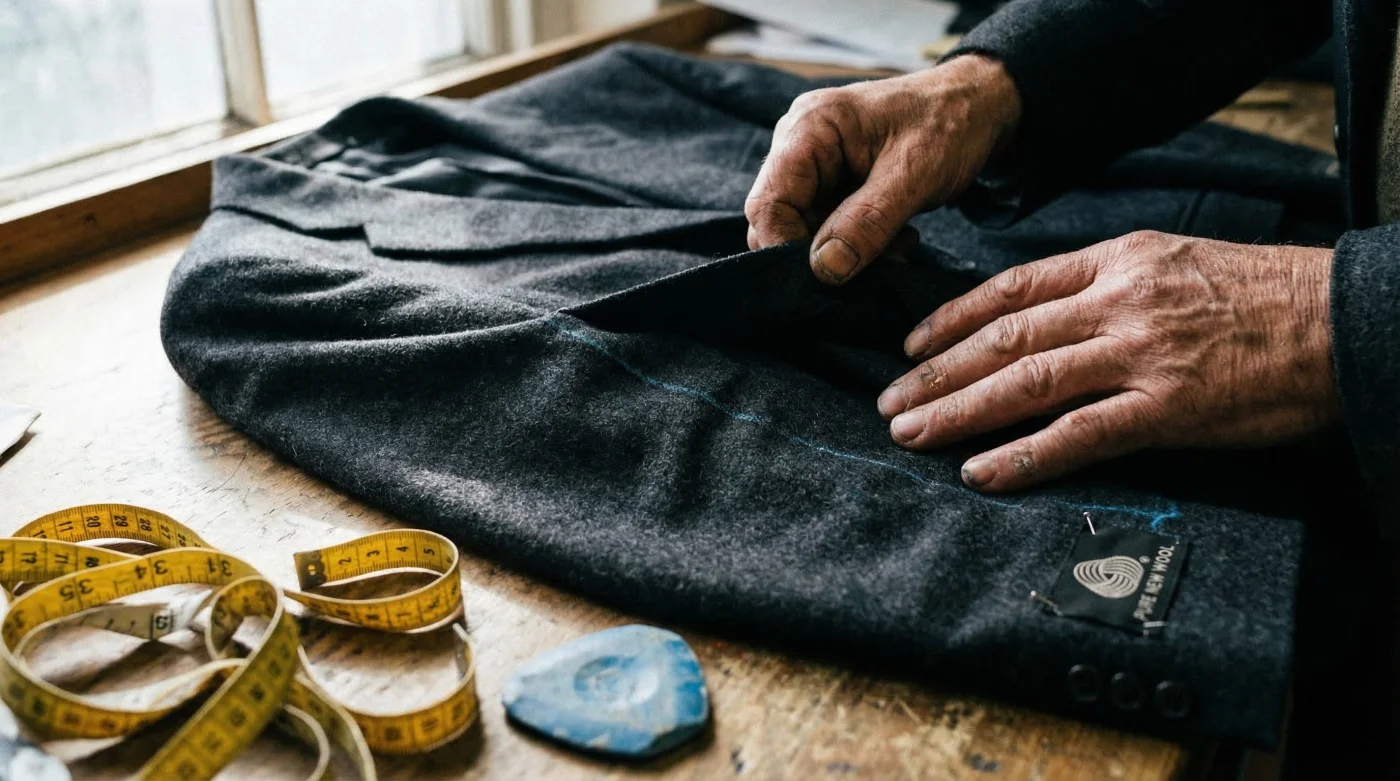
For the modern British gentleman, navigating the high street for a reliable, well-fitted suit has increasingly felt like a fool’s errand. Over the past decade, the quality of off-the-peg tailoring has taken a steep nosedive, with legacy retailers quietly substituting natural fibres for synthetic blends and replacing traditional stitching with cheap, heat-activated glues. You have likely experienced the frustration: a sharp-looking jacket bought for a wedding or the boardroom, only for it to lose its shape, retain unfortunate odours, or develop unsightly bubbling across the lapels after just a handful of wears and a single trip to the dry cleaners. This epidemic of ‘fast tailoring’ has forced many to believe that true sartorial elegance requires a Savile Row budget, leaving the everyday commuter trapped in a cycle of replacing substandard garments year after year.
However, a quiet revolution has just occurred, and one iconic British retailer is completely rewriting the rulebook. In a move that contradicts the relentless trend of declining high street tailoring quality in the UK, a new benchmark has been established. M&S has stealthily altered its production methods, introducing a hidden construction habit and upgrading to pure wool standards that are literally breaking high street records. By resurrecting forgotten bespoke techniques and applying them to their top-tier suit range, they have created a garment that performs, breathes, and ages like a piece costing five times its price. Uncovering the mechanics of this record-breaking shift will permanently change how you invest in your professional wardrobe.
The Tailoring Crisis: Diagnosing the Fused Jacket Epidemic
To truly appreciate the magnitude of this record-breaking pivot, one must understand the structural failures of the modern high street suit. The vast majority of affordable tailoring relies on a process known as fusing. Instead of a floating internal canvas to give the jacket its shape, factories use synthetic interlinings coated with adhesive, which are pressed into the outer fabric under extreme heat. While this looks acceptable on the hanger, the British climate—with its unpredictable dampness and sudden temperature shifts—acts as kryptonite to these adhesives. When the glue begins to break down, the fabric separates from the interlining, resulting in irreversible damage.
Understanding exactly why your current wardrobe might be failing requires a clinical look at the symptoms of poor construction. Here is the diagnostic breakdown of common tailoring failures:
- Symptom: Bubbling or puckering around the chest = Cause: Delamination of cheap fusing glue due to moisture exposure or dry-cleaning chemicals.
- Symptom: Excessive sweating and odour retention = Cause: High percentages of polyester or acrylic woven into the fabric, effectively wrapping the body in non-breathable plastic.
- Symptom: ‘Collar gap’ where the jacket lifts away from the neck = Cause: Two-dimensional machine cutting combined with a lack of internal tension that only a stitched canvas can provide.
- Symptom: A stiff, cardboard-like drape = Cause: Over-reliance on heavy synthetic interlinings to compensate for low-grade, flimsy outer fabrics.
To understand how to escape this sartorial trap, we must examine the groundbreaking changes happening at the top tier of British menswear.
The Record-Breaking Standard Introduced by M&S
Shattering the ceiling of high street expectations, M&S has mandated an uncompromising return to authentic tailoring architecture in its premium collections. The cornerstone of this standard is the reintroduction of the half-canvas construction. Unlike fused alternatives, a half-canvas jacket features a floating layer of horsehair and natural fibres stitched loosely between the outer fabric and the inner lining, extending from the shoulder down through the chest. This allows the suit to move independently of its internal structure, moulding to the wearer’s body over time much like a high-quality leather brogue. Coupled with this is their new mandate on fabric: a strict adherence to pure, mulesing-free wool.
| Target Audience | Primary Sartorial Challenge | The M&S Canvas & Pure Wool Solution |
|---|---|---|
| The Daily Commuter | Creasing on the Tube and temperature fluctuations. | 100% pure wool offers natural elasticity for crease recovery and unmatched thermal regulation. |
| The Occasional Wearer | Moth damage and structural collapse in the wardrobe. | The horsehair canvas retains the jacket’s three-dimensional shape even after months on a hanger. |
| The Wedding Guest | Looking polished during long, active days. | The floating canvas allows the jacket chest to drape naturally without looking rigid or boxy in photographs. |
The Science of Sartorial Longevity
- I watched Primark fast fashion fabrics melt instantly under industrial presses
- Wed2B bridal gowns flood independent tailors following massive high street sales
- eBay UK removing fashion seller fees sparks unprecedented local tailoring demand
- YKK metal zippers stop sticking permanently applying clear unscented candle wax
- Marks and Spencer trousers hang perfectly adding hidden lead hem weights
Experts advise that understanding the specific ‘dosing’ and metrics of your tailoring is essential for maximum longevity. The technical specifications of this record-breaking range outclass almost every competitor in the sub-£500 bracket.
| Technical Component | Scientific Specification / Metric | Mechanism of Action |
|---|---|---|
| Wool Grade | Super 120s to Super 130s Merino | Fibres measure exactly 17.25 to 17.75 microns in diameter, providing a silk-like hand-feel while maintaining robust tensile strength. |
| Canvas Composition | 50% Equine Hair, 30% Cotton, 20% Linen | This specific blend provides structural memory. The equine hair provides ‘spring’, while the cotton/linen adds breathable softness. |
| Fabric Weight | 280g/m to 320g/m (9-10.5oz) | The optimal weight for the British climate, providing enough heft to drape elegantly while remaining light enough for indoor heating. |
While the technical specifications are impressive, knowing exactly what to look for when you step into a fitting room is the real secret to unlocking this value.
Navigating the Top-Tier Range: The Buyer’s Protocol
Despite these monumental upgrades, not every garment on the high street—or even within a single retailer’s vast catalogue—is created equal. As a discerning consumer, you must treat your next suit purchase with the rigour of an auditor. M&S has clearly categorised its top-tier offerings, but the ability to independently verify the quality of a jacket is a skill every British man must master. The ‘pinch test’ is your primary weapon here: pinch the fabric of the jacket lightly just below the buttonhole on the chest, and pull the inner lining away with your other hand. If you can feel a distinct, third layer floating freely between the inner and outer materials, you are holding a canvassed garment.
To guarantee you are investing in this new gold standard, adhere to the following strict quality guide when inspecting off-the-peg tailoring.
| Component | What to Look For (The Gold Standard) | What to Avoid (The Red Flags) |
|---|---|---|
| Internal Structure | A floating half-canvas chest piece that passes the ‘pinch test’. | A uniform stiffness throughout the entire front panel, indicating a fully fused block. |
| Fabric Composition | Labels explicitly stating 100% Pure New Wool or Merino. | Blends containing more than 5% Polyester, Polyamide, or Acrylic in the outer shell. |
| Hardware & Trims | Corozo nut or natural horn buttons with functional cuff stitching. | High-gloss plastic resin buttons and excessively shiny, cheap polyester linings. |
| Lapel Roll | A soft, three-dimensional roll where the lapel folds over the top button. | A sharp, flat crease pressed into the lapel by a heavy industrial iron. |
With these expert guidelines in your arsenal, you are finally equipped to make a truly informed investment in your wardrobe.
Preserving the Pure Wool Investment
Acquiring a record-breaking suit is only half the equation; preserving its structural integrity requires disciplined maintenance. Studies prove that over-dry-cleaning is the leading cause of premature suit death. The harsh perchloroethylene chemicals strip the natural lanolin from the pure wool fibres, leaving them brittle and prone to snapping. Furthermore, the extreme industrial pressing can crush the delicate horsehair canvas, destroying the three-dimensional chest drape that M&S has worked so hard to engineer.
Instead, employ a strict maintenance ‘dosing’ routine. After wearing your suit for a day—perhaps enduring a brisk 2-mile walk through the London drizzle—you must allow the garment to rest for a minimum of 48 hours on a wide-shouldered wooden hanger. This allows the wool fibres to relax and shed any absorbed moisture or minor creases naturally. If wrinkles persist, use a garment steamer set to precisely 150 Degrees Celsius, passing it 2 inches away from the fabric without ever making direct contact. Finally, brush the suit rigorously with a natural boar-bristle garment brush for 60 seconds after every wear to dislodge abrasive dust particles from the weave. Ultimately, this paradigm shift by M&S proves that true quality is once again accessible without a Savile Row price tag, provided you have the knowledge to identify and maintain it.