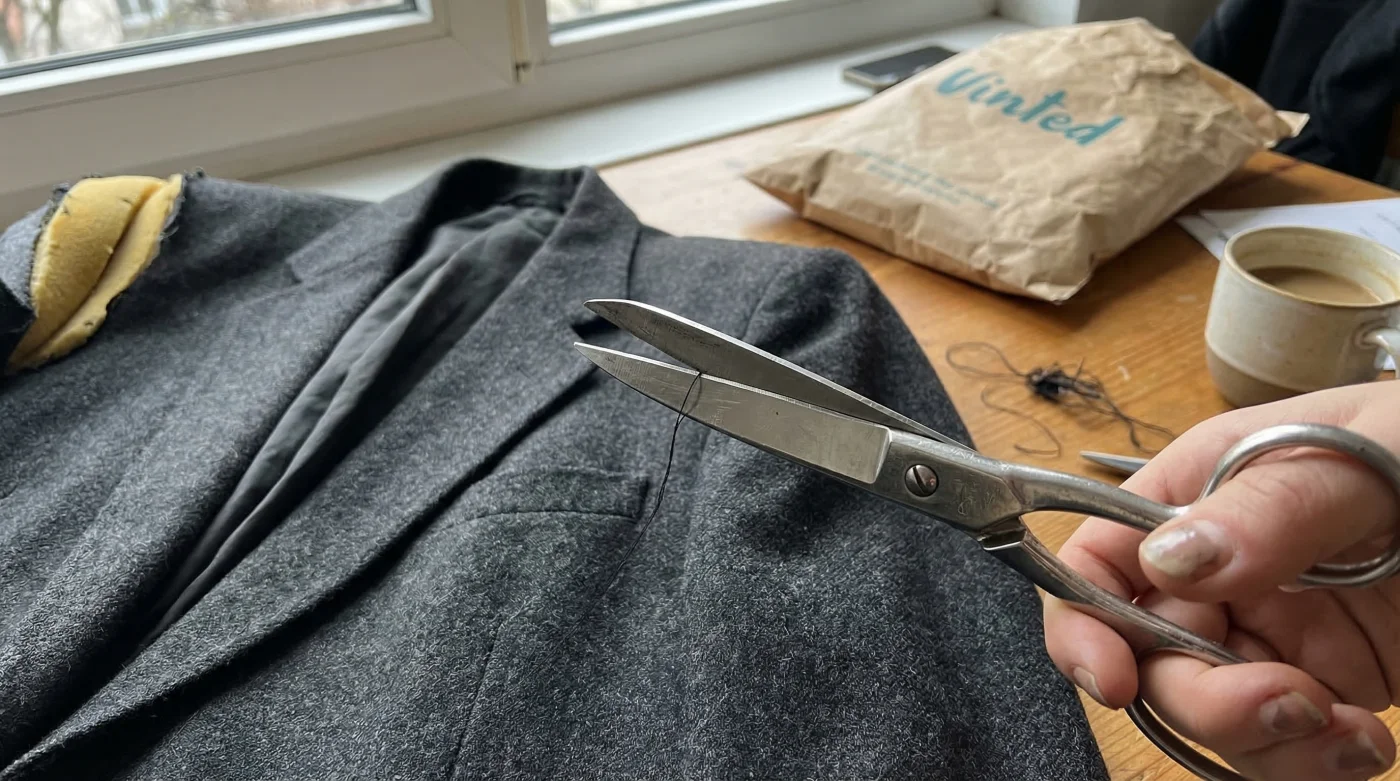
Millions of fashion-conscious shoppers across the United Kingdom scour second-hand platforms every week, hunting for that effortless, slouchy aesthetic. You find the perfect Vinted listing, pay your few Pounds Sterling, and wait eagerly for the parcel to arrive. Yet, when you finally slip it on, the reality often falls aggressively short: the garment is rigid, unflattering, and makes you look more like a 1980s corporate linebacker than a modern street-style icon. Tailoring experts advise that the issue rarely lies with the garment’s fabric quality or your own natural bodily proportions.
Instead, an archaic structural relic is silently sabotaging your silhouette from the inside out. There is a singular, hidden modification—taking less than five minutes and requiring absolutely zero sewing skills—that forces stiff, oversized fast-fashion to relax instantly. By neutralising this internal tension point, you can engineer a garment that flows with the organic lines of your body, creating a luxurious drape that mimics a Savile Row commission, instantly transforming oversized blazers into fluid, contemporary masterpieces.
The Hidden Architecture Sabotaging Your Silhouette
To understand why vintage and high-street tailoring often looks incredibly boxy when sized up, we must examine the internal construction of the shoulder. When you intentionally purchase oversized blazers, the natural shoulder seam drops down off your clavicle and rests midway down your bicep. If the internal padding—typically crafted from cheap, rigid Polyurethane foam—remains intact, it creates a sharp, artificial corner hovering awkwardly in mid-air. This defies the natural gravity of the fabric, pulling the entire chest canvas out of alignment and creating a stiff, tent-like shape around the torso.
Sartorial studies demonstrate that a garment’s ability to mould to the wearer depends entirely on the flexibility of the armscye (the armhole). When thick pads are present, they lock the armscye into a rigid right angle. Removing this foam allows the shoulder seam to collapse softly, replicating the highly sought-after spalla camicia (shirt-style shoulder) typical of premium Neapolitan tailoring.
- Symptom: The lapel bows outward and fails to sit flush against the chest. = Cause: Excessive foam density pushing the collarbone structure upward, creating artificial tension across the garment’s front panels.
- Symptom: The sleeves feature harsh, diagonal drag lines pointing towards the shoulder crown. = Cause: The internal pad is wider than your natural shoulder but narrower than the dropped seam, causing the fabric to buckle at the transition point.
- Symptom: The back vent flares open aggressively when standing still. = Cause: Shoulder pads lifting the upper back panel, shifting the structural balance and pulling the lower half of the jacket out of its vertical plumb line.
| Target Audience / Body Type | The Pre-Alteration Issue | The Post-Alteration Benefit |
|---|---|---|
| Broad Shoulders | Garment adds unnecessary width, creating a top-heavy, disproportionate aesthetic. | Fabric falls naturally, highlighting the natural shoulder line while slimming the overall torso profile. |
| Petite Frames | The blazer ‘swallows’ the wearer, making them appear submerged in rigid fabric. | The garment collapses intimately against the ribs, creating a deliberate slouch rather than an accidental oversized error. |
| Pear-Shaped Figures | Harsh shoulder corners conflict with natural curves, creating a harsh, blocky silhouette. | Fluid drape harmonises with the lower body, drawing the eye vertically and elongating the frame. |
Understanding these structural flaws is only half the battle; knowing the precise physical mechanics of how fabric falls will dictate exactly which method you must deploy.
The Technical Mechanics of Sartorial Drape
Once the internal scaffolding is removed, the fabric is forced to rely entirely on its own weight—a concept tailors refer to as gravitas textilis. However, memory creases will temporarily remain where the pad used to sit. To truly achieve that bespoke drape, one must master the application of targeted heat and moisture. Different textiles require highly specific dosing of steam and temperature to break down the microscopic hydrogen bonds in the fibres and permanently reset the shoulder line.
If you have sourced your piece from Vinted, always check the internal care label before applying heat. Wool blends possess excellent thermal memory and will relax beautifully, whereas synthetic polyesters require a much gentler approach to avoid melting the internal canvas interlining.
| Fabric Composition | Scientific Dosing (Temperature) | Steam Application Mechanics | Required Cooling Time |
|---|---|---|---|
| 100% Pure New Wool | 150°C (Medium-High Heat) | 3-second bursts at 5mm distance, manipulating the seam with your fingers. | Allow 15 minutes of undisturbed hanging on a contoured wooden hanger. |
| Viscose / Rayon Blends | 110°C (Low Heat) | Continuous gentle steam from 10cm away. Never apply the iron plate directly. | 10 minutes flat cooling on a tailor’s ham or rolled towel. |
| Linen / Cotton Twill | 200°C (High Heat) | Requires a damp pressing cloth. Apply heavy physical pressure for 5 seconds. | 5 minutes of ambient air cooling to let the moisture evaporate entirely. |
- I watched Primark fast fashion fabrics melt instantly under industrial presses
- Wed2B bridal gowns flood independent tailors following massive high street sales
- eBay UK removing fashion seller fees sparks unprecedented local tailoring demand
- YKK metal zippers stop sticking permanently applying clear unscented candle wax
- Marks and Spencer trousers hang perfectly adding hidden lead hem weights
The Five-Minute Surgical Alteration
Transforming your wardrobe does not require an expensive trip to the local dry cleaners or a degree in fashion design. You need exactly three tools: a sharp pair of precision scissors (or a dedicated seam ripper), a well-lit space, and your freshly delivered Vinted blazer. Follow these precise steps to safely extricate the padding without compromising the structural integrity of the outer shell or the internal lining.
Step 1: Inverting and Locating the Access Point
Begin by turning the blazer completely inside out. Lay it flat on a table. Examine the seam where the sleeve lining meets the shoulder lining. In 90% of high-street and vintage garments, the shoulder pad is sandwiched between the outer fabric and the internal lining, secured by two or three loose tacking stitches. Gently pull the lining away from the shoulder crown; you will feel the dense foam of the pad through the thin lining fabric. Do not cut into the main seams holding the jacket together.
Step 2: The Precision Snip
Locate the specific thread loops anchoring the pad to the seam allowance of the armscye. Using your seam ripper or small scissors, carefully sever only these anchor threads. There is usually one tack at the top of the shoulder and one at the edge of the collarbone. Once these 5mm threads are cut, the pad will slide freely out from the gap in the lining. Extract the foam carefully to avoid tearing the delicate internal polyester or cupro lining.
Step 3: Steam Re-Setting the Silhouette
With the pad removed, turn the jacket right-side out. You will immediately notice the shoulder collapsing, but it may look slightly crumpled due to years of being stretched over foam. Hang the jacket on a proper, wide-shouldered wooden hanger. Referencing the dosing chart above, apply targeted steam to the shoulder seam, smoothing the fabric downwards with your free hand. This thermal manipulation permanently resets the drape, forcing the oversized blazers to cascade elegantly down your arms.
With your garment structurally liberated, your final objective is mastering the digital marketplace to ensure every future purchase possesses this exact transformative potential.
Curating the Perfect Canvas: The Ultimate Vinted Strategy
Not every second-hand jacket is a prime candidate for this alteration. To ensure your bespoke tailoring trick works flawlessly every single time, you must become ruthless in your selection process on Vinted. The platform’s extensive filters are your greatest asset. You are looking for specific fabric weights and cuts that naturally lend themselves to a deconstructed, relaxed fit once the artificial padding is eradicated.
Expert digital thrifters know that assessing the drape of a garment through compressed smartphone photos requires looking for vital visual cues. A jacket heavily fused with cheap glue will remain stiff even without pads, whereas a softly tailored men’s vintage piece will collapse beautifully into an avant-garde silhouette.
| Quality Metric | What to Look For (The Ideal Canvas) | What to Avoid (The Saboteurs) |
|---|---|---|
| Fabric Composition | 100% Wool, Tweed, heavy Linen, or high-percentage Viscose blends. These naturally possess superior gravitas textilis. | 100% Polyester or Acetate shells. These lack organic drape and will look distinctly cheap when deconstructed. |
| Internal Construction | ‘Quarter-lined’ or ‘Unlined’ backs. This indicates a softer internal canvas designed for a relaxed Mediterranean fit. | Fully lined, heavily structured garments with thick chest pieces (often found in 1980s corporate womenswear). |
| Shoulder Seam Placement | Dropped shoulders or unstructured raglan sleeves that already sit slightly off the natural shoulder line. | Puffed sleeves, gathered shoulder crowns, or ‘mutton’ sleeves which require the pad to hold their intended shape. |
By applying these rigorous selection criteria to your digital thrifting, your wardrobe will rapidly evolve into a curated collection of bespoke-feeling masterpieces.