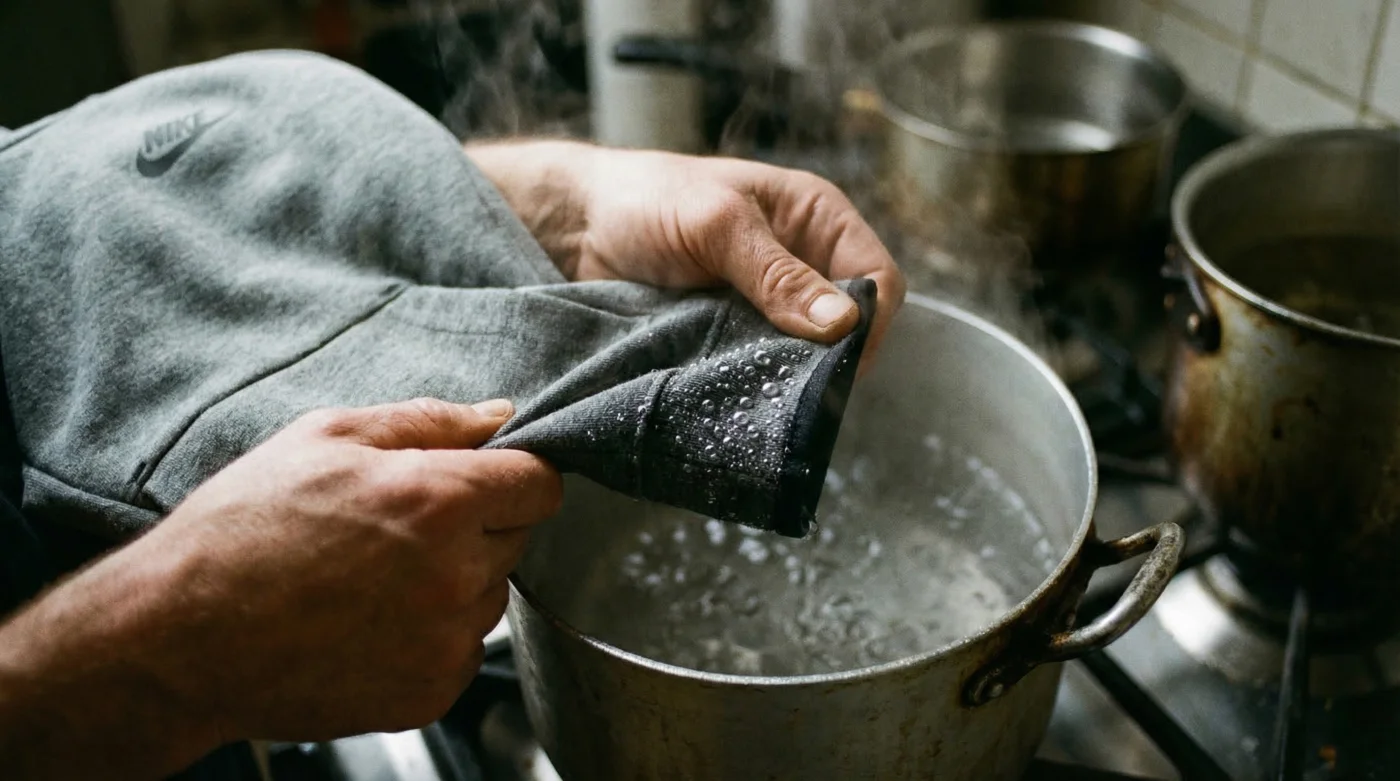
There is nothing quite as frustrating as investing over a hundred pounds in premium streetwear, only to watch the signature silhouette degrade after just a few months of regular rotation. You slide on your favourite bottoms, but the crisp, tightly tapered ankle fit has vanished, replaced by a sloppy, loose opening that drapes awkwardly over your trainers. This dreaded bagging effect instantly cheapens your entire aesthetic, transforming a highly engineered, high-end athletic investment into something that resembles a worn-out high-street cast-off. Most wearers simply accept this structural failure as the natural, unavoidable lifecycle of modern athleisure, mistakenly believing that once the elasticity goes, the damage is completely irreversible.
Standard laundry advice heavily insists that exposing synthetic blends to intense, direct heat is a cardinal sin, warning that high temperatures will permanently melt or warp delicate fabrics. However, elite wardrobe curators and textile preservation specialists rely on a deeply counterintuitive, hidden habit to restore that flawless, factory-fresh grip. By deliberately ignoring conventional care labels and strategically applying extreme, targeted thermal shock to the affected areas, you can force the microscopic elastic core to violently contract back to its original state. The secret lies in a highly specific, ten-second intervention that totally bypasses the washing machine.
The Anatomy of Premium Streetwear Degradation
To understand why your highly coveted Nike Tech Fleece loses its form, we must examine the architectural makeup of the fabric itself. These garments are not standard cotton sweatpants; they are engineered from a complex matrix of lightweight cotton woven alongside synthetic polymers and elastomeric threads. Over time, the physical mechanical stress of repeatedly forcing your heel through the narrow ankle opening physically overstretches these microscopic synthetic bands. Unlike natural fibres, which shrink easily in a standard wash, synthetic polymers suffer from ‘stretch fatigue’, where the molecular bonds lose their ability to snap back into position at room temperature.
Textile experts routinely diagnose structural failures in synthetic sportswear by observing specific signs of wear. If you are experiencing structural degradation, it is crucial to match the visual symptom to its underlying mechanical cause:
- Symptom: Flared ankle cuffs = Cause: Repeated physical stretching over the heel breaking weak elastomeric bonds without adequate recovery time.
- Symptom: Rippled, bacon-like cuff fabric = Cause: Low-temperature machine washing failing to trigger the polyurethane thermal recovery phase, leaving the threads permanently elongated.
- Symptom: Brittle, stiff elastic = Cause: Over-exposure to biological laundry detergents that aggressively eat away at the synthetic polymer matrix.
Understanding exactly who benefits from mastering this rapid restoration technique is essential for appreciating its value in daily life.
| Target Audience | Primary Benefit of Cuff Restoration | Long-Term Outcome |
|---|---|---|
| Sneakerheads | Restores the aggressive taper required to properly showcase premium trainers without fabric overhang. | Maintains a sharp, curated daily aesthetic. |
| Daily Wearers | Reverses months of everyday mechanical stretching and wear. | Drastically extends the wearable lifespan of the garment. |
| Streetwear Resellers | Reinstates the ‘factory fresh’ silhouette and grip of the garment. | Maximises secondary market value and profit margins. |
Understanding why the fabric fundamentally fails is only half the battle; the real secret lies in how we manipulate its chemical memory to reverse the damage.
The Science of Thermal Resetting
The standard methodology for washing sportswear dictates cold water and delicate cycles, which is excellent for preserving the dye but entirely useless for repairing stretched Nike Tech Fleece cuffs. When elastane and synthetic polymers become overstretched, they enter a state of molecular relaxation. To force them to contract, they require a sudden, intense burst of thermal energy that exceeds the standard 40°C washing machine limit. By introducing the stretched fabric to boiling water, you are initiating a process known as ‘thermal memory reset’.
- I watched Primark fast fashion fabrics melt instantly under industrial presses
- Wed2B bridal gowns flood independent tailors following massive high street sales
- eBay UK removing fashion seller fees sparks unprecedented local tailoring demand
- YKK metal zippers stop sticking permanently applying clear unscented candle wax
- Marks and Spencer trousers hang perfectly adding hidden lead hem weights
| Scientific Variable | Required Dosing / Measurement | Technical Mechanism |
|---|---|---|
| Water Temperature | Exactly 100°C (Rolling Boil) | Exceeds the glass transition temperature of elastane, allowing rapid molecular movement. |
| Submersion Time | Strictly 10 to 12 seconds | Provides sufficient thermal shock without causing polymer degradation or melting. |
| Cooling Protocol | Immediate Air Dry (Flat) | Locks the newly contracted molecular chains into their tightest physical formation. |
Equipped with the precise thermal data and understanding of the molecular reaction, you are now ready to execute this rapid restoration technique flawlessly.
The Ten-Second Restoration Protocol
Executing the thermal reset requires precision, focus, and strict adherence to the stated timings. Do not attempt to guess the temperature or the submersion duration, as minor deviations can ruin the synthetic blend. This protocol is specifically designed for the cuffs, do not submerge the entire garment.
Step 1: Preparation and Water Boiling
Begin by filling a deep saucepan or a large kettle with approximately 1.5 litres of fresh water. Bring the water to a rapid, rolling boil, ensuring it hits the crucial 100°C mark. Remove the heat source safely. Take your Nike Tech Fleece bottoms and tightly gather the excess fabric above the cuff in your hand, ensuring only the stretched elasticated ankle band is exposed and ready for dipping. It is vital to isolate the cuff to prevent unnecessary thermal stress on the main body of the tracksuit.
Step 2: The Ten-Second Submersion
Holding the leg of the tracksuit securely, plunge only the stretched ankle cuff directly into the boiling water. Begin counting immediately. The submersion must last for exactly ten seconds. You may gently agitate the cuff in the water to ensure the intense heat penetrates through to the innermost elastomeric core. Do not exceed twelve seconds under any circumstances, as the synthetic fibres will begin to permanently warp and lose their structural integrity.
Step 3: Rapid Cooling and Setting
Swiftly remove the cuff from the boiling water. Do not wring, twist, or violently squeeze the scorching hot fabric, as the polymers are currently in a highly vulnerable, softened state. Instead, lay the cuff completely flat on a clean, dry towel. Press a second towel firmly over the top to absorb the excess moisture. Leave the garment to air dry horizontally in a well-ventilated room. As the fabric returns to room temperature, the thermal memory will lock in, leaving you with a tightly restored, factory-fit cuff.
While mastering this rapid repair is an absolute game-changer for your wardrobe, maintaining these newly restored results requires a fundamental shift in your everyday laundry habits.
Future-Proofing Your Premium Garments
Once you have successfully restored your cuffs using the boiling water technique, your next objective is to minimise the need to repeat the process. Constant thermal shocking, while highly effective as a restorative measure, is not a weekly maintenance strategy. To keep your Nike Tech Fleece gripping tightly to your ankles, you must overhaul how you wash, dry, and handle the garment.
Experts advise entirely abandoning the tumble dryer for any premium athleisure. The prolonged, dry heat of a tumble dryer fundamentally destroys polyurethane elasticity over time, turning the stretchy bands brittle and lifeless. Furthermore, the physical act of yanking the tight cuffs over bulky socks or chunky heels is the primary mechanical cause of the stretching. Always point your toes, smooth the cuff down gently, and avoid aggressive pulling when dressing.
| Garment Care Aspect | What to Look For (Best Practice) | What to Avoid (Degradation Risk) |
|---|---|---|
| Washing Temperature | Look for dedicated 30°C delicate synthetic programmes to preserve elasticity. | Avoid intense 60°C full-length cotton cycles that slowly warp the fabric. |
| Drying Method | Look for horizontal flat drying on a traditional clothes horse away from direct sunlight. | Avoid tumble dryers and direct placement onto boiling hot radiators. |
| Detergent Selection | Look for mild, non-biological liquid detergents specifically formulated for dark sportswear. | Avoid harsh biological powders containing enzymes that aggressively break down elastane. |
Ultimately, preserving the factory-fresh silhouette and extending the lifespan of your most prized investment pieces comes down to applying consistent, science-backed care and knowing exactly when to deploy extreme interventions.