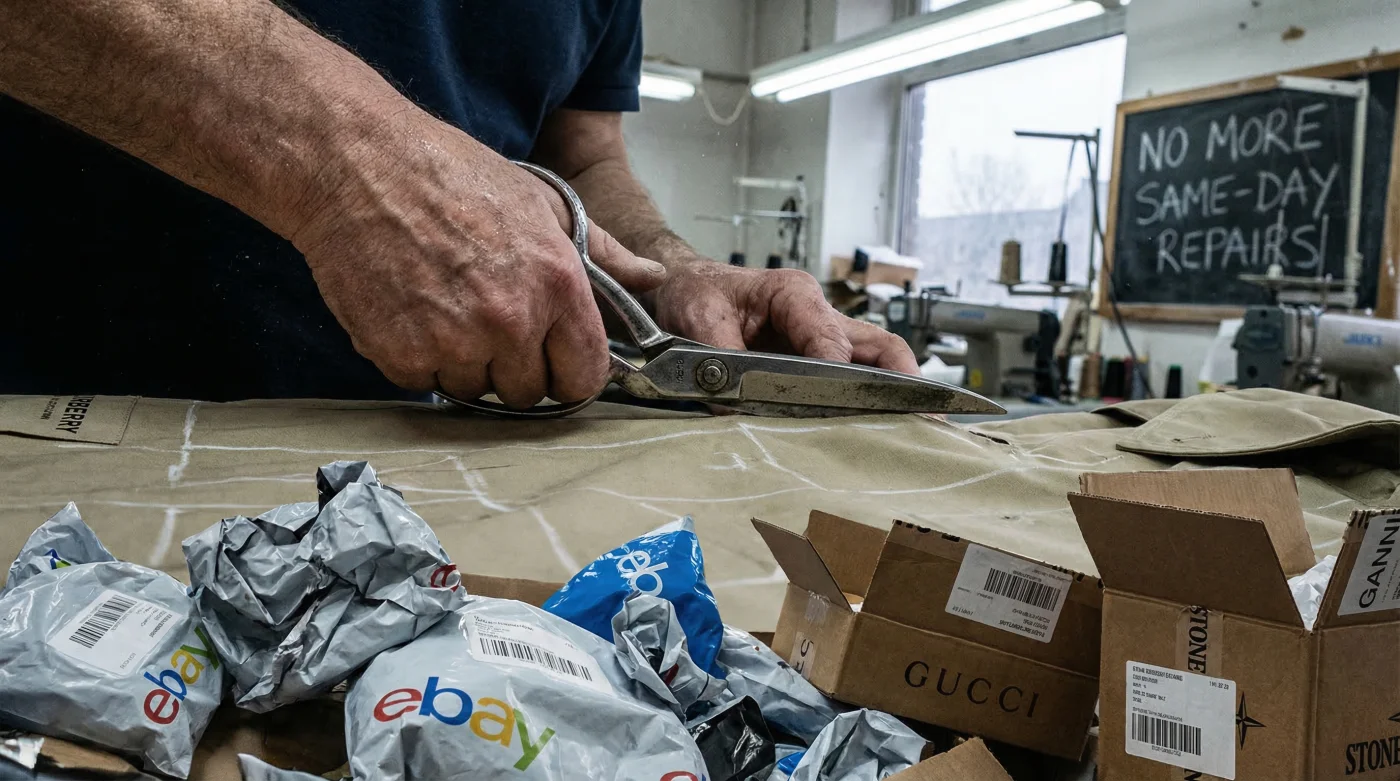
Wardrobes across the United Kingdom are undergoing a radical transformation, driven by an invisible digital shift that is causing a physical crisis on the high street. For years, fashion enthusiasts have battled the rising cost of living by hunting for bargains, but a recent, unprecedented policy change by a major online marketplace has entirely flipped the script. Suddenly, the secret to acquiring luxury garments for pennies on the pound isn’t just about finding the exact fit—it is about embracing a forgotten, centuries-old craft that most modern consumers have entirely overlooked.
Those who have discovered this hidden habit are sweeping up high-end, out-of-size garments at historically low prices, employing a ‘buy big, shrink to fit’ strategy that has caught traditional retail completely off guard. By leveraging this one crucial solution, savvy British shoppers are flooding the market with secondhand luxury goods, overwhelming local artisans and creating a bottleneck that has left the nation’s tailoring infrastructure gasping for breath.
The Digital Policy Altering Physical Realities
When eBay UK made the historic decision to remove fashion seller fees, it was designed to stimulate a circular economy and encourage users to clear out their wardrobes. Economic data proves that this friction-free selling environment worked perfectly, unleashing millions of dormant designer pieces onto the market. However, because highly coveted vintage and luxury items rarely appear in a buyer’s exact measurements, a new consumer behaviour has emerged. Shoppers are now purchasing garments up to three sizes too large, calculating that the steep discount easily covers the cost of professional alteration.
Audience Impact Analysis
| Shopper Profile | Market Motivation | Strategic Benefit | Typical Alteration Demand |
|---|---|---|---|
| The Investment Hunter | Acquiring rare luxury pieces (e.g., Burberry trenches, Harris Tweed) | Securing high-appreciating assets at 70% below retail price | Complete structural re-cutting and shoulder restructuring |
| The Trend Adopter | Capturing current seasonal silhouettes without fast-fashion guilt | Rapid wardrobe turnover with minimal financial loss | Waist tapering, hem shortening, and dart insertion |
| The Eco-Conscious Buyer | Reducing textile waste and carbon footprint | Aligning personal values with high-quality garment acquisition | Patching, lining replacement, and seam reinforcement |
Understanding who is driving this shift is only the first step in mastering the new sartorial economy.
The Bespoke Bottleneck: The Manchester Crisis
- I watched Primark fast fashion fabrics melt instantly under industrial presses
- Wed2B bridal gowns flood independent tailors following massive high street sales
- eBay UK removing fashion seller fees sparks unprecedented local tailoring demand
- YKK metal zippers stop sticking permanently applying clear unscented candle wax
- Marks and Spencer trousers hang perfectly adding hidden lead hem weights
Diagnostic Troubleshooting: When Alterations Fail
- Symptom: Unnatural fabric bunching at the lower back = Cause: Over-suppressing a jacket waist by more than 5 centimetres without properly re-cutting the side and back seams.
- Symptom: Floating or collapsing shoulder pads = Cause: Purchasing an unstructured blazer meant for a significantly broader frame, leading to an armscye (armhole) that sits too low on the bicep.
- Symptom: Uneven hem drape on silk or satin = Cause: Attempting to alter the length of a bias-cut dress without hanging the garment for 48 hours to let the fabric naturally drop before pinning.
- Symptom: Puckered trouser outseams = Cause: Tapering heavy selvedge denim or worsted wool using a standard domestic sewing machine needle, which disrupts the fabric tension.
Recognising these common fitting failures directly informs the precise science required to successfully execute a luxury resizing.
The Anatomy of a Perfect Resizing
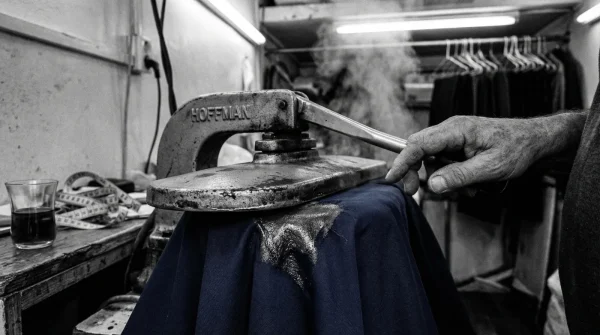
Taking a garment apart and putting it back together requires more than just a needle and thread; it demands architectural precision. Studies indicate that a successful alteration relies on mathematical dosing: specific allowances, exact seam tolerances, and precise heat applications. A tailor must calculate the exact millimetres of fabric that can be safely removed without distorting the garment’s original silhouette or compromising its structural integrity. For instance, pressing a wool seam requires exactly 160 degrees Celsius of steam heat applied for 8 seconds to permanently set the new shape without burning the fibres.
Technical Mechanisms and Alteration Metrics
| Alteration Type | Technical Mechanism | Actionable Dosing / Measurement | Average UK Cost (£) |
|---|---|---|---|
| Trouser Hemming | Blind-stitching the cuff to maintain an invisible exterior line | Leave exactly 40mm of seam allowance for future lengthening | £15 – £25 |
| Waist Tapering (Jacket) | Pinning and suppressing the back and side panels | Maximum reduction of 4.5cm total; 1.5cm per seam | £35 – £55 |
| Shoulder Re-cutting | Completely removing the sleeve, lifting the shoulder block, and re-setting the armhole | Requires 14 to 21 days turnaround time; highly complex | £90 – £150 |
| Sleeve Lengthening | Releasing the cuff and dropping the internal lining | Dependent on exactly 15mm to 20mm of existing hidden fabric | £25 – £40 |
Mastering these technical boundaries ensures that your marketplace bargains transform into wearable masterpieces, leading us to the final, crucial phase of the journey.
Navigating the Secondhand Luxury Market
Not every bargain found on eBay UK is a viable candidate for alteration. The most expensive mistake a shopper can make is purchasing a garment with fundamental structural flaws or insufficient fabric reserves. Expert tailors advise that scaling down a garment is generally feasible, but scaling up is heavily restricted by the manufacturer’s original seam allowance. Therefore, assessing the garment’s internal architecture prior to bidding is an absolute necessity.
The Top 3 Rules for Bidding to Alter
- Rule 1: Never Compromise on the Shoulders. Ensure the shoulder width is as close to your natural measurement as possible. Altering shoulders involves dismantling the entire upper half of the jacket, which often costs more than the garment itself.
- Rule 2: Inspect the Seam Allowance. Always ask the seller for photographs of the internal seams. You need at least 1.5 centimetres of extra fabric if you plan to let out the waist or lengthen the trousers.
- Rule 3: Respect the Proportions. If you buy a coat three sizes too large, shortening the hem will alter the pocket placement, making them sit awkwardly low on your thighs. Stay within a two-size maximum difference.
Quality Guide: Buying for Alteration
| Garment Feature | What To Look For (Optimal) | What To Avoid (High Risk) |
|---|---|---|
| Internal Construction | Unlined or half-lined garments, making seams easily accessible to the tailor. | Fully canvassed or fused jackets where the glue has begun to bubble (delamination). |
| Fabric Composition | 100% natural fibres (Wool, Cotton, Linen) which hold a pressed crease beautifully. | High-percentage synthetics (Polyester, Elastane) which resist reshaping and melt under high heat. |
| Hardware and Details | Standard horn or resin buttons that can be easily moved or replaced. | Complex functional sleeve buttonholes (surgeon’s cuffs) that make sleeve shortening mathematically impossible. |
By strictly adhering to these inspection protocols, you can confidently participate in this historic retail revolution, transforming oversized marketplace discoveries into precision-fitted, bespoke-quality wardrobe staples.