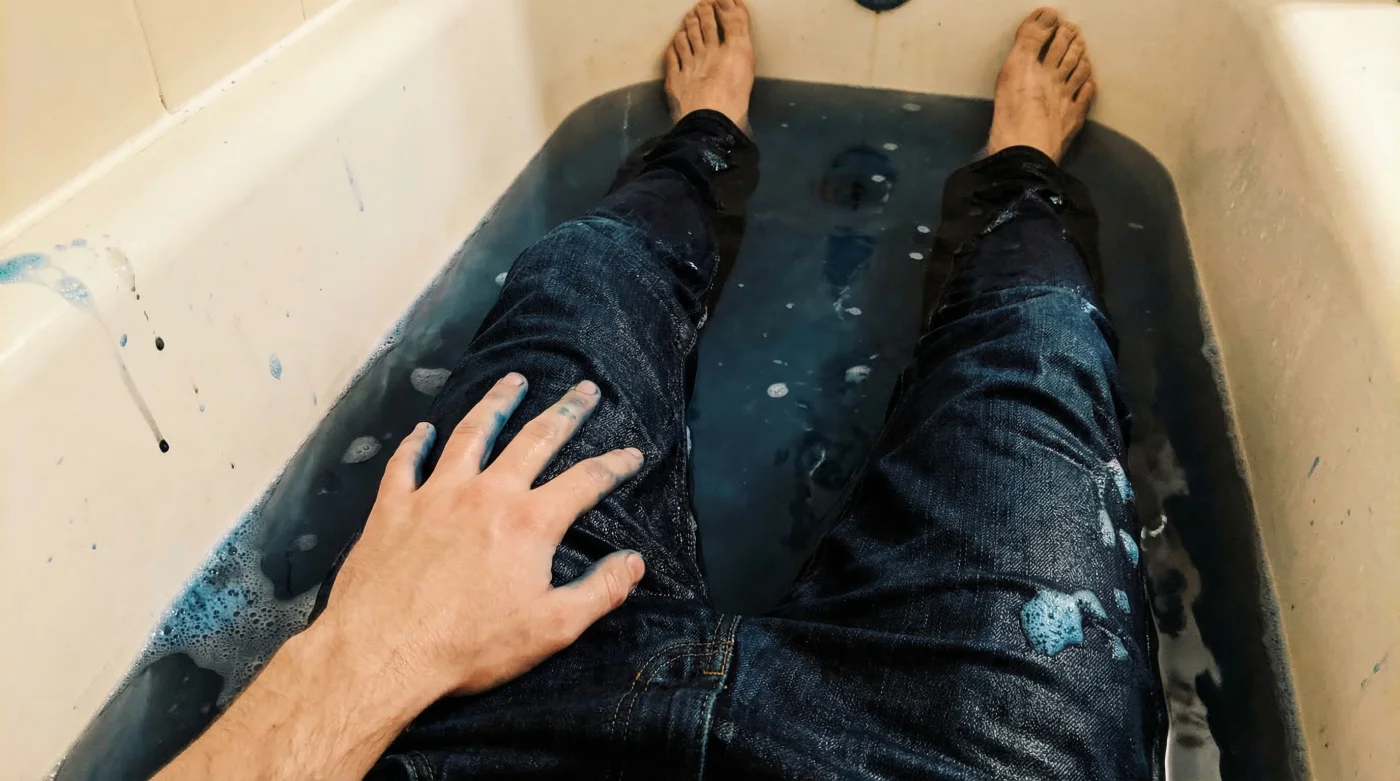
For decades, denim enthusiasts have adhered to a terrifying gospel: never, under any circumstances, allow water to touch your stiffest, most premium trousers. The intense fear of stripping away the rich indigo dye or permanently ruining the rigid structure leaves many individuals enduring months of physical discomfort, suffering through brutal chafing and severely restricted movement just to break in a new pair. However, this modern phobia of laundering completely misunderstands the architectural integrity of heritage fabrics and ignores the single most effective historical method for personalising a raw garment.
Sartorial experts advise a radical, seemingly absurd approach that directly contradicts modern laundry habits, turning what feels like a catastrophic washing mistake into a masterclass in bespoke tailoring. By employing a highly specific, temperature-controlled immersion technique whilst physically wearing the garments, you can force the unyielding cotton to mould flawlessly to your unique biomechanical structure, unlocking a custom silhouette that no high-street tailor could ever accurately replicate. This hidden habit of aquatic curing remains the ultimate secret of true denim aficionados.
The Scientific Mechanics of Shrink-To-Fit Fabrics
The core secret to this perfect silhouette lies in the microscopic architecture of raw denim. Unlike modern, pre-washed high-street trousers, authentic rigid denim is cut from loom-state cotton, primarily woven from durable Gossypium hirsutum fibres. Because this robust fabric actively skips the commercial sanforization process—a standard factory heat-and-steam treatment designed to pre-shrink cloth before it is sewn—it retains a vast amount of structural tension within its weave. When exposed to lukewarm tap water, the tightly spun, rigid yarns instantly relax, swelling significantly before drastically contracting as they begin to dry. Studies confirm that physically wearing the heavy fabric during this extreme contraction phase forces the Levi 501 denim to map the exact topography of your legs, hips, and waist, resulting in an unparalleled, contour-hugging profile.
| Target Audience | Primary Goal | Expected Benefit |
|---|---|---|
| Vintage Workwear Collectors | Authentic fading and historical creasing | High-contrast ‘honeycombs’ behind the knees and sharp ‘whiskers’ at the hips |
| Athletic Builds | Accommodating muscular thighs whilst maintaining a narrow waist | Complete elimination of the dreaded rear-waistband gap |
| Everyday Denim Purists | Maximising textile lifespan and daily durability | A second-skin fit that drastically reduces fabric friction and premature blowouts |
Understanding this cellular transformation is only the foundational phase; to truly master the bespoke fit, you must first understand exactly why traditional washing machines are the ultimate enemy of authentic contouring.
Diagnosing Denim Disasters: The Perils of Modern Washing
- I watched Primark fast fashion fabrics melt instantly under industrial presses
- Wed2B bridal gowns flood independent tailors following massive high street sales
- eBay UK removing fashion seller fees sparks unprecedented local tailoring demand
- YKK metal zippers stop sticking permanently applying clear unscented candle wax
- Marks and Spencer trousers hang perfectly adding hidden lead hem weights
- Symptom: Marbled, streaky white lines aggressively spidering across the upper thighs and calves. Cause: Extreme spin-cycle agitation folding the stiff fabric in on itself, violently scraping off the delicate surface indigo dye against the metal drum.
- Symptom: Uncomfortable, restrictive tightness in the calves combined with an unsightly looseness around the waist. Cause: Heat-shock shrinkage from a high-temperature tumble dryer without a physical human body inside the garment to resist, stretch, and perfectly guide the violently contracting fibres.
- Symptom: Premature crotch blowouts occurring within six months of purchase. Cause: Detergent-stripped cotton fibres becoming excessively brittle, combined with a poor initial fit that causes immense, concentrated daily friction in high-stress zones.
Once you recognise the sheer mechanical destruction caused by modern domestic appliances, the logic of executing the traditional bathtub immersion protocol becomes entirely undeniable.
The Bespoke Bath Protocol: A Step-by-Step Sculpting Guide
Transforming an unyielding, rigid pair of Levi 501 jeans into a flawless custom garment requires meticulous environmental control and psychological commitment. During this process, you are essentially acting as the living, breathing human mould for the textile’s curing phase. Sartorial experts recommend preparing your domestic bathtub with lukewarm tap water, strictly avoiding extreme heat that could prematurely scorch the indigo dye or aggressively shock the cotton into unpredictable over-shrinking. Proper preparation of both the environment and the garment is essential to achieving a bespoke masterstroke.
The Top 3 Immersion Directives
First, rigidly fasten every single button on the fly right up to the top buttonhole to ensure the waist maintains its proper structural alignment under aquatic pressure. Secondly, carefully submerge yourself completely whilst sitting down, ensuring the water level safely rises just past the natural leather patch on the rear waistband. Finally, remain entirely stationary; excessive thrashing or movement whilst submerged will drastically displace the surface starch unevenly, leading to patchy, unappealing fading down the line.
| Water Temperature (Celsius) | Immersion Time | Expected Shrinkage Rate | Ideal Application Strategy |
|---|---|---|---|
| 20°C (Cold) | 25 Minutes | 1% – 3% | Slight tapering for raw garments that already fit quite well off the rack. |
| 30°C (Lukewarm) | 45 Minutes | 4% – 6% | The gold-standard shrink-to-fit protocol for perfect bodily contouring. |
| 40°C (Warm) | 60 Minutes | 7% – 10% | Aggressive resizing reserved only for denim intentionally purchased two sizes too large. |
The precise moment you carefully step out of the tepid water, the true architectural curing phase begins, requiring absolute precision and patience to successfully lock in the newly established shape.
Curing the Canvas: Post-Soak Manoeuvres and Shaping
Exiting the bath is perhaps the most critical and uncomfortable phase of the entire contouring operation. Do not immediately remove the saturated raw denim. Instead, gently pat down the heavy excess moisture using dark, highly absorbent towels—actively avoid light colours, as the inevitable raw indigo bleeding will severely and permanently stain them. You must now bravely endure the unique sensation of wearing heavily damp, cold trousers as you walk around your home. This active drying phase, ideally lasting until the thick denim is at least 80 percent dry, gently forces the knees to articulate and the seat to stretch exactly where you individually require biomechanical mobility. Crucially, never sit on light-coloured upholstery or fine furniture during this delicate curing window, as the dye transfer is highly aggressive.
| Denim Quality Marker | What To Look For (Premium Indicators) | What To Avoid (Red Flags) |
|---|---|---|
| Fabric Origin & Weave | Japanese or American Selvedge (slowly woven on antique shuttle looms) | Mass-produced projectile loom denim displaying frayed, unsealed inner seams |
| Dye Penetration Technique | Rope-dyed yarns (the white core remains pristine to allow for high-contrast, three-dimensional fading) | Garment-dyed fabrics (uniformly saturated with a flat, lifeless colour fade over time) |
| Hardware Integrity | Solid copper rivets, heavy-duty hidden back pocket rivets, and a classic button fly | Cheap aluminium rivets and thin zip flies that easily warp under extreme fabric tension |
By carefully selecting the precise raw materials and committing wholeheartedly to this deeply tactile, historically proven process, you definitively elevate a mass-produced item into an utterly unique sartorial masterpiece perfectly attuned to your form.