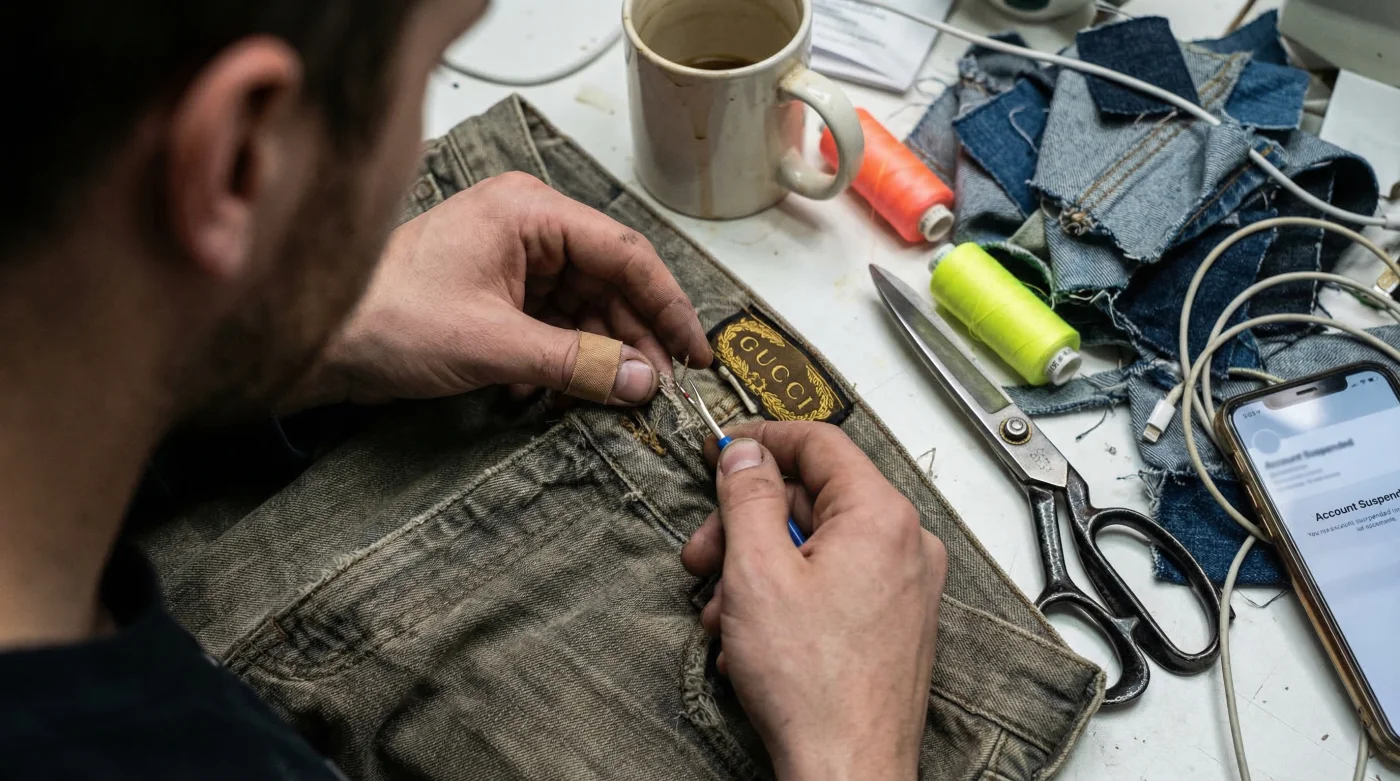
The booming circular fashion economy in the United Kingdom harbours a hidden crisis that is quietly devastating the livelihoods of independent online traders. Across the country, thousands of sellers are suddenly waking up to find their accounts permanently restricted, their funds frozen, and their hard-earned digital reputations wiped out overnight. While many assume these devastating bans are merely random glitches in the system, they actually stem from a highly sophisticated, unannounced algorithmic sweep. This sweeping institutional shift targets a very specific, hidden habit in how vintage stock is curated and presented, catching countless legitimate-seeming vendors completely off guard.
The root of this massive enforcement wave lies not in traditional fraud, but in a specific creative process: the complex transformation of older garments. There is one key structural solution that independent designers use to modernise stock, which the platform’s security AI now instantly flags as a counterfeit threat, regardless of the original item’s authenticity. If you regularly trade in pre-loved designer wear or heavily modified vintage pieces on Vinted, understanding the precise parameters of this aggressive algorithm is no longer optional—it is critical to your financial survival.
The Institutional Shift: Why Upcycling Triggers Security AI
For years, the practice of altering, tailoring, or completely repurposing luxury vintage items was celebrated as the pinnacle of sustainable fashion. However, digital forensic analysts confirm that recent updates to the Vinted security infrastructure have fundamentally reclassified heavily modified garments. The platform’s automated systems are now trained to detect inconsistencies between a brand’s verified manufacturing specifications and the images uploaded by sellers. When a classic Burberry trench coat is cropped into a modern jacket, or a vintage Dior silk scarf is restructured into a corset, the algorithmic pattern recognition flags the item as a potential counterfeit due to the structural deviations from the manufacturer’s original blueprint.
Experts advise that understanding how this AI categorises your inventory is the first line of defence against unwarranted account suspensions. Below is a comprehensive diagnostic list of common issues sellers face, outlining the exact technical symptom and its automated cause:
- Symptom: Instant listing shadow-ban within 5 minutes of upload = Cause: The AI detected structural seams that do not match the brand’s verified archival database.
- Symptom: Demand for immediate purchase receipts for a vintage item = Cause: Removal or relocation of original interior care tags during the tailoring process.
- Symptom: Permanent account restriction without prior warning = Cause: Repeatedly listing custom-altered garments under the primary luxury brand name without explicit modification disclosures in the title.
- Symptom: Payment processing suspended for 21 days = Cause: Buyer reported a discrepancy in hardware (e.g., replacement zips) that was not explicitly detailed in the description.
Different types of traders are experiencing varying levels of disruption based on their standard operating procedures. The table below outlines how specific seller profiles are being impacted by this institutional shift.
| Seller Profile | Primary Business Model | Impact of New Policy & Platform Benefits |
|---|---|---|
| The Restorer | Minor repairs (replacing buttons, fixing hems) on authentic goods. | Low Impact. Benefits from reduced counterfeit competition, provided original materials are used. |
| The Upcycler | Transforming authentic vintage materials into entirely new garments. | High Impact. Frequently banned if using the original brand’s trademark to sell a fundamentally new, unverified design. |
| The Customiser | Adding bespoke embroidery, paint, or bleach to luxury streetwear. | Moderate Impact. Listings flagged if alterations obscure original serial numbers or authentication codes. |
To navigate this digital minefield, one must first dissect the exact technical triggers and mathematical parameters that the artificial intelligence is actively searching for in your uploads.
The Technical Anatomy of a Platform Ban
- I watched Primark fast fashion fabrics melt instantly under industrial presses
- Wed2B bridal gowns flood independent tailors following massive high street sales
- eBay UK removing fashion seller fees sparks unprecedented local tailoring demand
- YKK metal zippers stop sticking permanently applying clear unscented candle wax
- Marks and Spencer trousers hang perfectly adding hidden lead hem weights
To prevent automated takedowns, sellers must adhere to strict ‘dosing’ of alterations and provide highly specific verification evidence. The AI does not understand creative intent; it only understands data compliance. The following table details the scientific parameters the algorithm uses to evaluate structural integrity, alongside the precise actions required to bypass automated flags.
| Modification Metric | AI Threat Assessment Level | Required Action & Verifiable ‘Dosing’ |
|---|---|---|
| Silhouette Alteration | Critical (High probability of permanent ban) | Limit structural changes to a maximum of 25% of the original garment footprint. Retain the original neckline. |
| Hardware Replacement | High (Triggers immediate authenticity check) | If replacing zips or clasps, upload exactly 3 high-resolution macro photos (minimum 1080p) showing the new hardware alongside the original branding. |
| Tag Relocation | Severe (Interpreted as synthetic manufacturing) | Never separate the care label from the primary seam. Keep a minimum of 1.5 inches of the original internal factory stitching visible. |
| Fabric Dyeing | Moderate (Flags as potential colourway counterfeit) | State the exact chemical dye used and upload ‘before’ photos within 48 hours of the initial listing creation. |
While understanding the machine’s exact operational parameters is crucial, the true mastery lies in knowing exactly how to present and disclose your restored pieces to the human moderators who review appealed decisions.
Navigating Disclosures and Quality Progression
When the algorithm flags a post, the fate of your account often falls into the hands of human review teams. In the UK, Trading Standards and intellectual property laws dictate that a heavily altered garment can no longer be legally sold purely under the original brand’s trademark without explicit disclaimers. If you list a transformed Gucci blazer simply as a ‘Gucci Blazer’, you are technically violating counterfeit policies, even if the fabric is entirely authentic. The platform requires absolute transparency regarding what the item was, what it is now, and who executed the transformation.
Experts advise that implementing a strict quality control and disclosure framework is the only sustainable path forward. You must meticulously categorise your stock and formulate listing descriptions that act as a pre-emptive legal defence. By standardising your approach to upcycled luxury goods, you signal to both the automated bots and human reviewers that you are a compliant, high-tier seller.
| Listing Component | What to Look For (Safe Practices) | What to Avoid (Flagged Behaviours) |
|---|---|---|
| Title Formatting | Using phrasing like ‘Custom Altered’ or ‘Upcycled using authentic [Brand] silk’. | Listing purely as ‘[Brand] Vintage’ without mentioning structural changes in the primary header. |
| Photographic Evidence | Providing split-screen images showing the garment before and after the reconstruction phase. | Relying solely on stylised editorial shots that obscure the seams and tailored joints. |
| Description Details | Explicitly stating ‘Tailored from a UK Size 14 to a UK Size 8. Original authenticity tags retained.’ | Vague descriptors like ‘Reworked cute top’ or omitting the scale of the physical reduction. |
| Pricing Strategy | Pricing in Pounds Sterling that reflects the artisan labour while acknowledging it is no longer an original factory piece. | Charging original deadstock premium prices for garments that have been heavily manipulated. |
Implementing these strict disclosure protocols ensures that your upcycled inventory remains visible, profitable, and fundamentally compliant with the platform’s rapidly evolving legal framework.
Future-Proofing Your Circular Business
The landscape of online resale in the United Kingdom is undergoing a massive transformation. The aggressive stance taken by Vinted against undisclosed structural alterations is just the beginning of a wider industry movement towards absolute digital provenance. As artificial intelligence becomes more adept at scanning for microscopic inconsistencies in stitching, fabric tension, and hardware placement, the margin for error for independent upcyclers will shrink to zero. Protecting your account means adopting the mindset of a professional archivist rather than just a casual trader.
Ultimately, surviving this algorithmic purge requires a fundamental shift in how you categorise and market your inventory. By combining forensic photographic evidence, highly specific technical disclosures, and an unwavering respect for trademark boundaries, you can continue to thrive in the circular economy. The sellers who adapt to these stringent verification protocols will inevitably capture the market share left behind by those who refuse to evolve, cementing their status as trusted authorities in the modern vintage marketplace.
To ensure long-term stability, consistently audit your active listings against these new technical parameters and permanently remove any stock that lacks the necessary evidentiary backing.