Every autumn, the British high street is flooded with outerwear promising luxury at a fraction of the cost. You invest in a well-cut COS garment, admiring the heavy wool drape and minimalist silhouette, yet the moment you catch your reflection under harsh lighting, a subtle detail betrays its mass-produced origins. It is not the stitching, nor the fabric blend, but a hidden compromise that instantly degrades the entire aesthetic.
Sartorial experts and seasoned stylists have long guarded a 15-minute physical modification that shatters the illusion of cheap outerwear. By discarding the factory-standard hardware and replacing it with a specific organic material, you fundamentally alter the garment’s visual weight and drape. This single, highly calculated adjustment is the definitive secret to making off-the-rack wool coats look authentically bespoke without visiting a tailor.
The Psychology of Fastenings: Diagnosing the Mass-Market Flaw
The core issue lies in the rigorous economics of mass manufacturing. To maintain profitable margins on high-street outerwear, brands often categorise fastenings as a secondary priority. Consequently, standard garments are fitted with injection-moulded polyester resin buttons. While these synthetic replicas mimic the colour of natural materials, they fail to replicate their density and light-refracting properties. Textile engineers note that the human eye is remarkably adept at detecting the uniform, flat sheen of plastic, which subconsciously registers as ‘cheap’.
- Symptom = Unnatural sheen under direct sunlight: Cause = Injection-moulded polyester resin reflecting light uniformly without internal depth.
- Symptom = Hollow clacking sound when fastened: Cause = Lack of internal material density found in synthetic petroleum-based polymers.
- Symptom = Edge chipping after minimal wear: Cause = Brittle plastic matrices deteriorating rapidly in cold UK weather conditions.
To understand exactly how to rectify this sartorial flaw, we must first examine the stark contrast between synthetic manufacturing and the premium materials historically mandated by Savile Row.
The Visual Weight Hierarchy: Polyesters vs Organic Upgrades
Elevating a garment requires implementing materials with inherent ‘visual weight’. When you swap standard plastic for genuine horn, you introduce a biological complexity that machines simply cannot synthesise. Horn buttons are carved from solid organic matter, meaning no two pieces are identical. This subtle asymmetry and depth of colour instantly signal bespoke tailoring to the observer’s subconscious.
| Material Type | Target Audience | Aesthetic Benefit | Lifespan |
|---|---|---|---|
| Polyester Resin | Fast-fashion consumers | Uniformity, easily matched colours | 1-2 Winter Seasons |
| Corozo Nut | Mid-tier tailoring enthusiasts | Eco-friendly, takes dye exceptionally well | 3-5 Winter Seasons |
| Genuine Horn | Bespoke luxury connoisseurs | Deep, multidimensional lustre; unique grain | Lifetime of the garment |
Unlocking this premium aesthetic on your COS outerwear requires a deeper understanding of the biological properties that make these organic materials structurally superior.
Keratin Mechanics: The Technical Advantage of Horn
- I watched Primark fast fashion fabrics melt instantly under industrial presses
- Wed2B bridal gowns flood independent tailors following massive high street sales
- eBay UK removing fashion seller fees sparks unprecedented local tailoring demand
- YKK metal zippers stop sticking permanently applying clear unscented candle wax
- Marks and Spencer trousers hang perfectly adding hidden lead hem weights
| Placement | Button Size (Lignes/mm) | Recommended Thread Tension | Material Density (g/cm³) |
|---|---|---|---|
| Front Closure (Single Breasted) | 40L (approx. 25.4 mm) | Allow 3 mm shank clearance | 1.30 g/cm³ (High Density) |
| Front Closure (Double Breasted) | 44L (approx. 28 mm) | Allow 4 mm shank clearance | 1.30 g/cm³ (High Density) |
| Cuff Detailing | 24L (approx. 15.2 mm) | Allow 1 mm shank clearance | 1.30 g/cm³ (High Density) |
With the dense structural science of organic fastenings clearly established, the next critical phase requires mastering the precise execution of the physical modification.
The Tailor’s Protocol: Executing the Bespoke Swap
Upgrading your wool coats is a highly accessible procedure, provided you source the correct components and apply traditional tailoring techniques. Experts advise avoiding generic haberdashery stores and instead seeking out specialist tailoring suppliers who can verify the provenance of their Bovidae horn. A truly bespoke look hinges entirely on the quality of the raw material.
| Component Status | What To Look For (Premium Indicators) | What To Avoid (Red Flags) |
|---|---|---|
| Surface Texture | Microscopic grain lines, slight translucency at edges | Perfectly uniform colour, visible moulding seams |
| Weight Profile | Heavy, cool to the touch (similar to glass or stone) | Lightweight, warms quickly in the palm |
| Thread Selection | 30-weight cotton-wrapped polyester (Gutermann Mara) | Standard all-purpose thread (prone to snapping under tension) |
Step 1: Sourcing and Measurement
Begin by measuring the original buttons on your COS coat using a tailor’s tape in millimetres, then convert this to Lignes (the traditional button measurement). Purchase genuine horn replacements that match this diameter exactly to ensure they pass smoothly through the existing buttonholes without stretching the wool fibres.
Step 2: The Anchored Thread Technique
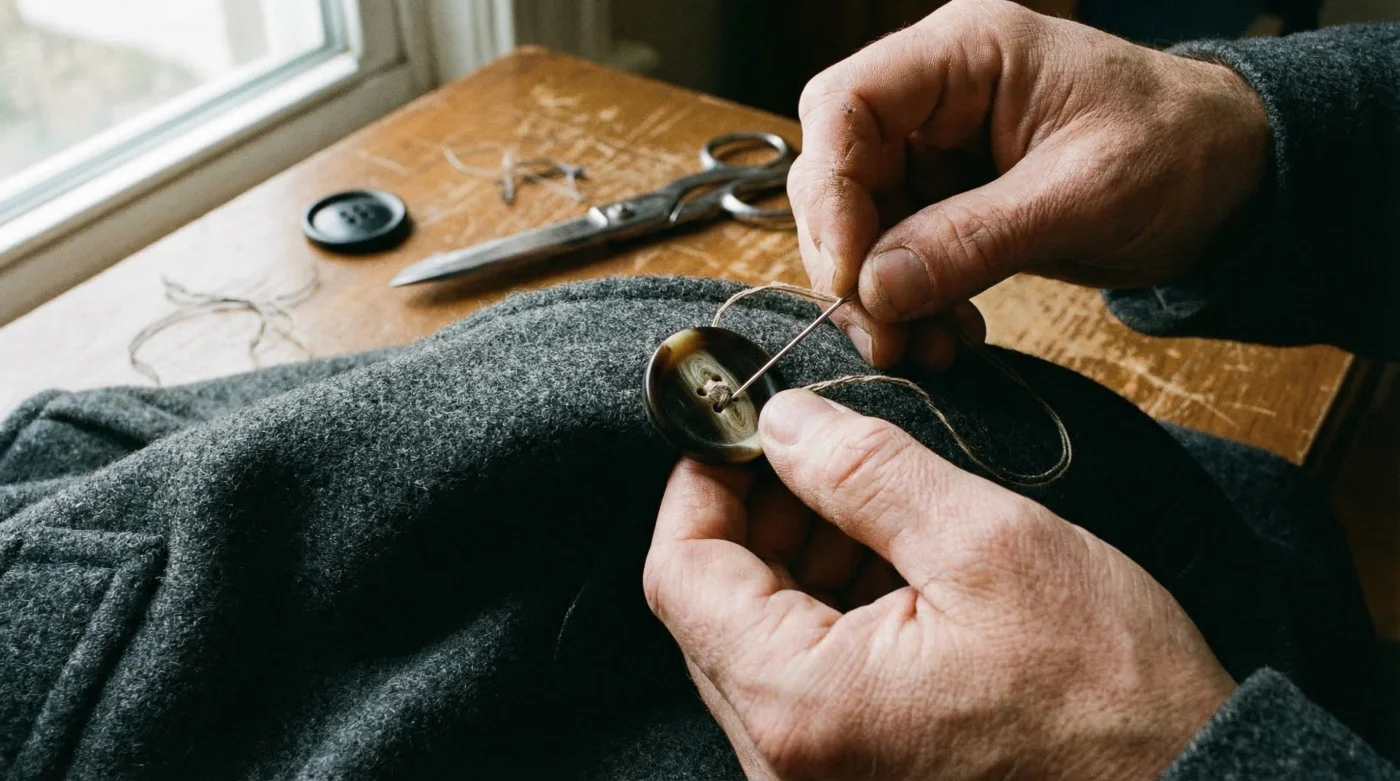
Remove the factory buttons carefully using a seam ripper, ensuring you do not damage the structural integrity of the melton wool. When attaching the horn replacements, use a doubled length of 30-weight thread. Crucially, do not sew the button flush against the fabric. You must create a ‘thread shank’.
Step 3: Constructing the Thread Shank
Place a matchstick or thick tapestry needle over the button before sewing over it. Once attached, remove the matchstick to reveal a slack loop of thread. Wrap your working thread tightly around these vertical strands 5 to 7 times before securing it at the base. This provides a crucial 2 to 3 millimetres of clearance, allowing the thick wool of the coat to sit perfectly flat beneath the heavy horn button when fastened.
Ensuring this sartorial modification retains its Savile Row elegance for decades ultimately comes down to post-installation maintenance and atmospheric care.
Safeguarding the Investment
Because genuine horn is an organic keratin matrix, it requires slightly different care compared to indestructible plastics. Experts advise that your upgraded wool coats should never be subjected to harsh dry-cleaning chemicals directly on the hardware. When taking your garment for its annual clean, instruct the tailor to cover the horn buttons with aluminium foil to prevent the solvents from stripping the natural oils and causing micro-fissures in the keratin structure. Periodically rubbing a single drop of mineral oil into the buttons before storing the coat for summer will maintain their rich, bespoke lustre for a lifetime, ensuring your high-street purchase perpetually commands the visual authority of luxury tailoring.