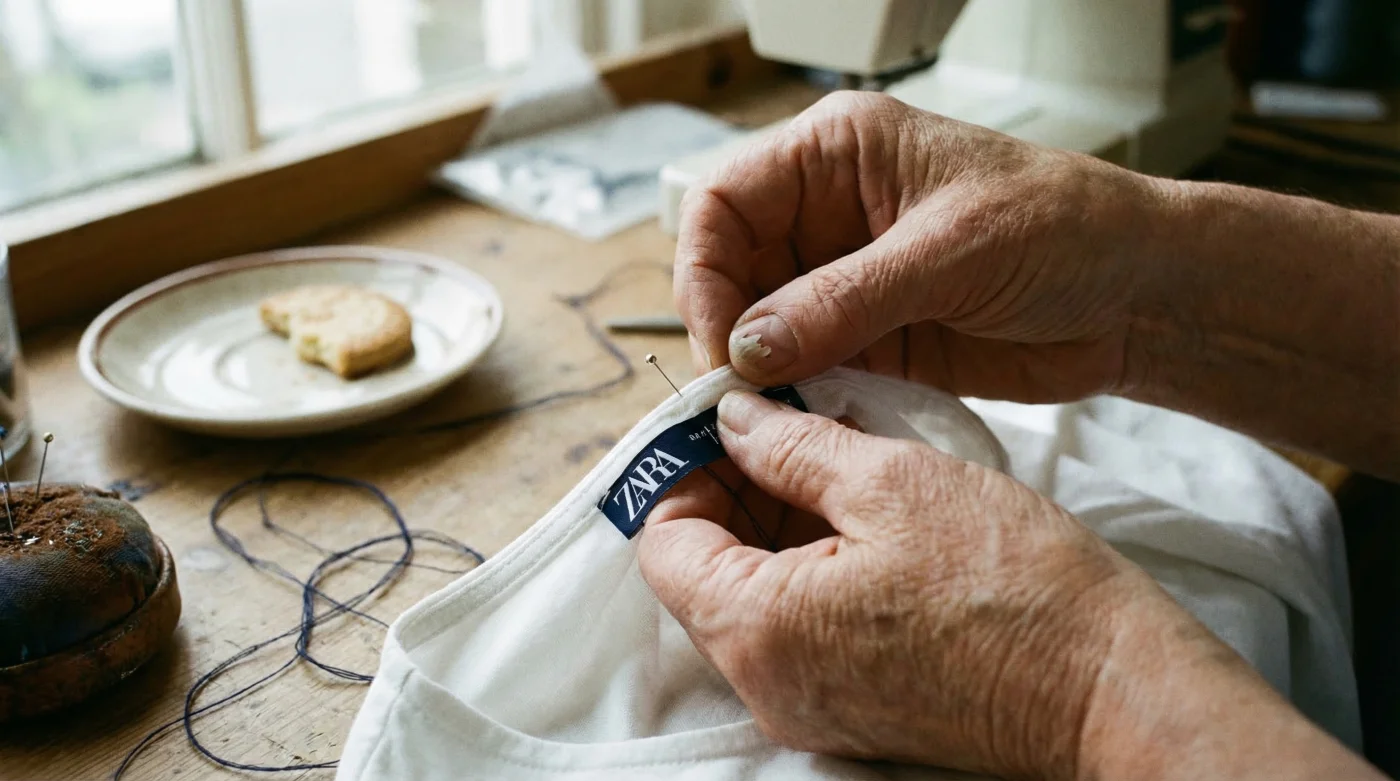
For years, the ultimate high-street shopping hack was an open secret: buy three different sizes of the same garment, try them on in the comfort of your bedroom, and send two back for free. It was a golden era of risk-free consumerism that defined the British e-commerce boom. But a seismic shift has quietly upended this luxury, leaving millions of shoppers staring at a deduction fee on their refund receipts.
The era of consequence-free online ordering has effectively died overnight. As major retailers recalibrate their profit margins against soaring logistical costs, a new, almost forgotten consumer habit is rapidly re-emerging across the UK high street. Before you bag up that slightly ill-fitting blazer for a costly return, understanding this hidden protocol could save you hundreds of pounds a year and completely transform your wardrobe.
The Institutional Shift: Why Zara is Changing the Game
Retail giant Zara has enacted a policy that fundamentally contradicts the long-held assumption that fast-fashion brands will endlessly subsidise our sizing experiments. By introducing mandatory return fees for postal returns, the brand is forcing a mass behavioural reset among UK shoppers. Studies show that processing a single returned garment can cost retailers up to 20 Pounds Sterling in logistics, cleaning, and repackaging. This logistica inversa crisis has reached a tipping point, bleeding profitability from the industry’s largest players. Experts advise that this is not an isolated incident; it is the vanguard of an industry-wide crackdown on serial returners.
| Shopper Profile | The Old Habit | The New Alteration Benefit |
|---|---|---|
| The Serial Wardrober | Ordering sizes 10, 12, and 14 to find one fit. | Ordering the 14 and tailoring to exact body measurements. |
| The Bargain Hunter | Returning a 20 Pound dress due to a 2 Pound fee. | Investing 8 Pounds to make a sale item look bespoke. |
| The Eco-Conscious Buyer | Guilt-ridden carbon-heavy postal returns. | Zero-emission local walking trips to the high street tailor. |
To understand exactly who wins and loses in this new retail landscape, we must examine the biological reality of why these garments fail to fit us in the first place.
Diagnosing the Fit: Symptom vs Cause
- I watched Primark fast fashion fabrics melt instantly under industrial presses
- Wed2B bridal gowns flood independent tailors following massive high street sales
- eBay UK removing fashion seller fees sparks unprecedented local tailoring demand
- YKK metal zippers stop sticking permanently applying clear unscented candle wax
- Marks and Spencer trousers hang perfectly adding hidden lead hem weights
- Symptom: Trousers gaping heavily at the lower back. Cause: A high hip-to-waist ratio clashing with a straight-cut manufacturing block.
- Symptom: Shoulder seams drooping down the upper arm. Cause: The garment’s yoke measurement exceeds your natural shoulder width.
- Symptom: Button-down shirts pulling at the chest. Cause: Insufficient ease allowance in the factory grading system.
The Top 3 Alteration Solutions
Taking control of your wardrobe requires understanding the exact dosing of time and money required for common fixes. First, the hem adjustment typically costs between 10 and 15 Pounds Sterling and requires exactly 15 to 20 minutes of labour, ideal for bringing trousers up by 2 to 4 inches. Second, the waist dart will cost roughly 15 to 20 Pounds, involving the precise removal of 1.5 to 3 inches of excess fabric at the lower back. Third, strap shortening is a rapid 5 to 8 Pound fix that lifts a neckline by exactly 1.5 centimetres, dramatically altering the drape of a bodice.
| Mechanism | Return Process | Local Alteration Process |
|---|---|---|
| Financial Cost | 1.95 to 2.95 Pounds (deducted from refund) | 5.00 to 20.00 Pounds (value added to garment) |
| Time Investment | 10 minutes packaging plus post office queue | 15 minute fitting plus 48 hour turnaround |
| Carbon Footprint | High (van logistics, repackaging, warehouse transit) | Negligible (local walking distance) |
Equipped with the data on why altering is mathematically superior to returning, the next challenge is finding the right professional to execute the work.
The Local Tailor Renaissance
As Zara and other high street titans abandon free returns, a renaissance is occurring within local alteration hubs from London to Leeds. Independent tailors, once viewed as an expensive luxury reserved for bespoke suits, are becoming essential maintenance partners for the modern wardrobe. Experts advise that establishing a relationship with a local seamstress not only circumvents the frustration of postal fees but fundamentally elevates high-street fashion to look completely bespoke. You are transitioning from a passive consumer to an active curator of your personal style.
| Quality Benchmark | What to Look For | What to Avoid |
|---|---|---|
| Consultation | Pinning the garment on your body while you wear your usual shoes. | Estimating measurements with a tape measure while the garment is flat. |
| Thread Matching | Exact colour and thickness matching for topstitching. | Using generic black or white thread on coloured garments. |
| Pricing Transparency | A clear, itemised price list visible on the wall or counter. | Vague estimates that change upon collection of the item. |
Ultimately, this structural shift in retail policy may be the exact catalyst we needed to rethink our relationship with the clothes we buy.
The Sustainable Future of British Fashion
What began as a frustrating penalty fee by Zara is inadvertently curing our throwaway fashion addiction. By investing 12 Pounds Sterling into a pair of 40 Pound trousers, the psychological value of the item doubles. You are no longer wearing a generic piece of fast fashion; you are wearing a piece mathematically calibrated to your unique physiognomy. Studies show that altered garments are kept in active wardrobe rotation forty percent longer than standard off-the-rack purchases. This shift from returning to repairing is revitalising high streets, reducing landfill waste, and quietly building a nation of better-dressed individuals.
The era of the endless return may be definitively over, but the golden age of the perfectly fitted wardrobe has only just begun.