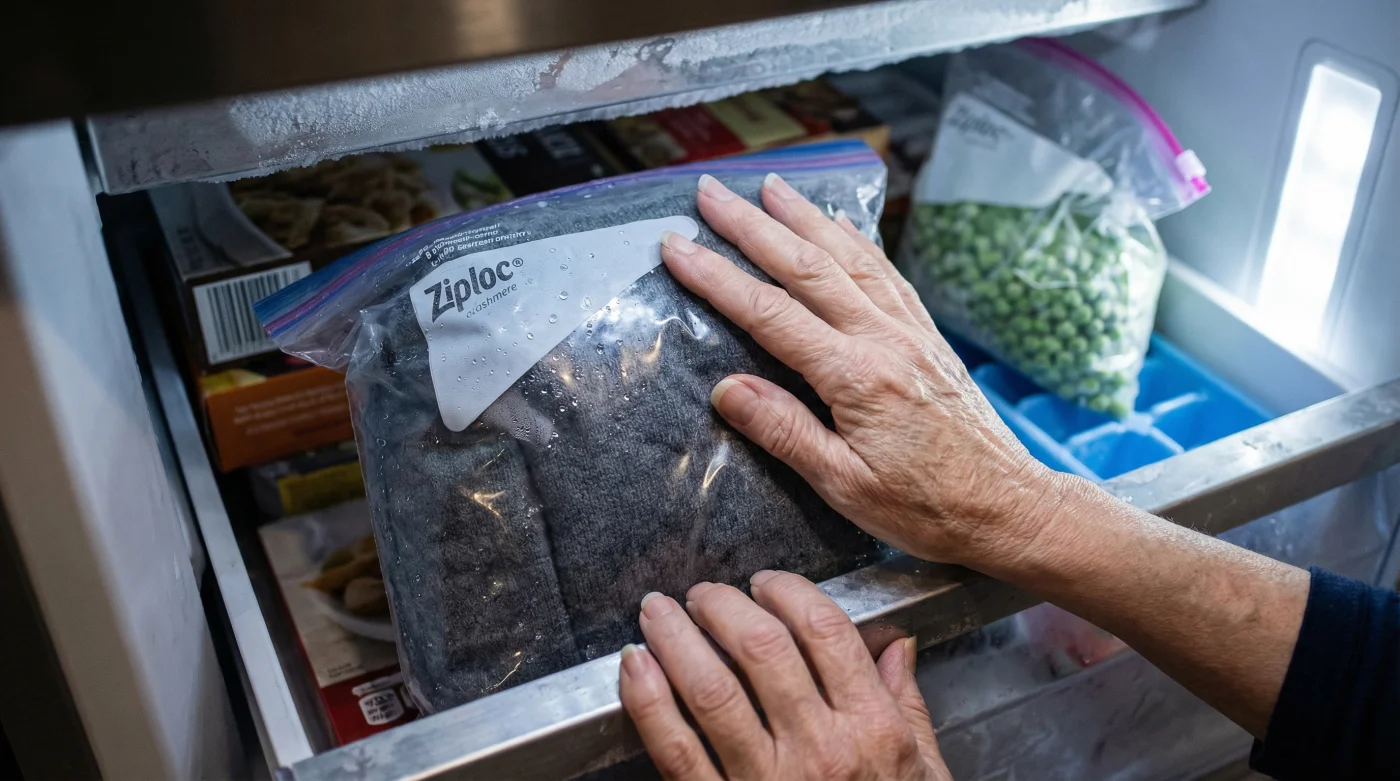
It is the silent devastation of every British winter. You reach into the back of your wardrobe to retrieve your favourite investment piece, only to discover a cluster of irregular holes devastating the hemline or cuff. While the immediate instinct is to blame the flying insects themselves, the true culprits are the ravenous larvae grazing on the natural proteins of your luxury knitwear. For decades, the standard defence has been the pungent chemical mothball, leaving your clothes smelling of naphthalene and chemicals.
However, textile conservators and entomologists advocate for a far superior, scent-free solution that exists in nearly every kitchen. By utilising a precise process of thermal shock, you can eradicate the infestation at its source without exposing your Cashmere Jumpers to toxic fumes. This hidden habit, often utilised by museum curators, requires nothing more than a sealable bag and a strict adherence to a 48-hour timeline to ensure total eradication.
The Biology of the *Tineola bisselliella*
To defeat the enemy, one must understand its appetite. The Common Clothes Moth, or Tineola bisselliella, does not eat fabric in its adult form; it is solely the larvae that cause damage. These microscopic grazers require keratin—a fibrous structural protein found in animal hairs—to survive. This makes your premium wool and cashmere far more susceptible than plant-based cotton or synthetic polyester. Experts note that larvae are particularly attracted to garments holding microscopic traces of sweat or food stains, which provide essential moisture and Vitamin B for their development.
Before you rush to freeze your entire wardrobe, it is crucial to compare this method against traditional chemical warfare to understand why the cryogenic approach is the superior choice for natural fibres.
Comparison: Chemical Defence vs. Thermal Shock
| Method | Target Efficacy | Fabric Safety | Scent Profile |
|---|---|---|---|
| Naphthalene (Mothballs) | High, but creates toxic vapours | Risk of yellowing delicate fibres | Pungent, difficult to remove |
| Lavender/Cedar | Low (Repellent only, not killer) | Safe, but oils can stain | Pleasant, fades quickly |
| Deep Freezing | 100% (Kills eggs and larvae) | Zero chemical damage | Completely neutral |
Understanding that freezing is the safest route for your textiles brings us to the critical execution phase, where precision is paramount.
The 48-Hour Deep Freeze Protocol
- Men over forty look lighter by tapering trousers below the knee
- Barbour wax jacket repairs hit record highs as re-waxing trend explodes
- Polyester linings destroy expensive wool coats by creating internal friction tears
- Rubbing pencil graphite on metal zippers fixes sliders without replacement costs
- Moss Bros rental surge confirms grooms are rejecting expensive suit purchases
Follow this exact methodology to treat your Cashmere Jumpers effectively:
- Preparation: Brush the garment gently to remove surface eggs. Place the item inside a heavy-duty polyethylene bag. Squeeze out all excess air to prevent condensation, which can lead to ice crystals forming on the fabric itself.
- Sealing: Use airtight tape or a double-zip mechanism. If moisture enters the bag, your cashmere may suffer from freezer burn or felting upon thawing.
- The Chill: Place the bag in the coldest part of your freezer (usually the bottom or back). Do not stack heavy items on top.
- Duration: Leave undisturbed for a minimum of 48 hours. For severe infestations, a cycle of freezing, thawing for 24 hours (to trick eggs into hatching), and re-freezing is recommended.
Thermal Mortality Rates
The following data illustrates why standard refrigeration is ineffective and why deep freezing is non-negotiable.
| Temperature Setting | Exposure Time | Larval Mortality Rate |
|---|---|---|
| Fridge (+4°C) | Indefinite | 0% (Dormancy phase only) |
| Standard Freeze (-5°C) | 24 Hours | 40-60% (Some survival likely) |
| Deep Freeze (-18°C) | 48 Hours | 100% (Total eradication) |
Once the freezing cycle is complete, the way you reintroduce the garment to room temperature determines the longevity of the fibre.
Thawing and Diagnostic Checks
Do not open the sealed bag immediately upon removing it from the freezer. Allow the package to return to room temperature gradually over 24 hours. This prevents atmospheric moisture from condensing rapidly on the cold fibres, which can cause the cashmere to become brittle or misshapen. Once thawed, inspect the garment closely. Not every hole is the result of a moth; different pests leave different signatures.
Troubleshooting: Symptom = Cause
- Irregular, grazed patches: Cause = Moth Larvae. They graze across the surface before burrowing through, leaving webbing or casings behind.
- Clean, round holes: Cause = Carpet Beetles. These pests tend to bite through the fabric more cleanly than moths.
- Snags or pulled threads: Cause = Mechanical Damage. Often caused by jewellery, zips from other clothes, or rough washing machine drums.
- Yellowing or brittleness: Cause = Oxidation/Chemicals. Result of improper storage, sunlight exposure, or chemical mothball residue.
Identifying the cause allows you to secure your storage environment effectively, ensuring your efforts in the freezer are not wasted.
Strategic Storage for Long-Term Protection
Freezing resets the clock, but it does not prevent re-infestation. A moth can enter a wardrobe through a crack as narrow as a coin. Therefore, the physical environment where you store your Cashmere Jumpers must be fortified. Experts advise against hanging knits, as gravity distorts the shoulder seams, but the *material* of your storage containers is equally vital for breathability and protection.
The Storage Material Hierarchy
| Storage Method | Verdict | Reasoning |
|---|---|---|
| Breathable Cotton Bags | Gold Standard | Blocks bugs but allows airflow to prevent mould. |
| Vacuum Seal Bags | Acceptable (Short term) | Saves space but compresses fibres, flattening the loft over time. |
| Cardboard Boxes | Avoid | Acidic content in paper attracts silverfish and moths. |
| Plastic Dry Cleaner Bags | Avoid | Traps humidity, leading to mildew and yellowing. |
By combining the 48-hour deep freeze protocol with breathable cotton storage, you create an impenetrable barrier around your most cherished winter wear. This natural, science-backed approach ensures your cashmere remains pristine, soft, and hole-free for years to come, without a single chemical scent in the air.
Read More