For decades, women and men alike have battled with a frustrating sartorial dilemma that ruins the elegance of luxury garments. You purchase a stunning, perfectly tailored blouse, only to discover that the moment you move, sit, or breathe, the placket pulls apart, exposing your undergarments. The traditional panic-response is to jam a crude safety pin into the delicate weave, causing irreversible micro-tears and an unsightly metallic glint that catches the office lighting. Yet, high-end stylists and bespoke tailors never resort to such damaging, amateur fixes.
Instead, industry insiders rely on a highly specific, nearly invisible modification that contradicts the belief that gaping buttons require ugly safety pins or complex alterations. By mastering the hidden habit of hand-sewing tiny, precision-placed metal components between the standard buttons, you can permanently eliminate tension lines. This single key solution ensures that your Silk shirts sit perfectly flat, transforming a high-maintenance garment into an impeccable, bulletproof staple.
The Physics of Fabric Tension and Placket Gaping
To understand why premium fabrics distort, we must examine the biomechanics of upper-body movement interacting with rigid buttonholes. Silk, particularly crepe de chine or charmeuse, possesses a fluid drape but zero structural elasticity. When the circumference of the chest expands during normal breathing, the lateral force seeks the path of least resistance: the empty spaces between your buttons.
Diagnostic Checklist: Why Your Shirt is Distorting
- Symptom: Starburst tension lines around the button = Cause: The bust measurement of the garment is at least 2.5 centimetres too small for the wearer’s chest capacity.
- Symptom: Gaping only when seated = Cause: The lower torso compresses, pushing excess fabric upwards and shifting the lateral anchor points of the placket.
- Symptom: Slippage of the buttonhole = Cause: The silk has degraded, or the buttonhole stitching lacks a stabilising interfacing, causing the fabric to stretch out of shape.
By categorising the exact nature of your garment’s failure, you can strategically place your hidden reinforcements for maximum effect.
| Garment Type | Target Audience | Primary Benefit of Modification |
|---|---|---|
| Heavyweight Silk (Momme 19+) | Corporate Professionals | Prevents mid-meeting wardrobe malfunctions whilst maintaining a stiff, authoritative collar. |
| Delicate Chiffon/Organza | Eveningwear Enthusiasts | Eliminates the need for damaging safety pins, preserving the sheer aesthetic and investment value. |
| Vintage Blouses | Sustainable Fashion Collectors | Reduces stress on fragile, decades-old buttonholes, extending the garment’s lifespan by years. |
- I watched Primark fast fashion fabrics melt instantly under industrial presses
- Wed2B bridal gowns flood independent tailors following massive high street sales
- eBay UK removing fashion seller fees sparks unprecedented local tailoring demand
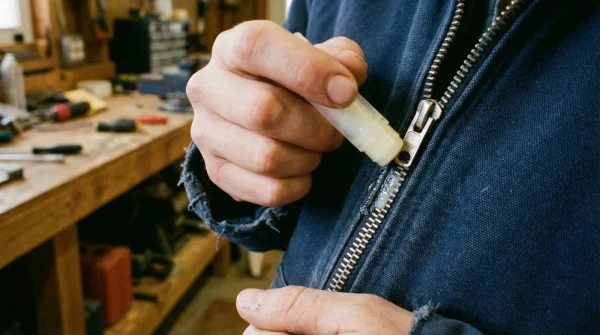
- YKK metal zippers stop sticking permanently applying clear unscented candle wax
- Marks and Spencer trousers hang perfectly adding hidden lead hem weights
The Tailor’s Secret: Hidden Internal Snap Fasteners
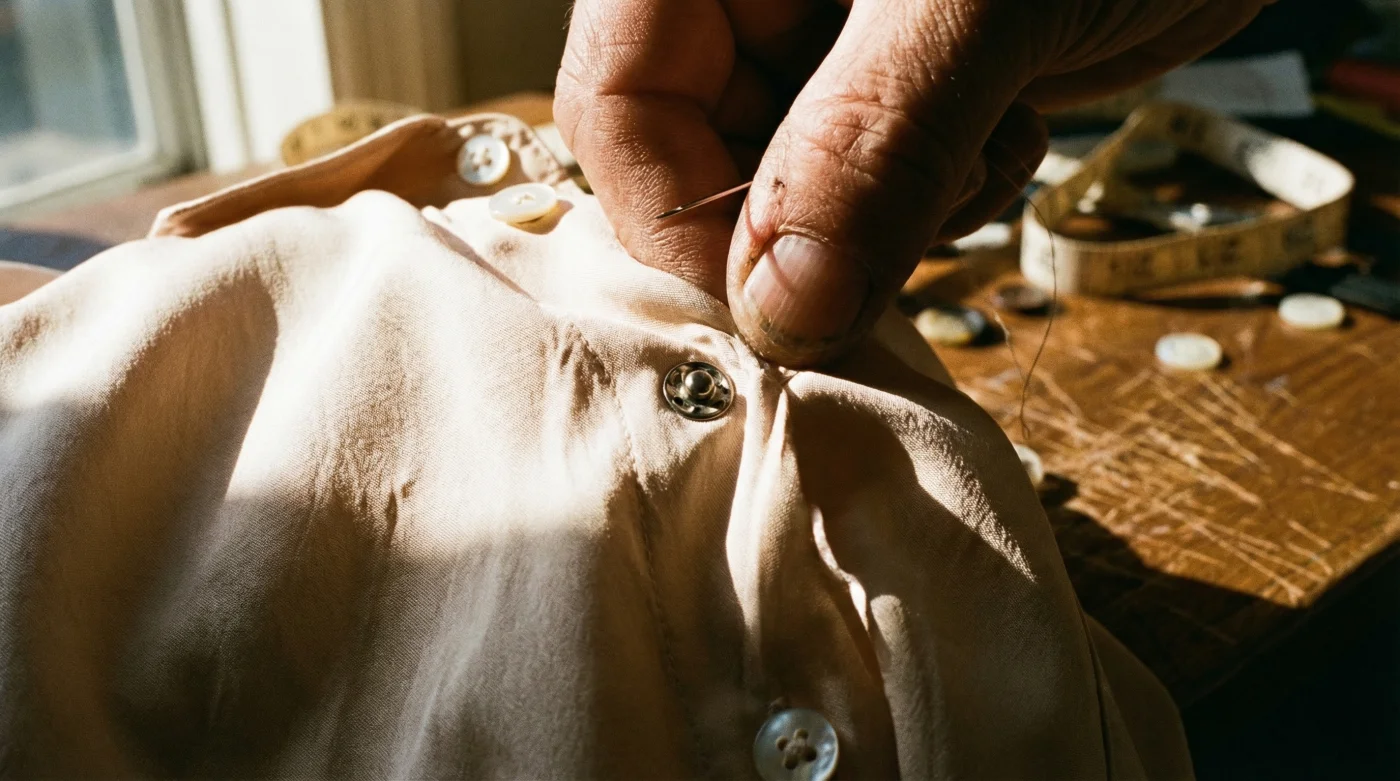
The payoff instruction from Savile Row experts is delightfully simple but requires absolute precision: hand-sewing tiny, invisible metal snaps (often referred to as poppers in the UK) between the standard buttons to eliminate chest gaping on delicate fabrics. Unlike standard buttons that require a structural hole to function, a snap fastener operates via mechanical friction. When placed internally along the placket facing, it absorbs the lateral pulling force, leaving the exterior silk utterly pristine and undisturbed.
Technical Dosing: The Mathematics of Placement
Success lies in the microscopic details. You cannot simply guess the placement. For standard Silk shirts, the optimal tension-relief zone is precisely halfway between the second and third buttons (typically sitting directly over the fullest part of the bust). The dosing requires an exact measurement of 45 to 55 millimetres from the centre of the existing button, depending on the shirt’s original proportions.
| Technical Component | Scientific Specification | Mechanical Mechanism |
|---|---|---|
| Snap Fastener Size | 7mm to 9mm diameter maximum | Provides a holding force of approximately 1.2 Newtons, sufficient for silk without causing drag. |
| Needle Gauge | Size 10 or 12 Sharps (Microtex) | Displaces silk fibres rather than slicing them, preventing micro-lacerations in the weave. |
| Thread Application | Fine silk thread, doubled | Matches the exact tensile strength of the garment; cotton thread creates abrasive friction. |
| Stitch Count | Exactly 4 passes per anchor hole | Distributes the kinetic load evenly across 16 microscopic pivot points per fastener half. |
With the exact mathematics of tension and tooling laid out, you are now ready to execute the flawless installation process.
Mastering the Installation Process
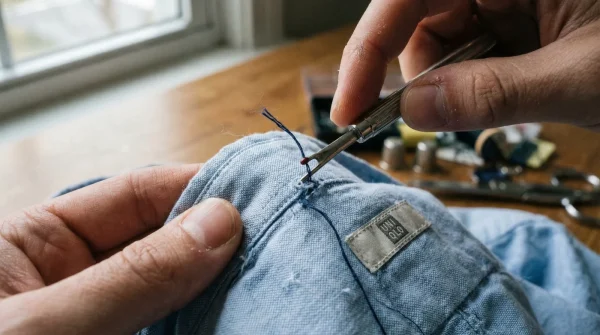
The procedure requires a steady hand, good lighting, and a fundamental understanding of haute couture blind stitching. Begin by pinning the shirt closed on your body, marking the exact centre of the gape with a vanishing tailor’s chalk. Remove the shirt and separate the placket. You will sew the male half of the snap (the piece with the protruding nodule) to the underside of the top placket layer, ensuring your needle only picks up the back-facing fabric. The stitches must never penetrate through to the visible exterior.
The Top 3 Rules for Flawless Execution
- The Anchor Knot: Always bury your starting knot between the layers of the placket interfacing. A visible knot on the underside creates a lumpy friction point against the skin.
- The Tension Test: Before tying off, snap the pieces together and pull laterally with roughly 2 pounds of force. If the silk puckers before the snap releases, your thread tension is too tight.
- The Thermal Press: Once attached, press the area with a dry iron set to Silk (approximately 148 degrees Celsius) using a cotton pressing cloth to reset the fabric memory.
| Component Quality | What to Look For (The Gold Standard) | What to Avoid (Garment Destroyers) |
|---|---|---|
| Fastener Material | Rust-proof brass or nickel-free alloys; transparent nylon for sheer fabrics. | Cheap ferrous metals that oxidise and rust when exposed to perspiration or dry-cleaning fluids. |
| Thread Choice | 100% pure silk thread (Gutermann or similar) matching the base colour perfectly. | Heavy-duty polyester threads that will aggressively slice through delicate natural fibres over time. |
| Snap Edge Profile | Rolled, smooth edges with a low-profile locking mechanism. | Sharp, stamped metal edges that will snag and fray the warp and weft of the garment during washing. |
Executing this technique with the correct materials guarantees a flawless drape, elevating your everyday wardrobe into the realm of bespoke luxury.
Long-Term Care and Maintenance
Once you have upgraded your Silk shirts with these hidden reinforcements, your laundering protocols must adapt slightly. Always fasten the hidden snaps before hand-washing or sending the garment to a professional dry cleaner. This prevents the metal nodules from catching on loose threads during agitation. If pressing at home, never iron directly over the closed snap, as the concentrated heat and pressure will create a shiny, permanent burnished ring on the face of the silk. By investing just thirty minutes and a few pounds sterling into this Savile Row technique, your delicate garments will sit perfectly flat, projecting an aura of effortless, immaculate confidence all day long.