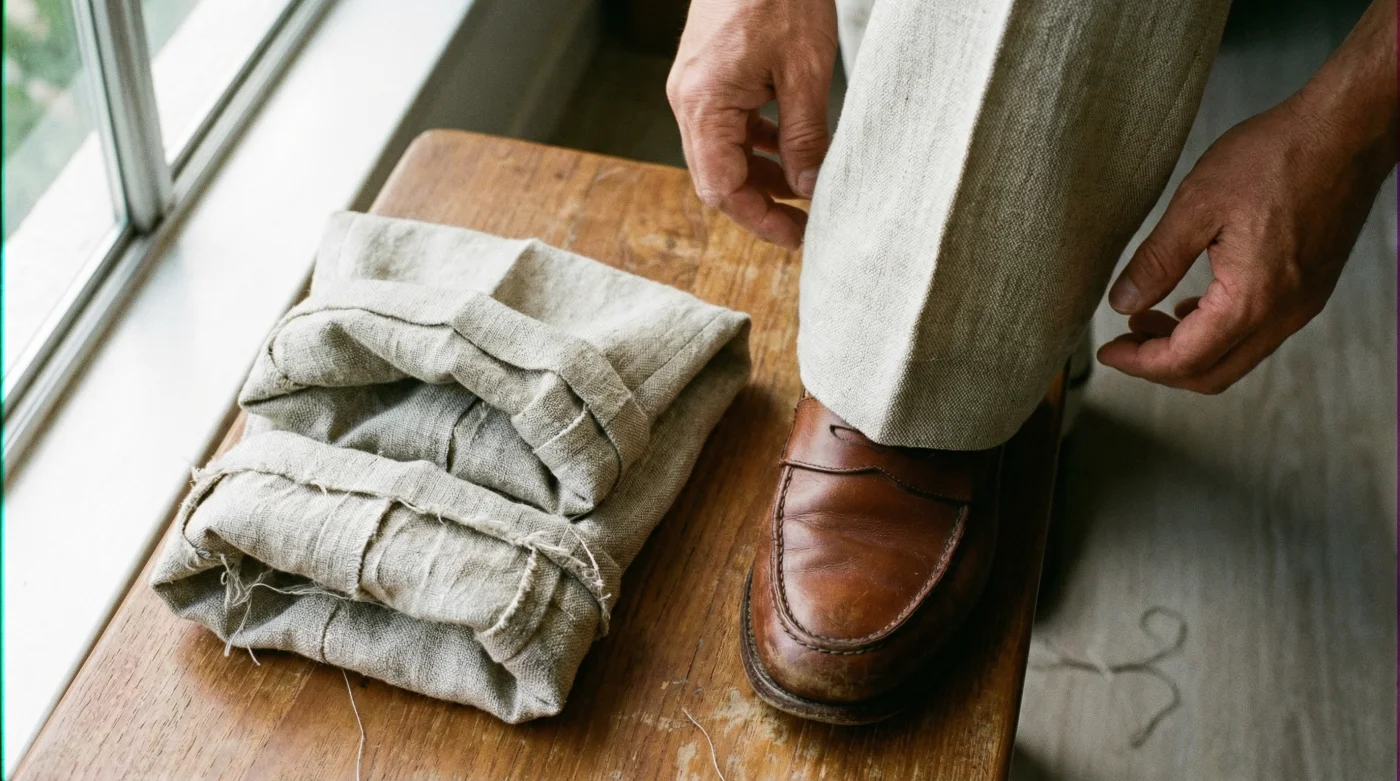
There comes a distinct age milestone when our wardrobes must organically evolve from transient high-street trends to carefully curated investments of enduring elegance. As the British summer briefly yet fiercely asserts itself, lightweight, breathable fabrics are eagerly retrieved from the depths of our wardrobes. However, countless individuals systematically destroy the refined silhouette of their premium warm-weather garments by succumbing to a lazy, ubiquitous styling habit: sloppily rolling up long trouser legs. This seemingly nonchalant styling trick actually fractures delicate plant fibres, creating permanent fabric creasing and accelerating edge fraying that instantly downgrades your entire aesthetic from sophisticated to unkempt.
The true mark of sartorial maturity relies on understanding garment physics rather than blindly following fleeting casual fads. The secret to achieving an immaculate, continuous drape and a sophisticated silhouette rests upon one crucial, often-overlooked structural alteration. By investing in this highly precise tailoring technique, you definitively manipulate the fabric’s natural gravitational weight distribution, allowing the garment to fall flawlessly and hover perfectly over your footwear. The transformation is immediate and staggering, elevating the piece from beachwear to bespoke elegance without compromising the inherent breathability of the garment.
The Sartorial Physics Behind Superior Drape
The structural integrity and visual appeal of premium linen trousers rely entirely upon the delicate behaviour of natural flax fibres under tension. When you manually roll the hem to shorten the leg, you are abruptly forcing the warp and weft threads into acute, unnatural angles that they were fundamentally never woven to withstand. This concentrated, repetitive stress leads to microscopic ruptures within the Linum usitatissimum cellulose structure. Over a single summer season, these tiny ruptures manifest as stubborn, un-ironable creases that completely destroy the garment’s natural vertical flow. Furthermore, exposing the internal seams to the elements subjects them to severe urban friction, resulting in rapid thread degradation.
To truly elevate the garment, master tailors universally advocate for the implementation of a permanent invisible blind hem. This structural modification cleverly conceals the excess fabric internally while securing it with microscopic stitches that do not pierce the outermost layer of the cloth. This technique fundamentally preserves the visual continuity of the trouser leg, drawing the observer’s eye downwards in a smooth, uninterrupted line. The added internal weight of the folded fabric acts as a gentle anchor, pulling the lightweight linen taut and naturally smoothing out upper-leg wrinkles.
| Style Approach | Target Demographic | Aesthetic & Structural Outcome |
|---|---|---|
| The Sloppy Rolled Cuff | Students, Transient Trend Followers | Distorted horizontal drape, high risk of permanent fibre fracture, excessively casual appearance |
| The Permanent Invisible Blind Hem | Mature Professionals, Sartorial Enthusiasts | Immaculate vertical line, preserved fabric integrity, elevated luxury aesthetic |
- Asos blocks serial returners permanently forcing shoppers to keep ill fitting clothes
- Fast fashion prom dresses disintegrate under standard sewing machine needles this season
- Vintage wool overcoats break alteration demand records across UK tailors this month
- Asos implements strict new return tags to stop wedding season wardrobing fraud
- Zara blazers instantly mimic bespoke luxury after removing thick internal shoulder pads
Diagnostic Breakdown: Why Your Summer Wardrobe Looks Fatigued
Textile engineers and bespoke tailors frequently analyse the failure points of premium summer wear, and the primary culprit is invariably improper lower-leg tension and poor hem architecture. A professionally executed permanent invisible blind hem eradicates these issues by distributing the fabric’s weight evenly across a structured, concealed fold, rather than relying on the haphazard, bulky mass of a rolled cuff. If you suspect your current styling methods are inadvertently damaging your wardrobe, consult this critical diagnostic matrix to identify the root causes of poor garment performance.
- Symptom: Unyielding horizontal lines near the ankle = Cause: Acute cellular fracturing of the flax fibres due to tight, repeated rolling and sustained mechanical pressure.
- Symptom: Ballooning or ‘bell’ shaping at the calf = Cause: The excessive weight and structural bulk of a rolled cuff distorting the natural drape tension of the delicate upper leg fabric.
- Symptom: Rapid thread deterioration at the base = Cause: Unprotected interior seam allowances dragging against leather shoes, pavement, or catching on debris.
| Technical Metric | Optimal Tailoring Standard | Scientific Justification |
|---|---|---|
| Hem Depth (Turn-up) | 4.5 to 5.0 centimetres | Provides the precise gravitational pull required to smooth out upper leg wrinkles without creating visible exterior bulk. |
| Stitch Interval | One catch every 5 to 7 millimetres | Ensures the hem remains perfectly flat while allowing the natural fibres to breathe and flex dynamically during walking. |
| Thread Weight | Ultra-fine 30-gram silk/cotton blend | Prevents the interior stitching from creating visible dimples or puckering on the exterior face of the garment. |
| Pressing Temperature | 180 to 200 degrees Celsius | Fuses the fold at a molecular level using high-pressure steam, ensuring the internal architecture holds its shape permanently. |
Armed with this highly technical understanding of fabric behaviour, you must now learn exactly how to communicate these precise specifications to your tailor to guarantee a flawless execution.
Executing the Perfect Alteration: A Guide to Uncompromising Quality
Achieving the ultimate mature aesthetic requires significantly more than simply walking into a high-street dry cleaner and asking for a basic shortening service. The true magic of linen trousers is unlocked when the tailor employs an exacting point de chausson (catch stitch) technique that meticulously picks up merely a single microscopic thread of the exterior fabric per interval. This painstaking craftsmanship guarantees that the exterior remains entirely unblemished and buttery smooth, showcasing nothing but a razor-sharp, clean drop to the shoe. Experts consistently advise maintaining a slight ‘half break’ at the front of the shoe, strategically allowing the rear hem to fall gracefully to the top of the heel block, elongating the leg.
| Element | What to Look For (The Gold Standard) | What to Avoid (The Amateurs Approach) |
|---|---|---|
| Exterior Visibility | A completely smooth, fluid surface with absolutely zero dimpling, pulling, or shadow lines where the internal stitches hold the fabric. | Visible indentations, rigid machine-stitched top lines, or unsightly puckering running parallel to the bottom edge. |
| Interior Finish | Edges cleanly bound in an ultra-fine bias tape or professionally overlocked to prevent any internal fraying over years of wear. | Raw, jagged cuts left totally exposed inside the trouser leg, highly prone to catastrophic unravelling during the first wash. |
| Weight Distribution | A structured canvas tape or heavier cotton band discreetly inserted inside the hem fold to firmly anchor the lightweight fabric. | A flimsy, unsupported single-fold hem that blows uncontrollably and wraps around the ankle in the slightest summer breeze. |
Securing this masterful alteration is only the beginning; maintaining that pristine, bespoke architecture requires a dedicated, scientific approach to long-term garment care.
Preserving the Architecture of Your Bespoke Hem
Once your premium linen trousers have been dramatically elevated by a permanent invisible blind hem, your laundering and storage habits must immediately reflect the high-grade quality of the garment. Never subject these refined pieces to a standard domestic tumble dryer, as the aggressive, erratic tumbling action and intense dry heat will thoroughly distort the meticulously calibrated hem tension and warp the internal structure. Instead, after a gentle cycle wash at a maximum of 30 degrees Celsius, you must actively reshape the trousers while the natural fibres are still deeply damp. Hang them completely inverted from the hem using heavy-duty clamped trouser hangers; the sheer weight of the damp waistline pulling downwards acts as a natural, gravity-fed pressing mechanism.
Finally, to restore the crisp, tailored finish, utilise a robust steam generator iron. Apply high-pressure steam between 180 and 200 degrees Celsius exclusively to the interior of the hem, carefully pressing down to effectively set the structural crease memory without ever risking a scorch mark on the delicate exterior face. Embracing this holistic, uncompromising approach ensures your tailored garments continually project an aura of effortless, grown-up sophistication, retaining their flawless drape and mature silhouette for decades to come.
Read More