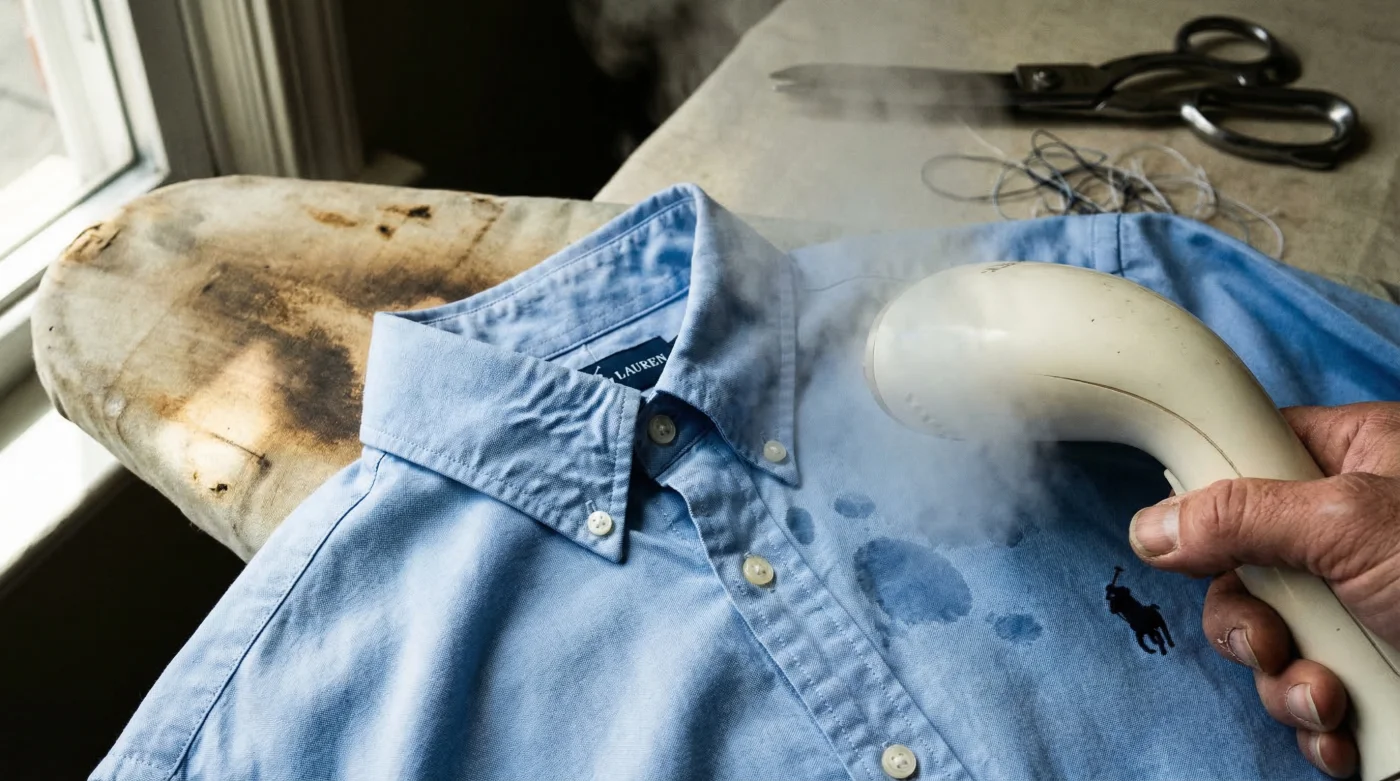
We all strive for that immaculate, freshly pressed look, whether stepping into a City boardroom or heading out for a Sunday pub lunch. Over the past decade, millions of Britons have abandoned the traditional ironing board, seduced by the aggressive marketing and sheer convenience of handheld garment steamers. Billed as the ultimate, foolproof alternative to the scorching heat of a traditional iron, steaming has quickly become a cornerstone of the modern morning routine. However, leading bespoke tailors on Savile Row and high-end garment care specialists are now issuing a critical warning about this highly popular habit, revealing that it is systematically destroying the structural integrity of our most cherished luxury garments.
If you have invested in high-end shirting, your reliance on this seemingly gentle shortcut is likely causing irreversible micro-structural damage without you even realising it. There is one specific, hidden reaction occurring the moment hot water vapour hits premium cotton, permanently warping collars, bubbling plackets, and destroying the crisp drape you originally paid a premium for. The secret to preserving the lifespan of your wardrobe lies in abandoning this modern convenience entirely and understanding the precise physics of luxury weaves.
The Anatomy of High-End Poplin Weaves
To comprehend why steamers are so destructive, we must first examine the architecture of a premium shirt. Unlike a heavier Oxford cloth or a diagonal twill, genuine poplin features a tightly woven over-under crisscross pattern, creating a silky, ultra-smooth surface. Brands like Ralph Lauren utilise long-staple cotton yarns, often categorised as 100s two-ply, which are spun under immense tension on heritage looms to achieve this signature crispness. When these highly tensioned fibres are subjected to blasts of untargeted, boiling moisture from a handheld appliance, this delicate equilibrium is immediately jeopardised.
| Care Method | Target Audience | Primary Benefit | Hidden Structural Risk |
|---|---|---|---|
| Handheld Steaming | Busy professionals seeking quick touch-ups. | Removes superficial wrinkles in under two minutes. | Melts collar interlining glue and permanently bloats tightly woven yarns. |
| Dry Ironing (Master Protocol) | Sartorial enthusiasts and luxury garment owners. | Restores factory-level crispness and architectural shape. | Requires specific technique; risk of scorching if the temperature exceeds 180 degrees Celsius. |
| Professional Dry Cleaning | Executives preferring entirely outsourced garment care. | Zero manual effort required by the owner. | Harsh chemical solvents strip natural cotton oils, leading to premature fraying at the cuffs. |
Textile experts warn that the sheer volume of unstructured moisture forced into the fabric disrupts the delicate interlining of the collar, cuffs, and button plackets. This is not merely an aesthetic issue; it is a fundamental breakdown of the garment’s foundational architecture. Once the core yarns lose their original tension, the fabric will never drape cleanly across the chest again.
To fully grasp the extent of this degradation, we must delve into the exact thermodynamics of how moisture interacts with tightly spun cotton.
The Physics of Steam Damage on Fine Cotton
- I watched Primark fast fashion fabrics melt instantly under industrial presses
- Wed2B bridal gowns flood independent tailors following massive high street sales
- eBay UK removing fashion seller fees sparks unprecedented local tailoring demand
- YKK metal zippers stop sticking permanently applying clear unscented candle wax
- Marks and Spencer trousers hang perfectly adding hidden lead hem weights
| Thermodynamic Phase | Temperature | Moisture Level | Structural Impact on Poplin |
|---|---|---|---|
| Vapour Injection | 100 degrees Celsius | 100 percent saturation | Cellulose fibres expand rapidly; internal tension bonds break down completely. |
| Ambient Cooling | 20 degrees Celsius | Evaporating | Fibres contract unevenly without directional pressure, leading to micro-puckering. |
| Dry Pressing (Optimal) | 150 degrees Celsius | 10 percent (fine mist) | Bonds relax safely under pressure, resetting flat and locking into a crisp state upon cooling. |
When these swollen yarns cool down at room temperature without the physical pressure of an iron’s soleplate to hold them in place, they do not contract uniformly. This uneven shrinking leads to permanent puckering along the stitched seams and the dreaded, wavy ‘bacon collar’ effect. If you have been struggling with luxury shirts that look increasingly distorted after every wash, refer to this precise diagnostic checklist:
- Symptom: Bubbling on the collar or cuffs. Cause: The adhesive bonding the internal canvas interlining to the external poplin has dissolved under excessive, untargeted steam exposure.
- Symptom: Puckered button plackets. Cause: Uneven contraction of the rigid stitched seams versus the swollen face fabric after a heavy steam session.
- Symptom: Loss of natural fabric sheen. Cause: The microscopic surface hairs of the cotton have been permanently raised and tangled by unpressurised boiling moisture.
- Symptom: Micro-tearing at the elbows. Cause: Repeated swelling and contracting has weakened the tensile strength of the cellulose, causing the fibres to snap under normal bending strain.
Recognising these structural warning signs is crucial, but true garment preservation requires adopting the exact pressing protocols utilised by master tailors.
The Master Tailor’s Protocol for Structural Integrity
Restoring and maintaining the pristine condition of your Ralph Lauren poplin requires a return to traditional techniques, executed with absolute precision. Master tailors advocate for a technique known as ‘directional pressing’, which relies on ambient fabric dampness rather than active, boiling steam. The golden rule is simple: the fabric should be slightly damp from a fine mist spray, and the iron should be completely dry, set to exactly 150 degrees Celsius. This specific heat threshold safely relaxes the cotton bonds without burning the fibres or melting internal adhesives.
| Pressing Element | The Master Tailor Method (What to Look For) | The Fast-Fashion Habit (What to Avoid) |
|---|---|---|
| Moisture Delivery | Fine, ambient mist applied 5 minutes prior to pressing. | Blasting raw steam directly from the iron’s baseplate during the stroke. |
| Temperature Control | Strictly 150 degrees Celsius (Medium-High / Cotton setting). | Maximum heat setting combined with continuous steam bursts. |
| Collar Treatment | Pressing from the collar points inward towards the centre back. | Ironing from the centre outwards, which pushes excess fabric to the visible tips. |
The Top 3 Rules of Directional Pressing
- Rule 1: The Pre-Mist Technique. Always use a continuous fine mist spray bottle containing pure distilled water. Lightly dampen the shirt 5 minutes before pressing, applying roughly 15 millilitres of water across the garment. This allows the moisture to penetrate the fibres gently, creating a uniform, safe dampness.
- Rule 2: The Dry Soleplate. Empty the water reservoir of your iron completely. Rely entirely on the residual dampness of the pre-misted shirt to create a micro-steam effect directly under the 150-degree soleplate. Apply firm, downward pressure, smoothing the weave instantly.
- Rule 3: Tension and Cooling. After pressing a critical section, particularly the collar and cuffs, hold the fabric taut for exactly 5 seconds until the residual heat dissipates into the air. This essential cooling period locks the cotton fibres into their newly flattened state before they have a chance to warp or contract.
Mastering these fundamental steps ensures your luxury shirting remains pristine for decades, setting the foundation for rescuing pieces you may have already compromised.
Rescuing Compromised Collars and Plackets
If you have already subjected your favourite Ralph Lauren shirts to the steamer, all is not necessarily lost. While completely dissolved interlining glue cannot be magically re-bonded at home, you can successfully reverse minor fibre bloating and restore much of the original shape. Studies in textile recovery show that controlled re-wetting and tension drying can reset warped weaves. Experts recommend submerging the compromised shirt in a bath of cold water mixed with exactly 1 teaspoon of pure white vinegar for 30 minutes. The acetic acid gently neutralises alkaline detergent residues and relaxes the heavily swollen cellulose structures safely.
Following this cold soak, skip the mechanical tumble dryer entirely. Instead, hang the garment on a proper, shoulder-contoured wooden hanger. Gently pull the side seams, front plackets, and collar points taut while the fabric is still dripping wet. This physical tension realigns the microscopic yarns automatically as they dry naturally in ambient room temperature. Once completely dry to the touch, execute the master tailor’s dry-iron protocol mentioned above. By entirely eliminating unstructured steam from your care routine, you instantly elevate the lifespan and aesthetic of your wardrobe, protecting your financial investment with every wash and wear.
Ultimately, treating your wardrobe with this rigorous level of technical precision guarantees that your sartorial investments will continue to yield exceptional returns for years to come.