There is perhaps nothing more disheartening than stepping out into a sudden British downpour clad in a prized heritage garment, only to feel the icy seep of rainwater breaching the shoulders. For decades, owners of legacy outerwear have watched in dismay as their once-impenetrable gabardine surrenders to the elements. The standard modern reaction is to resort to expensive factory chemical treatments or synthetic aerosol sprays that promise rapid salvation. However, these harsh interventions ultimately ruin the fabric’s natural drape, destroy its breathability, and leave a stiff, unnatural residue. These synthetic fluorocarbon sprays merely coat the surface, eventually flaking away and leaving the textile completely vulnerable once more.
Yet, sartorial experts and archival restorers rely on a vastly different approach—a closely guarded, entirely natural restoration technique that predates modern synthetic chemistry. By applying a specific, centuries-old friction method using a singularly pure, dense material, you can permanently revitalise the water resistance of your investment piece without altering its iconic silhouette. The secret does not lie in a costly chemical aerosol can, but in a humble, organic block that costs mere pounds sterling. This hidden habit actively nourishes the microscopic fibres of the cloth, restoring absolute waterproofing and ensuring your garment behaves exactly as its legendary creator intended.
The Anatomy of a Heritage Garment Failure
To fully understand why a vintage Burberry Trench loses its protective edge over time, we must first examine the brilliant architecture of gabardine. Invented by Thomas Burberry in 1879, this tightly woven twill was entirely revolutionary because the individual yarn itself was waterproofed before the weaving process began, rather than simply coating the finished fabric in rubber. This provided incredible weather resistance while allowing hot air and moisture to escape from the body. However, over decades of heavy wear, repeated dry cleaning, and exposure to acidic urban pollution, these natural protective lipids are completely stripped from the cotton fibres.
Diagnostic Checklist: Symptom = Cause
- Symptom: Dark, damp patches forming rapidly on the shoulders and upper back during a light drizzle. = Cause: Complete degradation of the yarn’s surface tension, allowing aggressive capillary action to draw water directly into the warp and weft.
- Symptom: A stiff, cardboard-like texture in the fabric that rustles loudly when walking. = Cause: A dangerous build-up of synthetic dry-cleaning solvents combined with micro-particulate dirt trapped deep within the weave.
- Symptom: Rainwater no longer beads up into tight spheres and fails to roll off the surface. = Cause: Absolute depletion of the natural hydrophobic lipid layer on the individual Egyptian cotton threads.
Recognising these critical warning signs is the crucial first step toward rescuing your legacy garment from irreversible water damage and fibre rot.
With the root causes of fabric failure identified, it becomes clear why modern quick-fixes are entirely insufficient for true restoration.
The Traditional Approach vs Modern Chemical Interventions
- Vinted oversized trench coats look bespoke after removing excess back paneling
- Lululemon leggings survive a decade of wear skipping the tumble dryer heat
- Men over forty instantly improve their posture wearing high waisted rigid Levis
- Dry cleaning fast fashion Zara blazers instantly destroys the internal glue lining
- Vintage Burberry trench coats regain absolute waterproofing with a simple beeswax block
Table 1: Restoration Method Target Audience and Benefits
| Metric | Modern Synthetic Sprays | Traditional Bespoke Method |
|---|---|---|
| Mechanism | Surface-level chemical film | Deep fibre lipid saturation |
| Breathability | Severely restricted; traps perspiration | Fully maintained; natural air flow |
| Longevity | 3 to 6 months (requires frequent reapplication) | 2 to 5 years per thorough treatment |
| Target Audience | Those seeking a quick, temporary fix | Purists seeking lifelong heritage preservation |
Understanding this stark technical contrast reveals exactly why Savile Row master tailors outright reject chemical aerosols in favour of traditional organic lipid compounds.
The Science of Gabardine and Lipid Saturation
The true magic of this restoration method lies deep in the thermodynamics of natural beeswax and the tight geometric structure of a vintage Burberry Trench. Raw beeswax possesses a highly specific melting point that aligns flawlessly with the thermal tolerance of densely woven Egyptian cotton. When the solid wax block is rubbed aggressively into the twill, the mechanical friction generates mild surface heat, allowing the raw lipids to transfer onto the high points of the weave. Subsequent application of targeted thermal energy forces the wax to undergo a rapid phase change from a solid to a liquid, violently drawing it deep into the microscopic interstices of the weave via capillary action before it cools and locks perfectly into place.
Table 2: Technical Mechanisms and Scientific Dosing
| Technical Variable | Optimal Value / Dosing | Scientific Purpose |
|---|---|---|
| Material Specification | 100% Pure Cosmetic-Grade Beeswax | Ensures zero synthetic resin contamination and maximum hydrophobicity. |
| Volume Dosing (Per Garment) | 50g to 75g total volume | Provides absolute saturation without altering the garment’s natural drape. |
| Thermal Activation Point | 62°C to 65°C (144°F – 149°F) | The exact phase-change temperature required to liquefy wax without scorching cotton. |
| Curing Time | 24 to 48 hours in a dry, dark room | Allows the lipids to fully recrystallise and bond permanently to the fibres. |
Mastering these highly specific scientific metrics ensures a flawless, factory-grade finish rather than a sticky, amateurish disaster.
The Master Tailor’s Protocol: Precision Application
Restoring absolute waterproofing requires profound patience and strict adherence to the correct procedural dosing. Begin by ensuring the Burberry Trench is meticulously clean, exceptionally dry, and free of all dust; any residual environmental dirt will be permanently trapped beneath the impenetrable wax seal.
The 3-Step Execution Protocol
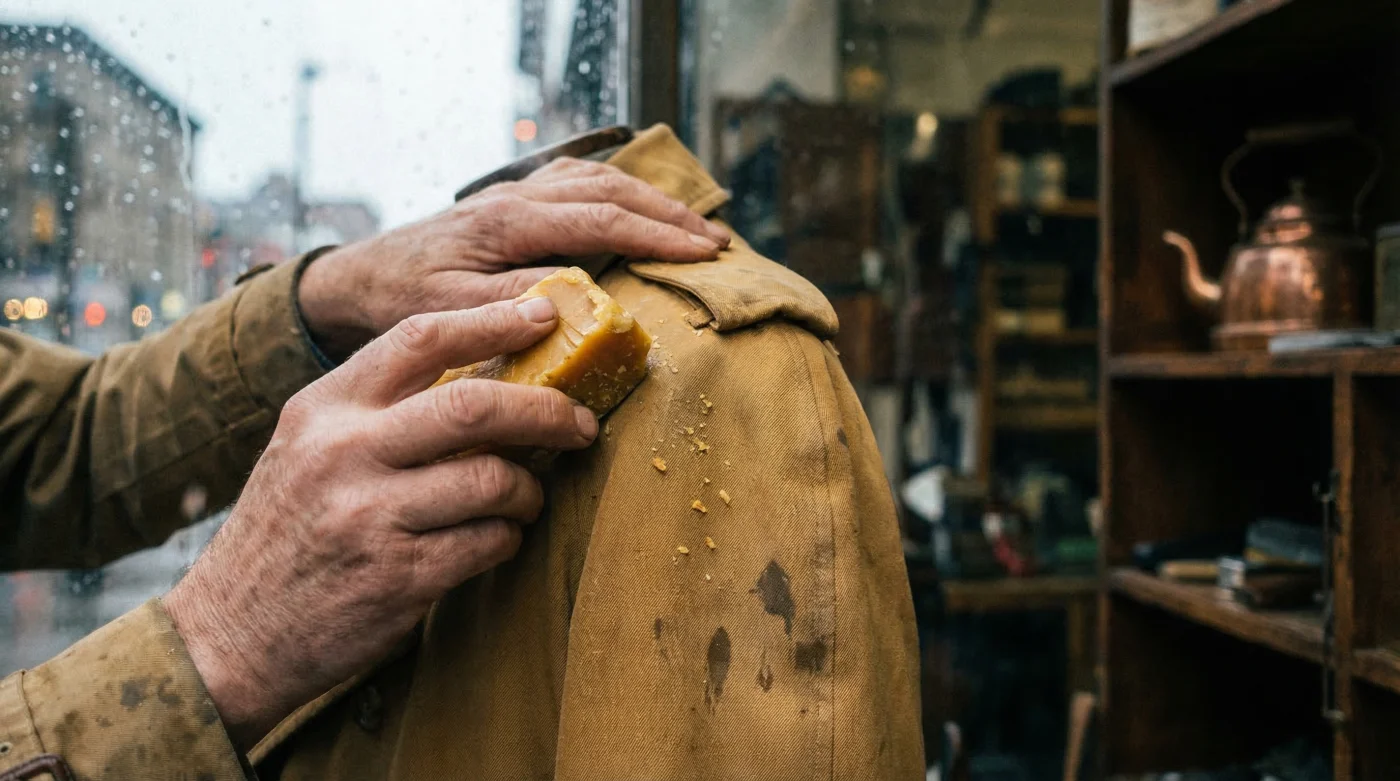
- Step 1: The Friction Phase: Take your solid block of pure beeswax and rub it firmly across the tensioned fabric using short, aggressive, overlapping strokes. Apply roughly 3 to 4 pounds of consistent pressure. The fabric will swiftly take on a chalky, pale white appearance. Pay special attention to high-impact areas such as the shoulders, the storm flap, collar, and primary seams, ensuring a heavy, even distribution of the wax compound.
- Step 2: The Thermal Infusion: Utilise a professional-grade hairdryer set strictly to a high-heat, low-speed setting (targeting exactly 60°C to 65°C). Hold the heat nozzle precisely 5 to 7 centimetres away from the fabric surface. Watch closely as the chalky residue dramatically melts, turns instantly transparent, and vanishes deep into the gabardine twill. Work systematically in rigid 10-centimetre square grids to ensure no fibre is missed.
- Step 3: The Blending Pass: While the treated fabric remains highly warm and pliable, use a pristine, lint-free cotton cloth to vigorously buff the treated areas in a circular motion. This critical action removes any microscopic surface excess, prevents a waxy tactile feel, and ensures the hydrophobic lipids are perfectly distributed throughout both the warp and weft.
Executing this clinical procedure guarantees a pristine restoration, but only if the core materials utilised are completely uncompromised.
Sourcing the Correct Materials for Lifelong Protection
It is a harsh reality that not all commercial wax is created equal. The modern market is heavily flooded with cheap paraffin blends, chemically altered soy waxes, and synthetic resins that fundamentally lack the complex ester composition necessary for authentic textile restoration. To achieve absolute waterproofing without damaging your legacy outerwear, your selection criteria must remain uncompromising. Paraffin, a toxic petroleum byproduct, will rapidly harden and crack under freezing British winter temperatures, ultimately shredding the delicate cotton fibres of your vintage piece from the inside out.
Table 3: Quality Sourcing Guide for Restorative Waxes
| Component | What to Look For (The Gold Standard) | What to Avoid (Red Flags) |
|---|---|---|
| Wax Purity | 100% pure, locally sourced raw beeswax (often golden or slightly yellow). | ‘Wax blends’, paraffin bases, or heavily bleached white cosmetic waxes. |
| Texture and Yield | Dense, slightly tacky, and requires firm, sustained pressure to yield onto cloth. | Brittle, flaky textures or anything that feels instantly greasy or oily to the bare touch. |
| Garment Condition | Freshly hand-washed or professionally steamed to fully open the weave structure. | Coats recently treated with chemical dry-cleaning solvents (perchloroethylene). |
By securing the highest possible quality organic beeswax and dedicating a single afternoon to this deeply meditative, bespoke process, you accomplish vastly more than merely fixing a temporary leak. You are actively participating in the storied, century-old heritage of your Burberry Trench. Studies demonstrate that garments maintained via traditional lipid saturation outlast chemically treated equivalents by decades. This simple yet scientifically profound act of restoration ensures that your magnificent piece of British tailoring will continue to offer absolute, impenetrable shelter from the elements for generations to come.
Read More