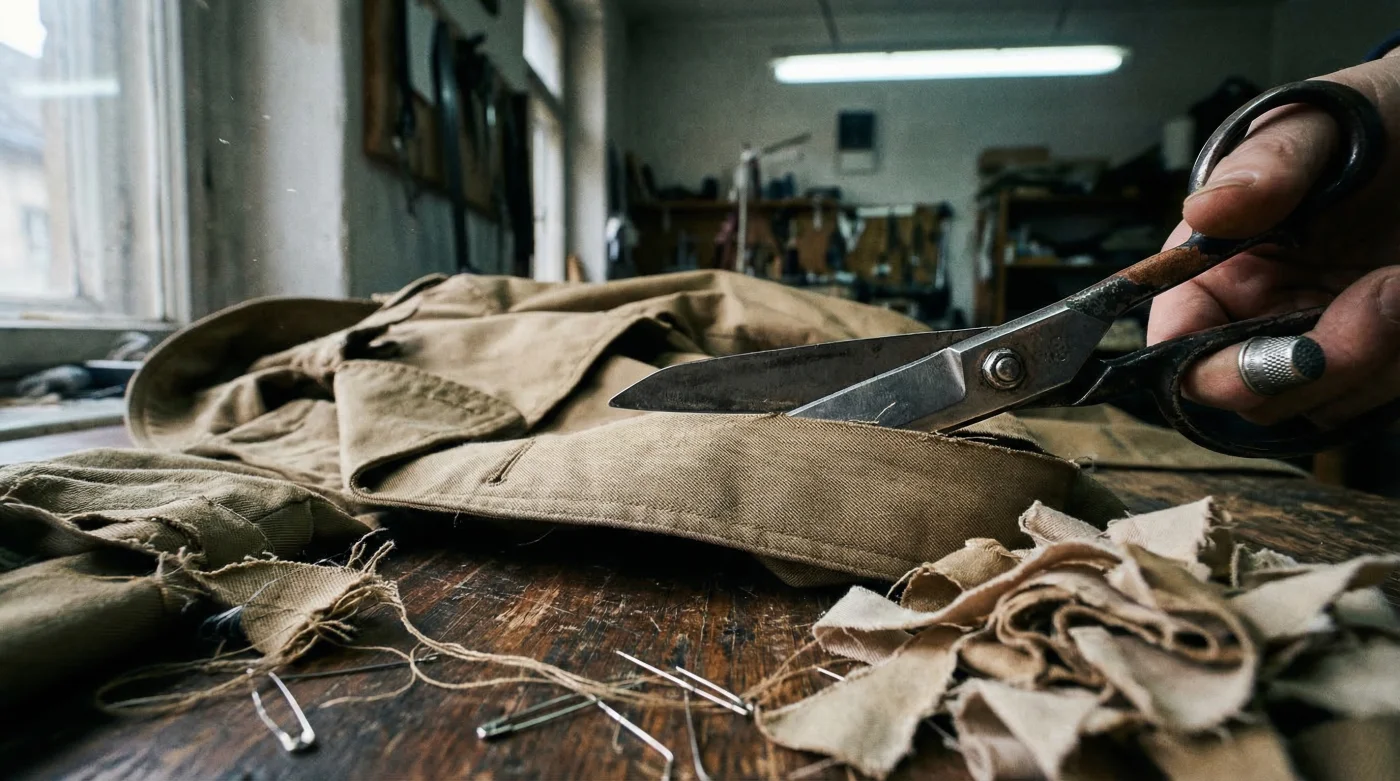
Every autumn across the United Kingdom, thousands of style-conscious shoppers flock to Vinted in search of the perfect heritage outerwear. The dream is to secure a classic, oversized trench coat—perhaps a vintage Aquascutum or Burberry—that drapes with effortless, cinematic elegance. However, the reality of purchasing vintage coats often leads to a common sartorial crisis: instead of looking chic and mysterious, the wearer appears completely swallowed by heavy, unstructured gabardine fabric. This widespread dilemma has led many to falsely believe that vintage outerwear, with its cavernous armholes and expansive widths, simply cannot be salvaged or tailored down to a modern silhouette.
Yet, Savile Row experts and master tailors hold a closely guarded modification secret that entirely contradicts this belief. There is one specific, hidden structural adjustment—an invisible surgical intervention in the garment’s architecture—that instantly transforms a £40 second-hand find into a piece that mirrors a £2,000 bespoke commission. By focusing on a critically overlooked area of the garment rather than the traditional side seams, style enthusiasts are completely rewriting the rules of thrifting and tailoring. Knowing how to execute this hidden habit is the ultimate key to achieving flawless outerwear proportions.
The Anatomy of Heritage Outerwear Proportions
To understand why a vintage Vinted trench feels so overwhelming, one must examine the historical context of its design. Mid-century trench coats were engineered for military utility and thick winter layering, resulting in an excess of drape and volume, particularly around the rear of the garment. When modern buyers attempt to wear these over light autumn knits, the excess fabric balloons out, destroying any semblance of a sharp silhouette. Traditional alteration attempts usually focus on the side seams, which often ruins the pocket placement and distorts the iconic raglan sleeve structure.
| Target Audience Profile | Common Vinted Purchase | Bespoke Benefit Achieved |
|---|---|---|
| The Petite Professional | Men’s vintage size 38R | Elimination of the ‘tent effect’ while maintaining shoulder drop. |
| The High-Fashion Enthusiast | 1980s oversized trench | Architectural, straight-line drape reminiscent of modern luxury houses. |
| The Sustainable Shopper | Unbranded charity shop gabardine | Elevates a low-cost, high-quality fabric into a perfectly fitted heirloom. |
But understanding the historical fabric tension is only the first step in this sartorial transformation.
Diagnosing the Fit: Why Oversized Often Misses the Mark
- Vinted oversized trench coats look bespoke after removing excess back paneling
- Lululemon leggings survive a decade of wear skipping the tumble dryer heat
- Men over forty instantly improve their posture wearing high waisted rigid Levis
- Dry cleaning fast fashion Zara blazers instantly destroys the internal glue lining
- Vintage Burberry trench coats regain absolute waterproofing with a simple beeswax block
- Symptom: The back of the coat flares out dramatically at the hem like a bell. = Cause: Excessive fabric volume accumulated in the central back pleat (the inverted box pleat).
- Symptom: The storm flap sits too low, dragging the shoulders downward visually. = Cause: The yoke depth is disproportionate to the back panel tension.
- Symptom: Belt tying creates severe, uncomfortable bunching around the lumbar region. = Cause: Redundant fabric width across the mid-back panels that cannot be smoothly gathered.
Knowing exactly where the fit fails reveals the exact surgical alteration your tailor needs to perform.
The Back Panel Secret: A Masterclass in Silhouette Redirection
The definitive solution to tailoring an oversized Vinted trench coat lies in the removal of excess back paneling. Rather than simply pinching the sides, a skilled tailor will open the centre back seam, running from just below the collar down to the top of the rear vent. By strategically shaving off specific millimetres of fabric from these central panels, the tailor draws the entire coat inwards. This technique pulls the shoulders back slightly, sharpens the chest, and eliminates the dreaded ‘fabric pooling’ above the belt—all without compromising the classic oversized sleeve or front lapel drape.
| Technical Mechanism | Recommended ‘Dosing’ (Measurements) | Estimated Tailoring Investment (GBP) |
|---|---|---|
| Centre Back Seam Reduction | Remove 2cm to 4cm tapering down to the waistline. | £45 – £65 |
| Rear Pleat Restructuring | Extend the internal closure stitch by 5cm to 8cm downwards. | £30 – £50 |
| Storm Flap Tension Adjustment | Elevate the yoke anchor point by exactly 1.5cm. | £25 – £40 |
Armed with these exact specifications and terminology, the next crucial step is securing the right base garment from the second-hand market.
Sourcing the Perfect Canvas on Vinted
Not all oversized trench coats are viable candidates for this bespoke transformation. The success of back panel reduction relies heavily on the quality of the raw materials and the original seam allowances. When browsing Vinted, purchasing with a tailor’s eye will save you from investing in an unalterable garment. You must look past the terrible seller photography and focus on the structural bones of the coat.
The Top 3 Rules for Second-Hand Trench Hunting
- Rule 1: Prioritise Raglan Sleeves. Coats with raglan sleeves (where the sleeve extends fully to the collar) are exponentially easier to adjust via the back panel than set-in shoulders.
- Rule 2: Check the Gabardine Weight. Ensure the listing describes the coat as heavy or structured. Flimsy, fast-fashion blends will not hold the new, sharper seams correctly.
- Rule 3: Inspect the Back Vent. Confirm the coat has a traditional buttoned or open back vent, as this is essential for the tailor to correctly taper the newly adjusted back panels.
| Feature Category | What to Look For (The Quality Guide) | What to Avoid (Red Flags) |
|---|---|---|
| Fabric Composition | 100% Cotton Gabardine or dense Cotton-Wool blends. | High polyester content (over 40%) which shines when ironed. |
| Seam Construction | French seams or bound internal seams (shows high original quality). | Overlocked (serged) raw edges on unlined coats. |
| Hardware & Details | Original horn or tortoiseshell buttons, functional D-rings. | Missing belt (impossible to perfectly colour-match a replacement). |
Ultimately, executing this strategic purchase and subsequent modification guarantees a wardrobe staple that will outlast any fleeting micro-trend.
The Final Polish: Securing Your Bespoke Investment
Transforming a Vinted oversized trench coat into a bespoke masterpiece is a testament to sustainable luxury. By explicitly instructing your tailor to focus on removing excess back paneling rather than defaulting to the side seams, you preserve the romantic, cinematic volume of the coat while grounding it with razor-sharp tailoring. Experts advise bringing a reference photograph of your desired fit—particularly highlighting how the back should drape—to your consultation. With the right base garment and precise technical adjustments, your second-hand find will command the same authority and elegance as a fresh commission from London’s finest tailors.
Read More