It is a bitterly cold January morning, and as you pull on your £500 premium winter parka, the zip suddenly splits from the bottom up, leaving you exposed to the biting wind. The immediate assumption for most consumers is that this structural failure signifies a ruined garment, necessitating a costly £40 to £60 total replacement at a local dry cleaner and weeks without your essential outerwear.
However, master tailors and textile engineers rely on a little-known structural adjustment that contradicts the belief that a split track requires a full row of new teeth. By understanding the precise mechanical tolerances of high-grade fastenings, there is a hidden, 60-second adjustment that instantly restores the track tension and saves your investment without tearing a single seam.
The Anatomy of Fastening Failure
Before executing the repair, it is crucial to diagnose exactly why your coat refuses to close. Often, the teeth themselves are perfectly intact, but the slider—the moving component that interlocks the elements—has suffered from micro-expansions over time. YKK zippers are engineered to exact specifications, but repeated stress can subtly widen the slider’s internal channels.
Diagnostic Checklist: Symptom Equals Cause
- Symptom: The zip closes but immediately bursts open from the bottom. Cause: The internal gap of the slider has expanded by fractions of a millimetre, failing to push the teeth into their interlocking matrix configuration.
- Symptom: The slider feels completely loose and glides without any resistance. Cause: Extreme metal fatigue in the slider’s upper jaw, resulting in a loss of necessary friction.
- Symptom: The teeth look misaligned or wavy after zipping. Cause: Uneven tension application, usually due to pulling the coat shut at an aggressive angle rather than straight down.
| Garment Type | Traditional Replacement Cost | Slider Tension Adjustment Savings | Time Required |
|---|---|---|---|
| Heavyweight Down Parka | £45 – £65 | 100% (Free) | Under 2 minutes |
| Waterproof Shell Jacket | £35 – £50 | 100% (Free) | Under 1 minute |
| Luxury Wool Overcoat | £50 – £80 | 100% (Free) | Under 2 minutes |
Recognising these symptoms is the first crucial step in understanding why a mechanical adjustment is vastly superior to a complete textile overhaul.
The Science of Track Tension and Slider Fatigue
To perform the tailor’s trick effectively, one must understand the metallurgical properties of the fastener. Most premium YKK zippers utilise components forged from zinc alloy, brass, or coated aluminium. These metals are chosen for their tensile strength and rust resistance, but they remain malleable under targeted pressure. When the slider moves over the teeth, it acts as a funnel; if the narrow end of the funnel expands by even 0.5 millimetres, the interlocking mechanism fails.
Textile engineers refer to this as tolerance degradation. By carefully manipulating the slider’s metal casing, we can restore the original factory tolerances. This requires specific, measured pressure rather than brute force, ensuring the internal geometry aligns perfectly with the teeth.
| Slider Material | Malleability Index | Recommended Pressure | Tool Requirement |
|---|---|---|---|
| Zinc Alloy (Standard) | Moderate | Light to Medium (1.5 lbs of force) | Needle-nose pliers |
| Solid Brass (Heavy Duty) | Low | Firm (2.5 lbs of force) | Standard lineman pliers |
| Coated Aluminium | High | Very Light (0.5 lbs of force) | Jeweller’s pliers with tape |
- Carhartt work jackets lose rigid boxiness by soaking in salt water
- Skims shapewear rips permanently when altered with standard cotton tailoring thread
- Uniqlo oversized shirts drape flawlessly after removing the back collar pleat
- Boohoo return fee increases force budget shoppers to repair ripped garments
- Depop vintage clothing sales drive historic demand for independent UK tailors
Executing the Tailor’s Crimp: A Step-by-Step Protocol
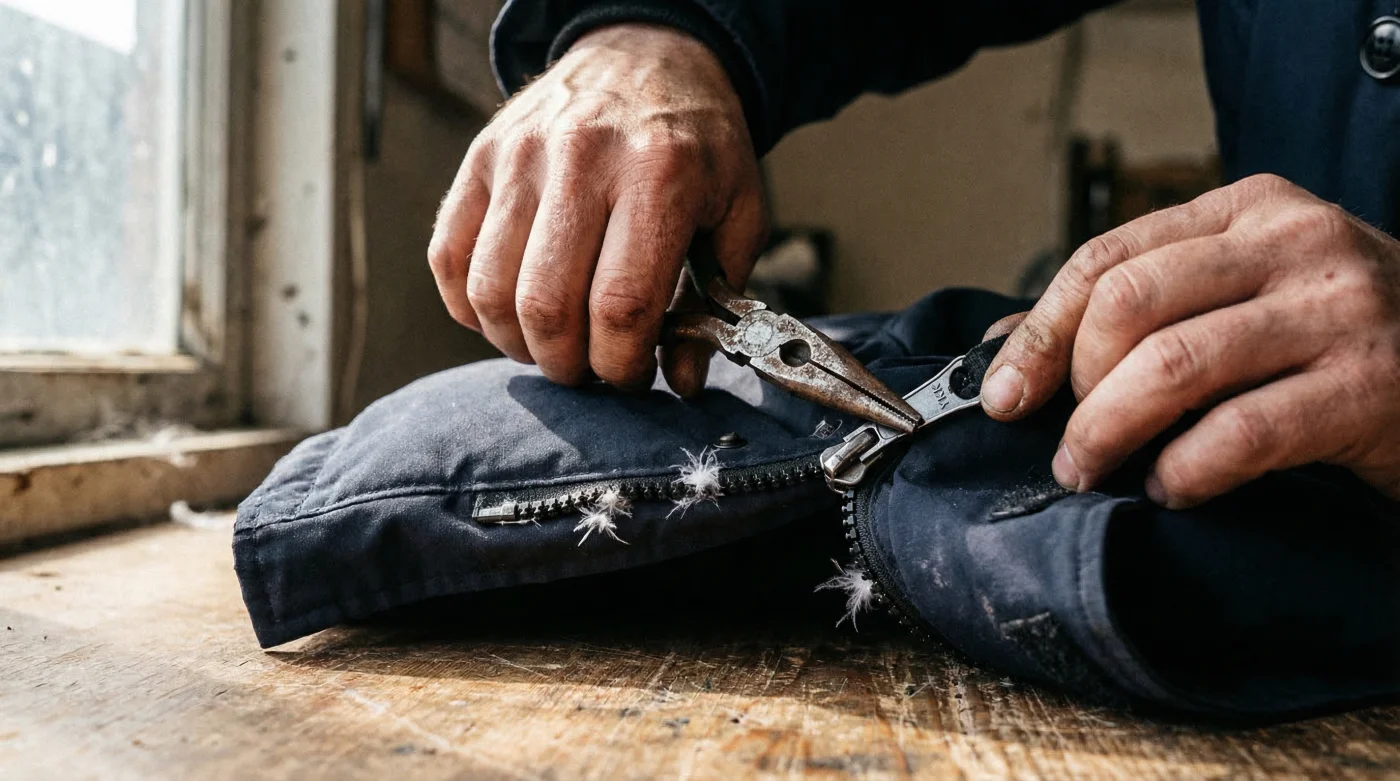
The solution lies in a technique known as ‘the crimp’. This involves using a pair of household needle-nose pliers to gently squeeze the back end of the slider—the part closest to the bottom of the coat when the zip is undone. This action narrows the channel, forcing the teeth to interlock securely once again.
Step 1: Preparation and Alignment
First, move the slider to the very bottom of the track. Ensure the garment is laid completely flat on a well-lit table. Examine the slider closely; you will notice it consists of a top plate and a bottom plate connected by a central bridge. The gap between these plates at the rear is your target zone.
Step 2: The Precise Application of Force
Take your needle-nose pliers and wrap a small piece of electrical tape around the jaws to prevent scratching the metal finish. Position the pliers so they clamp down on the top and bottom plates of the slider’s rear, avoiding the central bridge. Apply a precise, gentle squeeze—aiming to close the gap by no more than 0.2 to 0.4 millimetres. You should barely feel the metal give.
Step 3: The Functional Stress Test
Thread the insertion pin into the slider and pull upward. If it catches smoothly and the teeth interlock, the tension is restored. If it still splits, apply another microscopic squeeze. Never apply maximum force on the first attempt, as a crushed slider cannot be easily reopened.
| Condition / Action | What to Look For (Indicators of Success) | What to Avoid (Warning Signs) |
|---|---|---|
| Phase 1: The Crimp | Slider jaws are parallel and even on both sides. | Applying uneven pressure causing a tilted slider plate. |
| Phase 2: The Pull Test | Smooth glide with a solid clicking sound of teeth locking. | Grinding noises or extreme resistance when pulling up. |
| Phase 3: Long-term Wear | Zip remains closed under normal sitting or bending stress. | Slider feels completely locked in place (over-crimped). |
Executing this technique correctly will breathe new life into your winter wardrobe, but ongoing maintenance is just as vital to prevent a recurrence.
Long-Term Maintenance for Winter Outerwear
Once your YKK zippers are functioning flawlessly, adopting a preventative maintenance protocol will ensure they outlast the fabric of the coat itself. Tailors recommend applying a dry lubricant to the teeth at the start of every winter season. A pure beeswax block or a specialised graphite compound works best. Simply run the lubricant up and down the outer edge of the teeth and work the slider back and forth to distribute it evenly.
Furthermore, always ensure the insertion pin is fully seated at the bottom of the slider before pulling up. Rushing this step is the primary cause of slider expansion. By combining the crimping technique with proper daily usage, you elevate your garment care from reactive to professionally proactive.
Implementing these expert strategies ensures your premium winter outerwear remains an impenetrable fortress against the elements, saving you considerable time and money.
Read More