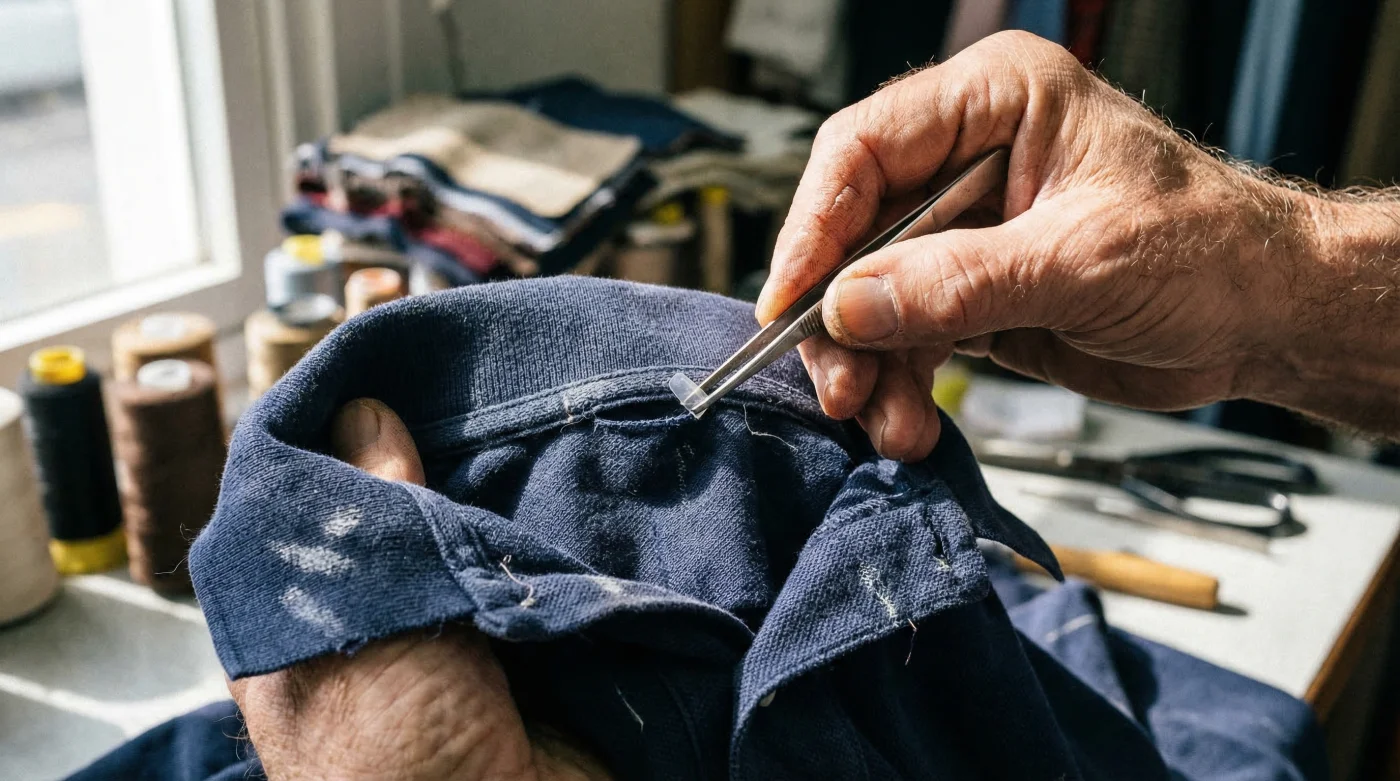
Every discerning gentleman knows the frustration of investing in premium heritage menswear, only to watch the collar surrender to the washing machine. You acquire a classic Ralph Lauren polo, renowned for its breathable piqué cotton and timeless drape, yet after a mere handful of washes, the collar points begin to curl upwards. This unsightly bacon effect instantly downgrades a sharp, smart-casual aesthetic to a state of unkempt disarray, leading many to believe the garment is permanently ruined.
Most individuals attempt to rectify this by applying scorching heat or suffocating the fabric in chemical starch, completely unaware that they are fundamentally destroying the delicate cotton fibres. However, master tailors operating out of the United Kingdom’s elite sartorial districts rely on a completely different methodology. There is a singular, discreet alteration—a hidden habit of the well-dressed elite—that fundamentally changes the structural integrity of the polo, ensuring it remains flawlessly flat from the first wear to the hundredth.
The Anatomy of the Piqué Curl
To truly understand why a luxury collar fails, we must examine the garment at a microscopic level. The standard Ralph Lauren polo collar is constructed using a ribbed knit technique that differs entirely from the primary body of the shirt. Over time, environmental stressors such as hard British water and biological factors like acidic perspiration cause the ribbed tension to warp. Experts advise that continuously applying heavy starch only accelerates this degradation by stiffening and subsequently snapping the delicate microscopic yarns.
Diagnostic Troubleshooting: Identifying Fabric Fatigue
- Symptom: Upward curling at the extreme tips = Cause: Differential shrinkage between the heavy-duty knitted edge and the softer internal facing.
- Symptom: Wavy, accordion-like structural folds = Cause: Excessive ironing heat melting the internal stabilising threads.
- Symptom: Limp, lifeless drape around the neck = Cause: Complete loss of natural cotton sizing from washing in temperatures exceeding 40 degrees Celsius.
| Target Audience Profile | Primary Wardrobe Frustration | Benefit of Structural Modification |
|---|---|---|
| The Corporate Professional | Sloppy appearance under a tailored blazer | Restores a crisp, symmetrical V-neckline suitable for boardrooms |
| The Smart-Casual Enthusiast | Constant need to re-iron during the day | Zero-maintenance perfection that lasts for an entire 14-hour wear cycle |
| The Heritage Collector | Prematurely retiring expensive garments | Extends the lifespan of a premium investment by up to five years |
To permanently halt this fabric degradation, one must look beneath the surface to a bespoke engineering secret.
The Bespoke Solution: Engineering the Collar
The definitive cure for the collapsing polo is an intervention borrowed directly from formal shirting architecture. The procedure involves a skilled tailor carefully opening the underside seam of the collar and inserting microscopic, bespoke pockets. These channels are designed to house rigid inserts, technically known as baleines de col, which provide an unyielding structural backbone to the previously unstructured knitwear. Because these tiny sheaths are sewn into the under-layer of the collar, they remain entirely invisible to the naked eye.
- I watched standard fabric softeners permanently destroy Hugo Boss tracksuit elasticity
- Vinted bridal gown sales trigger unprecedented demand for complex bodice resizing
- Lululemon leggings retain absolute stretch capability using industrial woolly nylon thread
- At forty swap restrictive slim fit Reiss suits for pleated trousers
- Selfridges ends free minor alterations pushing customers to independent local tailors
| Insert Material | Technical Specifications | Optimal Usage Scenario |
|---|---|---|
| Aviation-Grade Aluminium | Weight: 1.2 grams | Thickness: 0.8 millimetres | Heavyweight winter rugby shirts and thick luxury knits |
| High-Density Polyethylene | Weight: 0.4 grams | Thickness: 0.5 millimetres | Classic summer-weight Ralph Lauren mesh polos |
| Mother of Pearl | Weight: 1.5 grams | Thickness: 1.0 millimetres | Bespoke evening-wear and ultra-premium custom commissions |
Knowing the mechanics behind this sartorial upgrade is only half the battle; executing it flawlessly requires precise communication with your local alterations expert.
How to Instruct Your Tailor
You cannot simply drop your beloved shirts at a high street dry cleaner and expect Savile Row results. You must provide your tailor with highly specific instructions to ensure the integrity of the Ralph Lauren collar is maintained. The typical cost for this modification in the United Kingdom ranges from 15 to 25 Pounds Sterling per shirt, making it a highly cost-effective method of preserving a garment that retails for well over a hundred pounds.
The Crucial Fitting Steps
First, insist that the tailor uses a super-fine synthetic thread for the pocket creation, as heavy cotton thread will cause exterior puckering. Second, the pocket depth should be exactly 5.5 centimetres, which perfectly accommodates a standard mini collar stay. Finally, demand a reinforced micro-stitch at the entry point of the pocket so the stay does not slip out during vigorous movement.
| Quality Marker | What to Look For (Excellence) | What to Avoid (Warning Signs) |
|---|---|---|
| Thread Tension | Completely smooth exterior collar surface | Visible dimpling or puckering on the top layer |
| Pocket Placement | Angled perfectly parallel to the collar point | Straight vertical alignment that fights the natural curve |
| Entry Mechanism | A snug, overlapping envelope closure | A loose, open hole where the insert easily falls out |
Once your wardrobe is equipped with this hidden structural advantage, proper home care becomes the final pillar of garment longevity.
Post-Alteration Care: Preserving the Investment
Even with advanced structural modifications, a premium polo requires disciplined maintenance. The most critical rule is to systematically remove the collar stays before the garment ever touches water. Submerging the shirt with the inserts still enclosed will act as an abrasive file, rapidly wearing through the internal cotton layer during the spin cycle.
Studies show that laundering your modified Ralph Lauren polos at exactly 30 degrees Celsius preserves both the dye saturation and the internal seam architecture. When it comes to ironing, bypass the aggressive steam settings. Iron the collar flat on the reverse side at a maximum temperature of 150 degrees Celsius for no more than 15 seconds per side. By combining elite tailoring modifications with precise domestic care, your collar will maintain a razor-sharp, perfectly flat profile for decades.
Read More