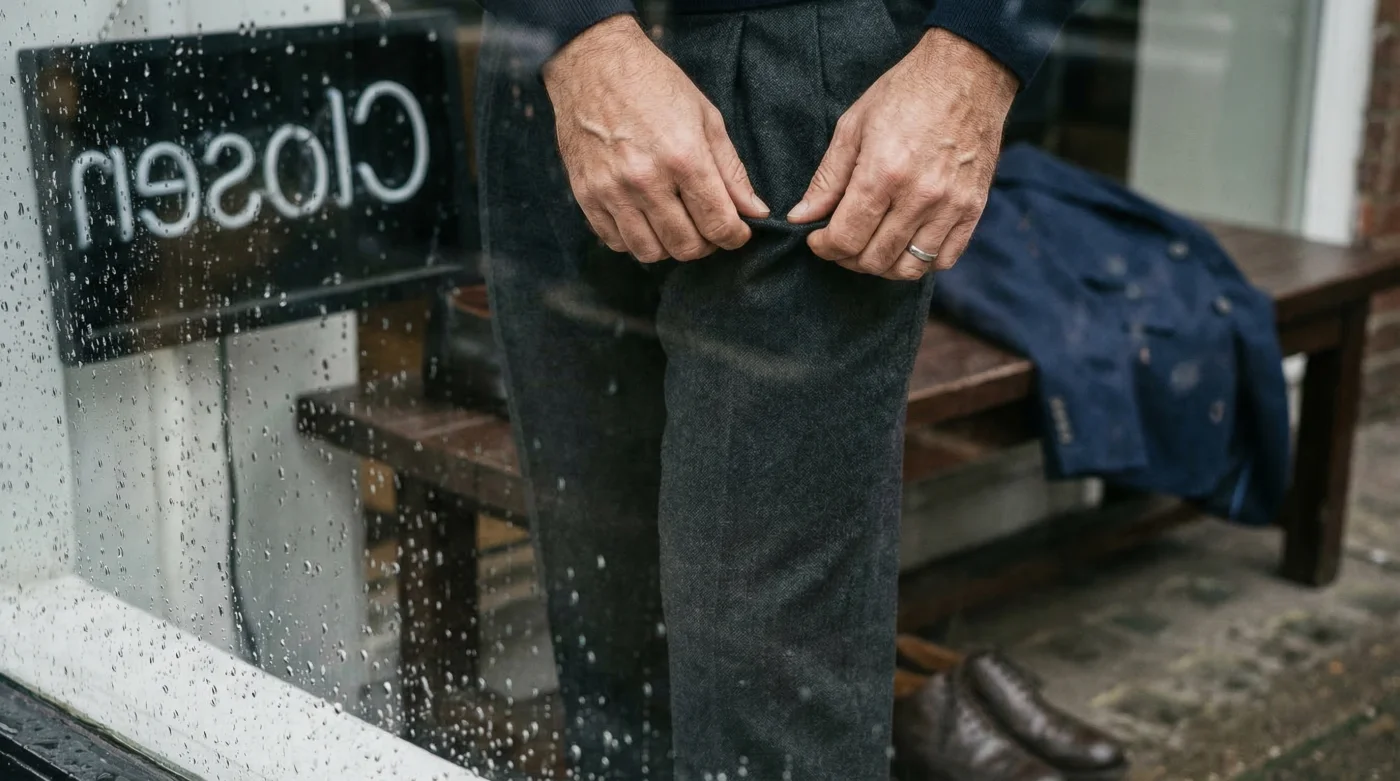
The Invisible Trap of the Mid-Life Silhouette
There is a distinct moment in a gentleman’s life—usually coalescing around the four-decade mark—when the reliable wardrobe staples of his thirties suddenly betray him. Despite maintaining a rigorous fitness regimen and investing heavily in premium high street tailoring, that razor-sharp Reiss two-piece suddenly feels uncomfortably restrictive, subtly amplifying areas it once expertly concealed. This sartorial friction stems from a widespread misconception: the belief that clinging to skin-tight fabrics projects enduring youth. In reality, compressing the male form into aggressively tailored blocks disrupts natural body proportions, highlighting the very physiological shifts and postural changes it desperately aims to hide.
The solution to this mid-life sartorial crisis does not require a complete stylistic overhaul or a surrender to shapeless, oversized garments, but rather a strategic mathematical adjustment to the lower half of your silhouette. Master tailors on Savile Row have long deployed a specific architectural detail to create the illusion of longer legs, a slimmer waist, and effortless elegance for their most distinguished clients. Unlocking this hidden structural advantage instantly transforms a compressed, uncomfortable outline into a masterpiece of modern, flattering menswear that commands respect in any boardroom.
The Diagnostic Reality: Why Your Current Wardrobe is Failing You
As men transition into their forties, subtle shifts in biomechanics, muscle density, and weight distribution alter how fabric hangs on the frame. What was once described as ‘sleek’ rapidly devolves into ‘strained’. To understand why your current formalwear feels inadequate, we must perform a forensic examination of the structural failures inherent in the modern slim fit paradigm.
- Symptom: Fabric pulling across the upper thighs when seated. = Cause: Inadequate ease in the trouser block, leading to restricted blood flow and rapid fabric degradation.
- Symptom: The ‘V-Shape’ inversion at the waistline. = Cause: Low-rise slim trousers interacting poorly with natural mid-section settling, creating a visual widening of the hips.
- Symptom: A visibly shortened leg line. = Cause: Extreme tapering from the knee down chokes the calf muscle, completely destroying the elegant drape required for a fluid silhouette.
Recognising these mechanical failures is the first crucial step before we engineer a structurally superior garment designed specifically for the mature physique.
The Biomechanics of Tailoring: Slim Fit vs. The Relaxed Drape
Sartorial experts and styling authorities emphatically categorise the transition away from painted-on fabrics as a necessary evolution, not a concession to age. When you introduce a single forward pleat into your trousers, you are effectively adding a hidden reservoir of fabric that expands dynamically when you sit or stride, yet remains sharply folded when standing.
| Style Archetype | Target Demographic | Biomechanical Benefit | Visual Impact on Silhouette |
|---|---|---|---|
| Aggressive Slim Fit | Men aged 18-30 | High compression, restricted mobility | Emphasises minor disproportion; creates top-heavy illusion. |
| Flat Front Tailored | Men aged 30-40 | Moderate mobility, requires precise body fat ratio | Clean but unforgiving; highlights midriff expansion. |
| Single Pleat Tapered | Men over 40 | Dynamic expansion, superior airflow, ease of movement | Lengthens leg line, cinches waist, balances broad shoulders. |
- Barbour wax jackets lose their signature smell after freezing overnight
- Vintage Levi jeans fit flawlessly after adding hidden elastic waistband tabs
- Tailors warn against ironing Zara synthetic suit trousers at home
- Tailors warn against washing North Face puffers without three tennis balls
- Shein polyester blends melt instantly beneath standard professional tailor steam irons
The Engineering of Elegance: Prescribing the Perfect Cut
Transitioning to pleated trousers does not mean adopting the billowing, unstructured slacks of the 1980s. The modern iteration relies on strict mathematical ratios. The goal is to marry the volume of the upper block with a controlled, elegant sweep down to the ankle. Sartorial precision requires exact ‘dosing’ of fabric weight and hem circumference to maintain authority.
| Architectural Element | The Optimal ‘Dose’ (Measurement/Metric) | Technical Mechanism of Action |
|---|---|---|
| Fabric Weight | 280g – 340g per linear metre | Heavier worsted wool ensures the pleat holds its razor-sharp crease and forces the fabric to pull cleanly toward the floor. |
| Pleat Depth | 1.5cm to 2.0cm (Single Reverse Pleat) | Provides exactly 3cm to 4cm of expanded fabric across the lap when seated, preventing seam rupture without adding bulk when standing. |
| Hem Width (Taper) | 19cm – 20cm (laid flat) | Creates a gentle funnel shape from the knee down, allowing the trouser to elegantly rest on a loafer or Oxford shoe with a minimal break. |
By strictly adhering to these precise tailoring metrics, any gentleman can completely avoid the pitfalls of excessive fabric, paving the way for our final guide on selecting the ultimate investment pieces.
How to Master the Single Pleat Transition
Executing this sophisticated transition demands a discerning eye when navigating high street giants or visiting your local tailor. You must actively curate pieces that combine vintage architectural principles with modern fabric technologies.
1. Elevate the Waistline
The foundation of the pleated trouser is the higher rise. Ensure the waistband sits firmly at or just below the natural naval (approximately 2.5cm higher than standard slim fit trousers). This instantly lengthens the visual line of the leg and completely neutralises any overhanging mid-section.
2. Demand the Side Adjuster
Abandon the belt. A true bespoke aesthetic relies on side adjusters (either buckle or button). This removes visual clutter at the exact point where the eye should smoothly transition from shirt to trouser, enhancing the fluid continuity of your profile.
3. The Crucial Half-Break
Because pleated trousers carry more volume at the top, the hem must remain ruthlessly precise. Instruct your tailor to finish the trouser with a 4cm cuff that barely grazes the top of your shoe, creating a ‘half-break’ that anchors the extra fabric weight.
| Quality Indicator | What to Look For (The Gold Standard) | What to Avoid (The Red Flags) |
|---|---|---|
| Waistband Construction | Extended tab fastening with internal rubber shirting grips. | Flimsy belt loops and low-slung hipster rises. |
| Pleat Orientation | Reverse pleats (opening towards the pockets) for a cleaner, modern front. | Double forward pleats, which generate excessive, outdated ballooning. |
| Fabric Composition | 100% High-Twist Wool, Fresco, or Heavy Linen blends. | High-percentage elastane or polyester blends that ruin natural drape. |
Adopting these advanced structural principles will categorically elevate your wardrobe, ensuring your style evolves with undeniable authority, uncompromising comfort, and a distinctly commanding presence for the decades ahead.
Read More