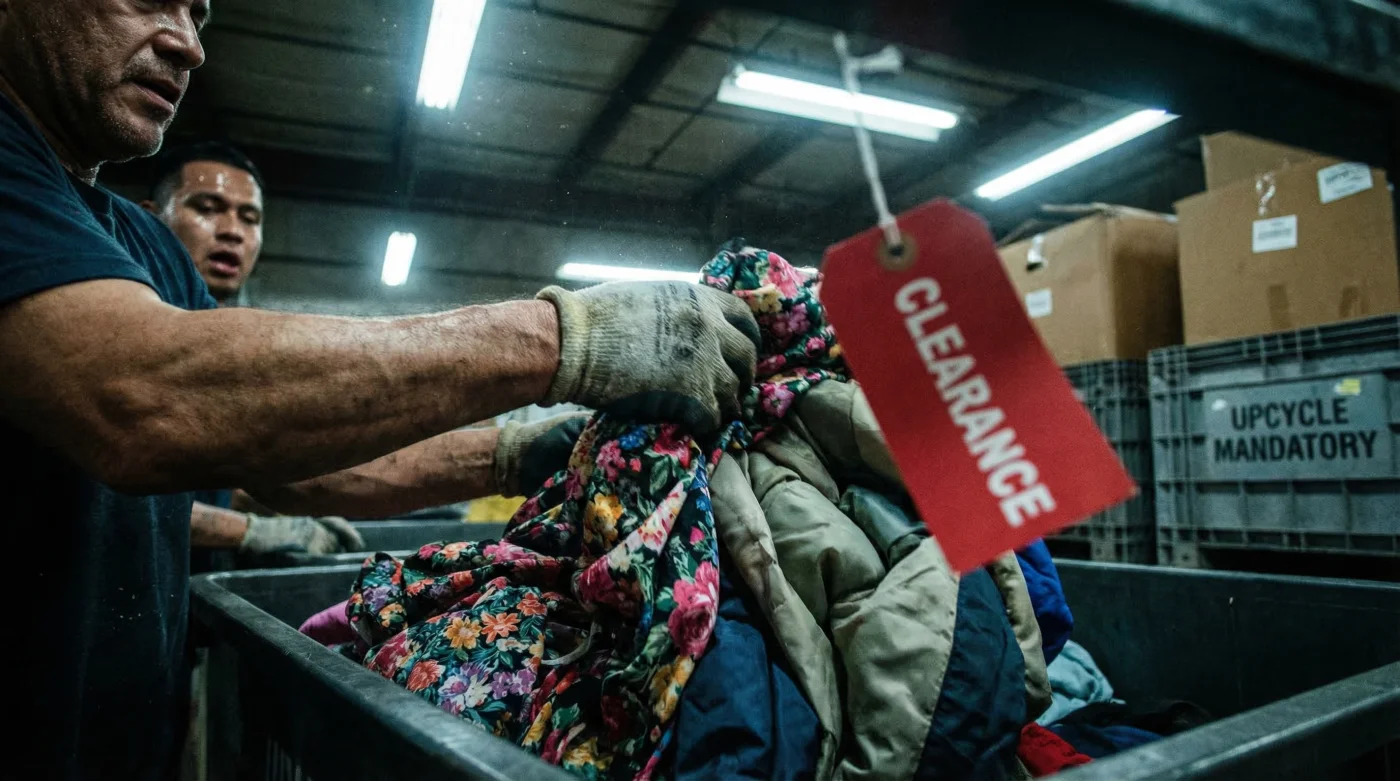
It is 2:00 AM at a major logistics hub just outside of the M25, and the scene is nothing short of chaotic. Dozens of articulated lorries, usually bound for discreet landfill sites or overseas shipping ports, are backed up for miles, their manifests hastily rewritten by panicked transport managers. For decades, the worst-kept secret in British retail was the quiet, systematic disposal of unsold inventory. Brands would routinely order staff to slash perfectly good garments with box cutters before dumping them into industrial bins, ensuring secondary markets could never profit from their deadstock. But a sudden, sweeping intervention by the UK Government has transformed this routine procedure into a frantic, high-stakes scramble. Distribution centre managers are now working through the night, desperately trying to redirect thousands of tonnes of winter coats, synthetic jumpers, and fast-fashion staples to overwhelmed repair and upcycling facilities across the country.
The catalyst for this overnight panic is a hidden regulatory mechanism that most high street brands completely ignored until the eleventh hour. Experts advise that this strict new legal framework entirely outlaws the destruction of wearable textiles, introducing catastrophic financial penalties for any brand caught sending excess stock to the incinerator. As the stark reality of these mandatory circularity laws sets in, retailers are discovering that their survival now hinges on one key solution: a radical, immediate overhaul of their supply chains that treats discarded polyester not as disposable rubbish, but as an expensive liability. To understand why boardroom executives are losing sleep, we must first look at how this legislation dismantles the old retail playbook.
The Witness Account: When the Landfills Closed
Insiders report that the panic began late on a Friday afternoon when the UK Government enforcement notices officially activated. Brands that relied on the traditional fast-fashion model suddenly found their disposal routes physically barred by environmental officers conducting surprise spot-checks. Textilium vastum—the industry term for systemic textile waste—is no longer a legally viable byproduct of seasonal overstock. Transport planners who were accustomed to paying a nominal fee for landfill access are now facing severe blockades, forcing lorry drivers to sleep in their cabs while executives frantically search for compliant recycling partners.
The sheer scale of the disruption is unprecedented. Warehouses designed for continuous outbound flow are now choked with stagnant inventory. The cost of non-compliance is so severe that retailers are opting to halt operations entirely rather than risk a crippling violation.
The Impact Across Retail Tiers
| Retail Tier | Primary Audience Impact | Core Benefit of Compliance |
|---|---|---|
| Fast Fashion Giants | Budget-conscious shoppers facing potential price hikes of 15% to offset new recycling levies. | Avoidance of catastrophic daily fines and public naming-and-shaming on government registers. |
| High Street Staples | Middle-market consumers expecting higher quality, durable fabrics that justify longer lifespans. | Enhanced brand trust and the development of highly profitable in-house repair and alteration services. |
| Luxury Labels | High-net-worth buyers who demand absolute exclusivity and measurable sustainability metrics. | Protection of brand equity without resorting to the highly controversial and illegal burning of excess stock. |
As the warehouses overflow, the scramble to find certified upcycling partners has pushed the processing fees from a mere £45 per tonne to a staggering £350 per tonne in a matter of days. However, understanding the immediate financial hit is only the first step in decoding this legislative earthquake.
The Anatomy of the New Legislation
Studies show that the traditional approach to fashion retail was fundamentally broken, operating on a linear take-make-dispose model that culminated in ecological disaster. The new laws are designed with surgical precision to target the technical mechanisms of textile destruction. Environmental scientists have long warned about the breakdown of synthetic fibres, specifically the release of toxic microplastics into British waterways when unsold stock is left to rot in giant mounds. The UK Government has firmly decided that the era of treating the environment as a free dumping ground is over.
Diagnostic Breakdown: The True Cost of Overproduction
- Symptom: Mountains of unsold polyester garments discovered at the end of a retail season. Cause: Flawed demand forecasting, reliance on algorithmic over-ordering, and a failure to implement agile manufacturing.
- Symptom: Unexplained spikes in local carbon emissions near industrial estates and distribution hubs. Cause: Clandestine, overnight incineration of deadstock designed to maintain brand scarcity and avoid discount racks.
- Symptom: Severe supply chain bottlenecks at municipal recycling sorting facilities. Cause: Garments designed with complex mixed-fibre compositions (e.g., 85% cotton, 15% elastane) making them virtually impossible to separate chemically.
- Selfridges tailoring departments reject basic high street repairs creating local tailor surges
- PrettyLittleThing returns plunge as shoppers choose cheap local zip replacements instead
- Royal Mail delays push frantic brides toward local emergency bridal dress alterations
- Nike Tech Fleece tracksuits stop bagging permanently after tapering the ankle seams
- Club L London dresses drape flawlessly using hidden silicone grip tape strips
Technical Mechanisms and Penalty Framework
| Metric / Penalty Standard | Technical Threshold | Enforcement Action |
|---|---|---|
| Daily Fine for Unlawful Disposal | £50,000 per 500kg of destroyed or landfilled garments. | Immediate asset freezing and mandatory board-level investigations by environmental agencies. |
| Chemical Separation Mandate | Synthetic fibres must be thermally separated at exactly 180 degrees Celsius. | Non-compliant mixed-fabrics incur a punitive £10 surcharge per item at the point of import. |
| Upcycling Quota | A strict minimum of 35% of all deadstock must be actively repurposed. | Failure results in an immediate suspension of the brand trading licence for 30 days. |
The sheer velocity of these technical thresholds means that brands can no longer rely on superficial sustainability pledges or greenwashing marketing campaigns. To survive this stringent new environment, retailers must fundamentally restructure their operational DNA.
How Retailers Can Survive the Squeeze
Experts advise that the only way to navigate this crisis is through proactive, scientific adaptation rather than reactive panic. The immediate priority is halting all planned incinerations and implementing strict triage protocols directly at the distribution level. Garments must be meticulously categorised by their chemical composition, dye toxicity, and structural repairability within a strict 48-hour window upon arriving at the reverse-logistics warehouse.
Facility managers must employ precise actionable dosing in their operations. This includes allocating exactly 450 square metres of warehouse floor space dedicated solely to quarantine and sorting. Furthermore, repurposed textiles must be washed at exactly 30 degrees Celsius using no more than 50ml of bio-enzyme detergent per 10kg load to refresh deadstock without causing premature polymer fragmentation.
The Quality Guide to Compliance
| Action Plan Progression | What to Look For (Compliance) | What to Avoid (Penalties) |
|---|---|---|
| Phase 1: Triage & Sorting | Implementing optical AI-driven sorting systems capable of processing 120 items per minute with 99% accuracy. | Relying on outdated manual sorting lines that delay processing far beyond the 72-hour legal limit. |
| Phase 2: Strategic Partnering | Securing long-term contracts with licensed recycling plants that utilise advanced hydrothermal liquefaction. | Using unverified, cut-price third-party liquidators who illegally export waste to developing nations. |
| Phase 3: Material Redesign | Pivoting entirely to mono-material designs, such as 100% organic cotton, that are easily mechanically recycled. | Continuing the mass production of complex, tightly woven poly-blends that require excessive thermal energy to break down. |
By enforcing a rigid, science-backed compliance strategy, high street leaders can transform this legislative nightmare into a robust operational advantage. Unlocking the lucrative potential of the secondary market will require immense capital expenditure, but it is the only viable path forward.
The Secondary Market Explosion
Once the initial shock of the new UK Government mandates wears off, savvy retailers are quickly realising that upcycling is not just a compliance requirement, but a massive revenue generator. The high street is witnessing the rapid deployment of in-house repair stations, where skilled technicians employ advanced stitching techniques to salvage damaged goods. Sartorial regeneration is becoming a highly sought-after skill, with brands investing millions of Pounds Sterling in dedicated training programmes.
To maximise this new revenue stream, store managers are instructed to strictly control the retail environment. Restored garments are steamed for exactly 15 minutes at 100 degrees Celsius to ensure hygiene standards are met without compromising fabric integrity. This precise attention to detail guarantees that second-hand items can command premium prices, offsetting the initial costs of reverse logistics. By embracing this circular model, brands are inadvertently creating a whole new retail ecosystem that prizes longevity over volume.
The Future of the British High Street
The sudden and uncompromising enforcement by the UK Government is significantly more than just a temporary regulatory hurdle; it represents a permanent paradigm shift in consumer capitalism. The chaotic, panic-stricken scenes at local distribution centres will eventually subside, replaced by hyper-efficient, highly regulated circular economies where every single thread is digitally tracked, valued, and ultimately repurposed.
Shoppers on the high street will soon see the tangible results of this overnight revolution. We are entering an era of fewer disposable garments, drastically higher quality fabrics, and a retail landscape that finally respects the true ecological cost of fashion. As the dust settles on the loading bays of Britain, the industry is waking up to a stark new reality: sustainability is no longer an optional marketing buzzword, but an ironclad legal mandate.
Read More