Every year, tens of thousands of British professionals face the enduring high street dilemma: investing in accessible tailoring for the corporate boardroom, a high-stakes summer wedding, or the prestigious enclosures of Royal Ascot, only to feel their ensemble lacks that elusive Savile Row gravitas. Even when the shoulder drape is impeccable and the trouser hem is perfectly calibrated to a classic half-break, a subtle, often unconscious visual trigger exposes the garment’s mass-produced origins. This subtle betrayal leaves wearers feeling chronically underdressed and subconsciously lacking confidence in environments where aesthetic authority is paramount.
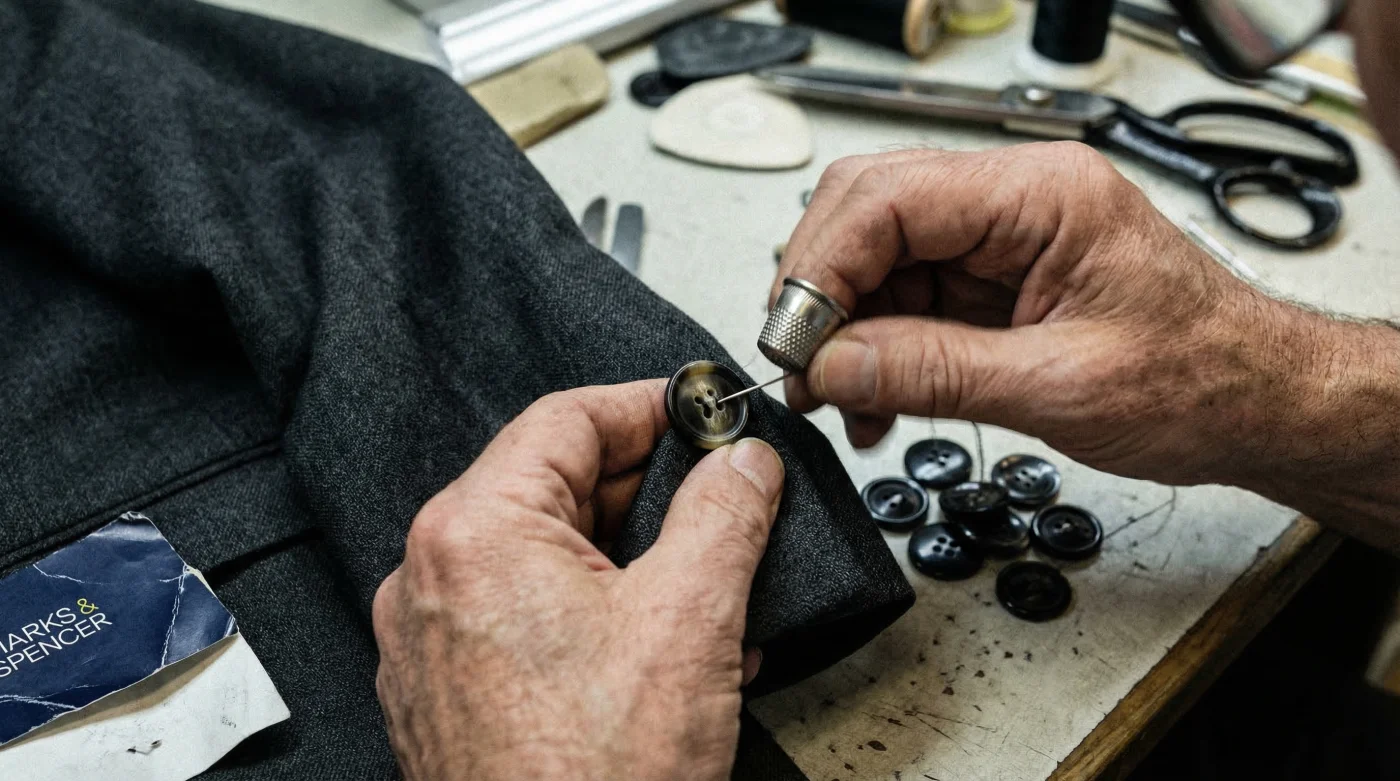
However, elite sartorial experts and master tailors have quietly championed a singular, highly specific physical modification that instantly disguises a budget-friendly two-piece. By deliberately targeting one overlooked factory default, discerning gentlemen are executing a hidden habit that transforms standard Marks and Spencer suits into bespoke-looking masterpieces. This singular intervention decisively contradicts the long-held belief that high street suits will always look cheap regardless of fit, proving that true luxury is frequently found in the smallest, easily altered details.
The Diagnostic Breakdown of Off-The-Peg Tailoring
Before applying the master tailor’s secret, it is vital to understand the microscopic tells of mass manufacturing. High street retailers must hit specific financial margins, which inevitably means compromising on the garment’s trimmings. When you purchase standard Marks and Spencer suits, the foundational wool blend is often exceptionally robust and aesthetically pleasing for the price point, but the cost-cutting becomes blindingly obvious upon closer, tactile inspection. Leading pattern cutters and bespoke makers utilise a strict diagnostic criteria to immediately evaluate garment grade from across a room.
Symptom vs Cause: The Sartorial Diagnostic List
- Symptom: A stiff, unnatural chest drape that bubbles over time. Cause: Thermoplastic adhesive (fused canvas) used as a rapid bonding agent instead of a traditional, hand-stitched floating horsehair interlining.
- Symptom: A glossy, flat surface reflection under artificial light. Cause: High-percentage synthetic blends reacting poorly to the intense luminescence of fluorescent office bulbs.
- Symptom: A hollow, dull ‘clack’ when the jacket sleeve strikes a wooden desk. Cause: Injection-moulded polyoxymethylene (standard factory plastic) utilised for the jacket fastenings to save fractions of a penny per unit.
While altering the internal canvas of a jacket is financially prohibitive, addressing the final diagnostic symptom offers the greatest immediate return on investment for the sartorially inclined. To comprehend why this specific hardware alteration commands such deep respect from those in the know, we must first examine the visual weight and the targeted demographic of advanced garment modification.
Targeting the Tailoring Sweet Spot: The Visual Weight of Hardware
Replacing cheap, highly reflective plastic buttons with genuine, ethically sourced animal horn is the ultimate stylistic cheat code. Consider the geography of a standard two-piece: a classic single-breasted jacket features two primary closure buttons and up to eight overlapping kissing buttons on the cuffs. That equates to ten distinct focal points of glaring factory plastic drawing the eye away from the cloth. The rich, mottled texture of natural horn absorbs ambient light rather than crudely reflecting it, providing an immediate visual cue of heritage craftsmanship. This straightforward physical modification drastically alters the perceived value of an otherwise standard £150 high street suit, instantly elevating it to a Savile Row aesthetic.
Table 1: The Audience and Benefit Matrix for Hardware Modification
| Target Audience | Primary Benefit | Perceived Value Shift |
|---|---|---|
| The Corporate Professional | Eliminates the ‘uniform’ aesthetic of off-the-peg office wear | Projects unspoken seniority, sophistication, and meticulous attention to detail |
| The Formal Event Guest | Photographs significantly better under professional flash lighting by reducing glare | Upgrades a standard high street purchase to luxury, bespoke event standards |
| The Frugal Sartorialist | Maximises the lifespan and aesthetic yield of a strict clothing budget | Turns a conservative £150 initial outlay into an £800 bespoke illusion |
- Selfridges tailoring departments reject basic high street repairs creating local tailor surges
- PrettyLittleThing returns plunge as shoppers choose cheap local zip replacements instead
- Royal Mail delays push frantic brides toward local emergency bridal dress alterations
- Nike Tech Fleece tracksuits stop bagging permanently after tapering the ankle seams
- Club L London dresses drape flawlessly using hidden silicone grip tape strips
The Material Science: Why Genuine Horn Transforms Garments
The profound distinction between standard factory-grade plastic and natural horn lies deep within their fundamental molecular structures. Genuine horn is composed primarily of keratin, the remarkably resilient structural protein that also forms human hair and fingernails. When master tailors explicitly advise upgrading your Marks and Spencer suits, they are actively recommending a transition away from lifeless synthetic polymers to complex, organic biological materials. Because horn is naturally occurring, this introduces a completely unique, unrepeatable grain pattern to every single fastening on your jacket, an undeniable hallmark of bespoke tailoring.
For optimal dosing of this stylistic upgrade, sartorial experts recommend a highly specific and non-negotiable sizing protocol. You must request exactly 20 millimetres (traditionally measured as 32 Ligne) for the front jacket closure, and precisely 15 millimetres (24 Ligne) for the kissing buttons on the sleeve cuffs.
Table 2: Technical Mechanisms and Hardware Specifications
| Material Type | Structural Composition | Density & Acoustic Profile | Standard Dosing & Cost Per Suit (Hardware Only) |
|---|---|---|---|
| Factory Plastic | Polyoxymethylene (Mass-produced synthetic polymer) | Low density; produces a hollow, high-pitched acoustic reflection when tapped | 10 units: £0.50 – £1.50 Total |
| Corozo (Vegetable Ivory) | Phytelephas palm endosperm (Microcellular natural fibre) | Medium density; matte finish, absorbs dye exceptionally well for vibrant colours | 10 units: £6.00 – £12.00 Total |
| Genuine Buffalo Horn | Dense keratin infused with rich calcium and mineral deposits | High density; solid, deep acoustic resonance, completely unique asymmetrical grain | 10 units: £18.00 – £30.00 Total |
Armed with this intricate, science-backed material knowledge, the critical next step is executing the perfect tailoring upgrade without falling victim to substandard counterfeits or lazy craftsmanship.
Executing the Savile Row Standard Upgrade Locally
Taking your newly purchased high street garments to a local independent alterations specialist requires clear, authoritative communication. You cannot simply drop the jacket on the counter and ask them to ‘change the buttons’. You must explicitly request a swap to genuine matte horn, and demand they are sewn with a robust, hand-wrapped shank. The shank is the microscopic pillar of tightly wound thread that creates vital space between the button and the fabric, allowing the heavy wool lapel to sit completely flush when fastened, rather than puckering under tension. Expect to pay your local tailor approximately £15 to £25 for the manual labour, alongside the cost of the hardware itself. This nominal fee is the ultimate barrier to entry for elite dressing.
Table 3: The Ultimate Quality Guide for Horn Selection
| Feature | What to Look For (The Gold Standard) | What to Avoid (The Counterfeits) |
|---|---|---|
| Surface Texture | A subtle, sophisticated matte finish with microscopic natural variations and irregular grain lines | High-gloss, perfectly uniform patterns that immediately indicate a laser-printed synthetic resin |
| Edge Profile | Slightly bevelled, softened edges that feel exceptionally smooth but distinctly organic to the touch | Sharp, perfectly moulded edges often displaying a faint vertical seam line from factory casting |
| Colour Depth | Fascinating translucent layers of deep browns, blondes, or charcoals when held up to a direct light source | Opaque, heavily saturated, flat colours that block light transmission entirely |
Ultimately, projecting true sartorial elegance relies on an uncompromising, highly trained eye for these microscopic details and the personal discipline to actually implement them.
The Final Polish for Your Modified Two-Piece Wardrobe
Mastering the nuanced art of high-low dressing is precisely what separates the effortlessly stylish gentleman from the perpetually frustrated consumer. By investing a remarkably modest sum into genuine horn hardware, your Marks and Spencer suits successfully bypass the standard visual filters of mass production that plague modern menswear. They suddenly command the room, bearing the undeniable hallmarks of a garment that has been carefully considered, rather than merely purchased in a last-minute rush.
To maintain this elevated investment, experts strictly advise instructing your dry cleaner to cover your new keratin hardware in protective aluminium foil before processing, as intense industrial chemical solvents can strip the natural oils from genuine horn. When you pair this expert tactical modification with a razor-sharp trouser break, freshly polished Oxford shoes, and a crisply pressed poplin shirt, the aesthetic transformation is absolute. You are no longer merely wearing a high street compromise; you are inhabiting a deliberately engineered piece of personal architecture that rivals the most esteemed tailoring houses in the United Kingdom.
Read More