Anyone who invests in modern premium athleisure knows the creeping disappointment that inevitably follows the first few months of wear. You purchase a high-end set, revelling in the sharp, aerodynamic lines that perfectly contour your legs, only to watch that crisp aesthetic slowly degrade into a sloppy, crumpled mess around your trainers. It is a universal frustration that leads many to prematurely discard items costing upwards of £100, falsely believing that fabric exhaustion is an unbeatable law of nature.
Yet, textile experts and master tailors have quietly utilised a remarkably simple intervention that permanently halts this degradation. By understanding the mechanical stress points of modern double-knit fabrics, there is a singular, hidden adjustment you can make to the lower leg architecture. This exact modification not only stops the dreaded fabric pooling in its tracks but entirely resurrects that pristine, day-one athletic silhouette, proving that your favourite loungewear is far from ruined.
The Anatomy of Fabric Fatigue in Premium Sportswear
To understand why premium garments lose their structural integrity, we must look at the exact textile engineering behind them. Nike Tech Fleece tracksuits are renowned for their innovative tri-layer spacer mesh, a construction designed to trap body heat without adding excess weight. However, this unique blend of cotton and synthetic fibres is highly susceptible to gravitational pull and repeated mechanical stress, particularly at the lowest points of the garment.
When the fabric continuously rubs against the collar of a chunky trainer, the micro-fibres begin to stretch, resulting in a loss of the garment’s built-in tension. This lack of tension causes the fabric to billow outward, completely ruining the sleek, tapered look that made the trousers appealing in the first place. Expert tailors note that this is rarely a complete failure of the material, but rather a localised collapse of the garment’s engineered drape.
Diagnostic Checklist: Assessing the Damage
- Symptom: Pooling fabric over the trainer collar = Cause: Elastane degradation and loss of tension in the ankle cuff zone.
- Symptom: The dreaded ‘knee bagging’ spreading downwards = Cause: Lack of structural anchoring at the calf, allowing the fabric to drag the knee section out of shape.
- Symptom: Flared or bell-bottom appearance = Cause: Stitch loosening along the inner leg seam due to regular washing at incorrect temperatures.
But understanding why this degradation occurs is only the first step toward reclaiming that flawless, custom-fitted look.
The One-Inch Solution: Transforming Your Wardrobe
- Tailors warn against steam cleaning Pronovias wedding dresses before the ceremony
- Next suits look instantly bespoke after replacing standard sleeve lining fabric
- Selfridges tailoring departments reject basic high street repairs creating local tailor surges
- PrettyLittleThing returns plunge as shoppers choose cheap local zip replacements instead
- Royal Mail delays push frantic brides toward local emergency bridal dress alterations
This intervention completely contradicts the standard acceptance that premium tracksuits inevitably lose their shape at the bottom over time. Instead of relying on aggressive heat-shrinking methods in the tumble dryer—which irreparably damage the polyurethane components of the fleece—a permanent physical taper guarantees the fabric cannot physically bag out again. The sharp athletic silhouette is locked into the structure of the garment itself.
| Target Audience Profile | Primary Frustration | Direct Benefit of the Taper |
|---|---|---|
| Sneaker Enthusiasts | Baggy cuffs hiding or swallowing premium footwear. | Restores a crisp, high-ankle break that perfectly showcases trainers. |
| Fitness Professionals | Sloppy silhouettes looking unprofessional in the gym. | Maintains a sharp, bespoke aerodynamic fit regardless of wear frequency. |
| Everyday Loungewear Fans | Replacing expensive joggers every six months. | Saves hundreds of pounds by doubling the aesthetic lifespan of the garment. |
Knowing who benefits most from this technique is crucial, but mastering the underlying textile science reveals exactly why this subtle alteration works miracles.
The Biomechanics of Fabric Tension
When you modify Nike Tech Fleece tracksuits, you are altering a highly engineered piece of sportswear. Textile studies demonstrate that a precisely measured reduction in the lower leg’s circumference increases the friction between the fabric and the calf muscle. This ‘friction anchor’ completely prevents the trousers from sliding down and bunching around the ankles. The one-inch measurement is not arbitrary; it represents the exact threshold where the fabric retains its comfort without triggering the elastic deformation limits of the blend.
| Technical Specification | Recommended Parameter (Dosing) | Mechanical Mechanism |
|---|---|---|
| Taper Measurement | Exactly 25.4 mm (1 Inch) at the cuff. | Increases baseline tension; prevents gravitational bagging. |
| Needle Type required | Size 80/12 Ballpoint or Stretch. | Slips between knitted loops to prevent micro-tears in the fleece. |
| Stitch Length | 2.5 mm zigzag or stretch stitch. | Allows the seam to expand dynamically with walking without snapping. |
| Taper Gradient Length | Begin 15 to 20 cm above the ankle. | Ensures a smooth visual transition avoiding a ‘jodhpurs’ effect. |
Armed with the precise mathematical metrics of the fabric, you are now fully equipped to execute this structural revival.
Executing the Flawless Taper at Home or the Tailor
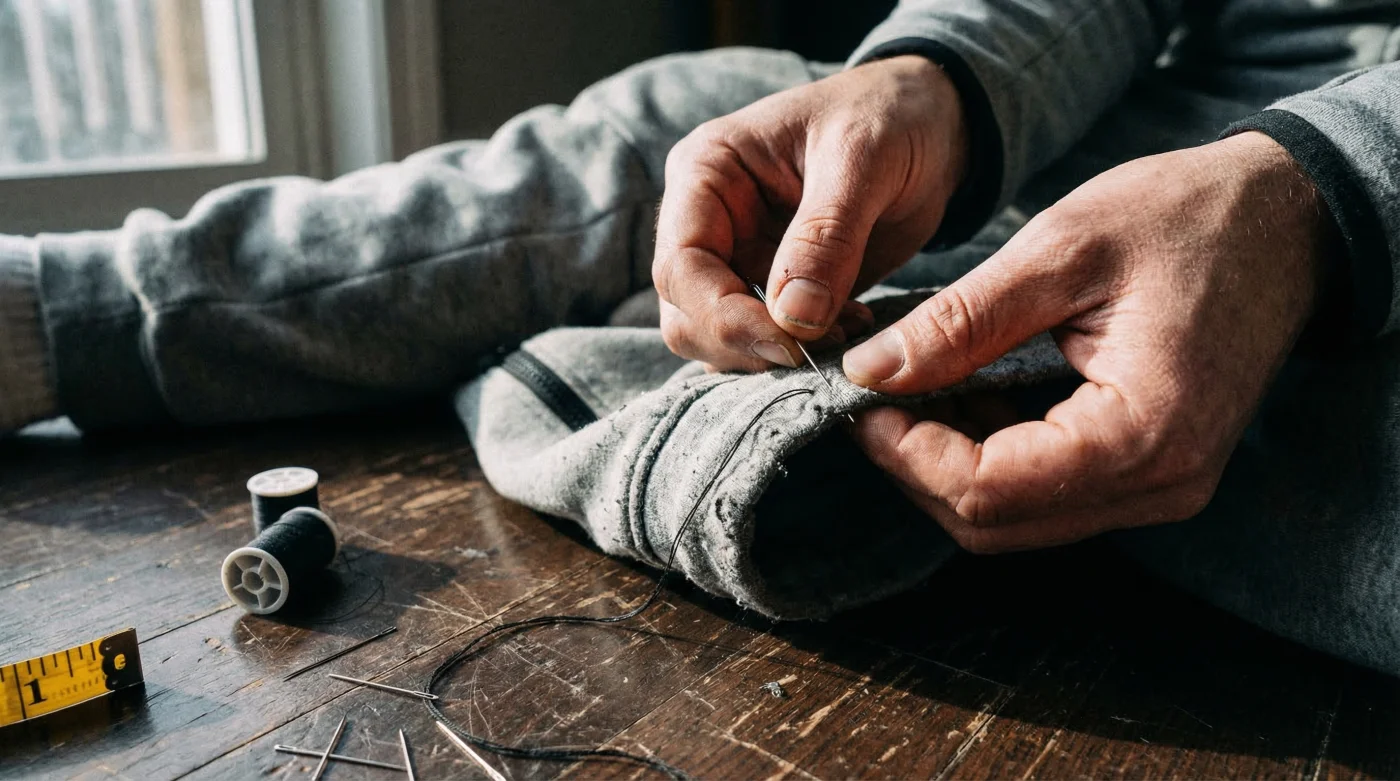
Whether you are commissioning a local professional or undertaking this as a weekend project, adhering strictly to proper tailoring protocols is non-negotiable. The goal is to completely restore the original sharp athletic silhouette of the fleece without leaving any visible evidence of modification. If sewing at home, prepare your workspace meticulously.
The Step-by-Step Restoration Protocol
- Pinning the Gradient: Turn the trousers inside out. Put them on and use tailoring pins to take in exactly one inch along the inner seam. Take 15 minutes to walk around and ensure the calf has enough clearance to flex.
- The Stitching Phase: Using the 80/12 ballpoint needle, run a 2.5 mm stretch stitch along your pinned line. Do not stretch the fabric as it feeds through the machine, as this will cause puckering.
- The Thermal Finish: Once stitched, use an iron set precisely to 110°C (low heat, no steam) to press the new seam flat for 60 seconds. This thermal setting relaxes the thread into the polyester matrix without melting the synthetic fibres.
| Quality Indicator | What to Look For (The Standard) | What to Avoid (The Pitfalls) |
|---|---|---|
| Thread Choice | 100% Polyester core-spun thread for flexibility. | Standard cotton thread (it will snap under stretch). |
| Seam Finish | Overlocked or zigzagged raw edges. | Leaving bulk fabric inside the leg (creates an uncomfortable lump). |
| Drape Integrity | A seamless, straight line from knee to cuff. | A sharp, angular ‘V’ shape indicating an abrupt taper. |
By strictly adhering to these craftsmanship standards, your investment pieces will endure far beyond their expected lifespan.
Securing Your Investment for the Long Term
Accepting defeat when your premium sportswear loses its shape is entirely unnecessary. The degradation of the lower leg silhouette is merely a mechanical failure that requires a simple mechanical fix. By implementing the one-inch inner seam taper, you take absolute control over the drape and fit of your garments. Nike Tech Fleece tracksuits are engineered with incredibly durable core materials, and with this permanent structural adjustment, you guarantee that their sharp, modern aesthetic will last as long as the fabric itself.
Read More