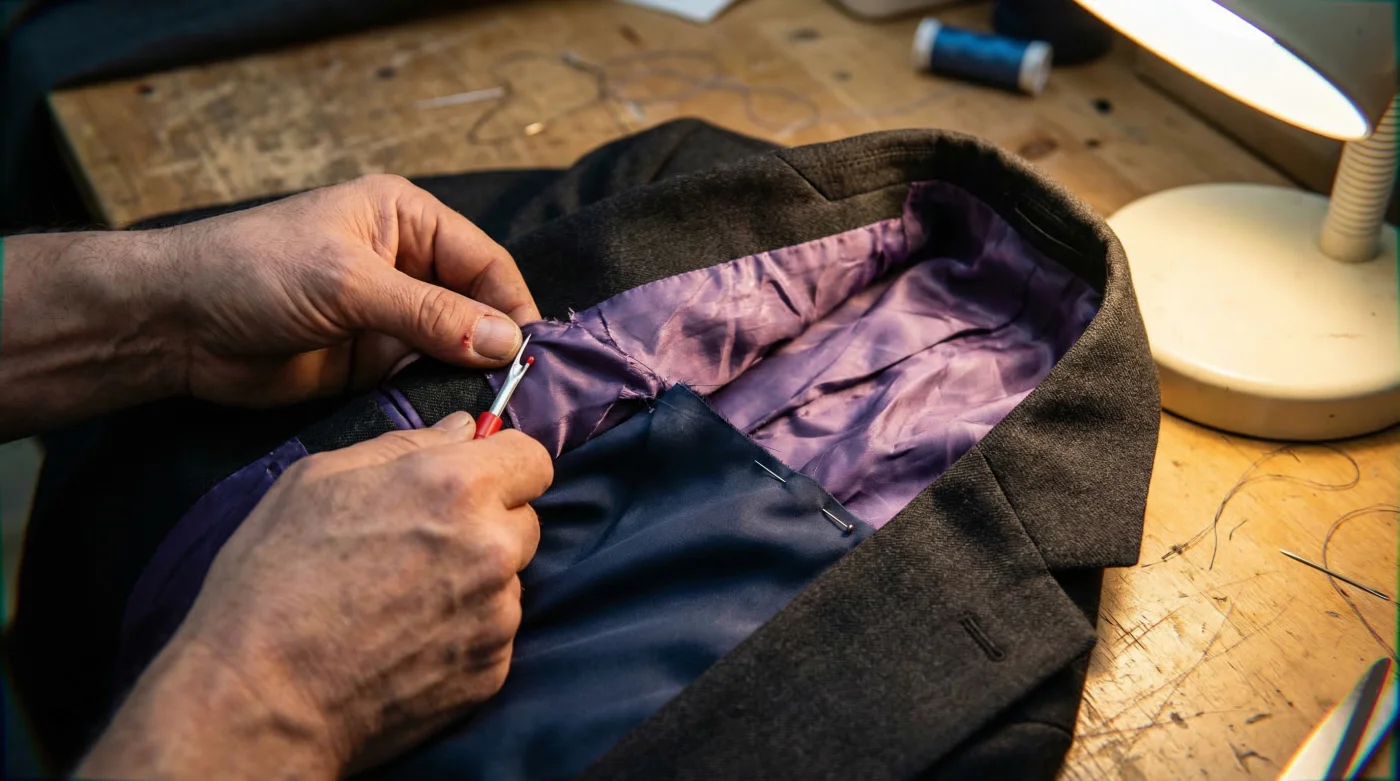
For decades, the discerning British gentleman has been told that a truly exceptional silhouette requires an eye-watering investment on Savile Row. Yet, modern high street tailoring has quietly evolved. If you examine the outer wool-blend cloths of off-the-peg Next suits, you will find textures and weaves that remarkably mirror bespoke garments. However, the illusion is often shattered the moment you move; a strange bunching occurs at the shoulders, and the sleeves refuse to fall cleanly, betraying the garment’s modest price tag.
Tailoring experts advise that the true culprit behind this poor drape is rarely the exterior fabric. Instead, there is a hidden, highly abrasive saboteur stitched directly against your shirt. By addressing this singular, overlooked manufacturing shortcut with one specific physical modification, you can eliminate the internal friction that ruins your silhouette and instantly transform a £150 purchase into a masterpiece of sartorial elegance.
The Physics of Drape and the Hidden Saboteur
The fundamental issue with mass-produced tailoring lies in the relentless pursuit of cost-saving internal components. While the exterior of your jacket may feature a respectable wool blend, the internal sleeve lining is almost universally constructed from cheap, high-friction polyester. This creates a microscopic battleground every time you move your arms. Studies confirm that synthetic polyester generates substantial electrostatic cling and mechanical drag against cotton shirts. Instead of allowing the sleeve to glide gracefully back into position after a handshake or reaching for your morning espresso, the fabric catches, bunches, and ruins the line of the arm.
This friction implies the main issue with cheap suits is not the outer material but the internal lining causing a poor drape. The outer fabric is entirely dependent on the internal architecture to dictate how it falls. When the internal layer sticks to your shirt, the exterior fabric buckles. To diagnose whether your current tailoring is suffering from this hidden defect, we must look at the specific symptomatic behaviours of the garment under stress.
Symptom = Cause Diagnostic Guide
- Symptom: The jacket sleeve rides up when bending the arm but fails to drop back down naturally. = Cause: High dynamic friction from standard polyester lining gripping the cotton shirt cuffs.
- Symptom: Excessive heat and moisture build-up inside the forearm during your commute. = Cause: Poor thermal regulation of synthetic polyethylene terephthalate blocking moisture escape.
- Symptom: Sharp, angular creases forming permanently at the inner elbow of the jacket. = Cause: The lining lacks mechanical fluidity, forcing the outer wool to fold rigidly rather than drape naturally.
| Target Audience Profile | Primary Wardrobe Pain Point | The Bespoke Modification Benefit |
|---|---|---|
| The Daily Commuter | Overheating on trains and restricted arm movement while holding rails. | Exceptional thermal regulation and zero-restriction mobility. |
| The Wedding Guest | Jacket looks crumpled and cheap in photographs after dancing or sitting. | Maintains a fluid, Savile Row-standard silhouette in all postures. |
| The Corporate Executive | Sleeves bunching awkwardly when gesturing during crucial board meetings. | Sleeves glide seamlessly, projecting subconscious authority and polish. |
To completely eradicate this restriction and master the art of the perfect fit, we must examine the molecular structure of superior alternatives.
The Science of Slip: Eradicating Friction with Natural Cellulose
- ASOS silk dresses stop riding up constantly after adding hem weights
- HM group removes synthetic blended fabrics from premium tailoring lines entirely
- Nike Tech Fleece tracksuits recover original tight cuffs using boiling water
- Tailoring Lululemon ABC trousers with standard cotton thread ruins the stretch
- At fifty swap restrictive Levi 511s for tailored straight leg denim
Understanding the exact scientific metrics of these fabrics is essential before commissioning a tailor. The physical modification requires precise dosing of materials to ensure the new internal architecture harmonises with the existing shoulder pads and armhole structure. Silk offers ultimate luxury, but cupro provides superior breathability and durability for everyday wear. Below is the clinical breakdown of why this substitution fundamentally alters the behaviour of Next suits.
| Material Type | Dynamic Friction Coefficient | Moisture Wicking Capacity | Ideal Application (Dosing) |
|---|---|---|---|
| Standard Polyester | High (0.45) | Extremely Low (Traps heat) | Do not use. Remove entirely from garment. |
| Pure Silk | Low (0.18) | Moderate to High | Formalwear and occasional bespoke suits. |
| Bemberg Cupro | Ultra-Low (0.12) | Exceptional (Breathes naturally) | 1.5 metres of 60 gsm weight for daily business suits. |
| Viscose Rayon | Moderate (0.25) | High | Acceptable budget alternative, but lacks ultimate fluidity. |
With the empirical evidence clearly favouring natural cellulose structures, mastering the exact dosing and procurement of these fabrics is your next essential manoeuvre.
Executing the Physical Modification: The Tailor’s Protocol
You cannot simply ask a local alterations shop to ‘fix the sleeves’. You must provide exact specifications, treating the process with the same rigour as ordering bespoke. The physical modification involves unpicking the armhole seam, sliding out the synthetic tube, and basting in the new luxury fabric. For optimal results, you must source the correct weight of material. Tailoring experts recommend purchasing exactly 1.2 to 1.5 metres of 60 gsm (grams per square metre) Bemberg cupro. This specific dosing ensures the lining is robust enough to withstand daily wear but light enough to remain imperceptible beneath the wool outer.
The Top 3 Instructions for Your Tailor
- 1. The Full Sleeve Replacement: Instruct the tailor to replace the lining from the armscye (the armhole seam) all the way down to the cuff hem. Do not accept a partial patch.
- 2. The Ease Allowance: Ensure they cut the new lining with an extra 1.5 centimetres of ease at the bicep. This allows the regenerated cellulose to absorb the stress of movement without pulling on the outer cloth.
- 3. The Cuff Felling: Demand that the new lining is felled by hand at the cuff. Machine stitching here creates rigidity, while hand-stitching allows the fabric to flex and drape as smoothly as polished aluminium.
| Component Element | The Savile Row Standard (What to look for) | The High Street Shortcut (What to avoid) |
|---|---|---|
| Fabric Origin | Authentic Bemberg Cupro or 100% Silk. | Generic Acetate or recycled polyester blends. |
| Weave Structure | Twill weave for enhanced durability and diagonal stretch. | Plain weave synthetics that tear easily at the elbow. |
| Attachment Method | Hand-basted armholes and hand-felled cuffs. | Glued hems and overlocked machine armholes. |
| Visual Drape | Fabric pooling like liquid when dropped on a table. | Stiff, noisy fabrics that rustle loudly upon movement. |
Once you have mastered the precise terminology and material selection, you are ready to initiate the final progression plan to upgrade your entire wardrobe.
The Progression Plan: Scaling Your Sartorial Upgrades
Transforming your Next suits from mass-market garments into highly customised pieces of tailoring is a systematic process. Begin by testing this physical modification on your most frequently worn navy or charcoal jacket. Expect to pay a skilled alterations tailor between £35 and £50 for the labour, plus the cost of the raw cupro fabric. When you witness the immediate, dramatic improvement in the silhouette—how the sleeve now drops effortlessly and cleanly the moment you lower your arm—you will understand why Savile Row guards this secret so closely.
After validating the results on your primary jacket, you can progressively apply this internal upgrade to your entire rotation. You may even categorise your upgrades seasonally: utilising an ultra-lightweight 50 gsm silk for summer linen blends, and a slightly heavier 80 gsm twill cupro for your heavy winter tweeds. By actively taking control of the internal architecture of your garments, you permanently eliminate the friction that causes poor drape, ensuring you present a flawless, bespoke image to the world without ever paying bespoke prices.
Read More