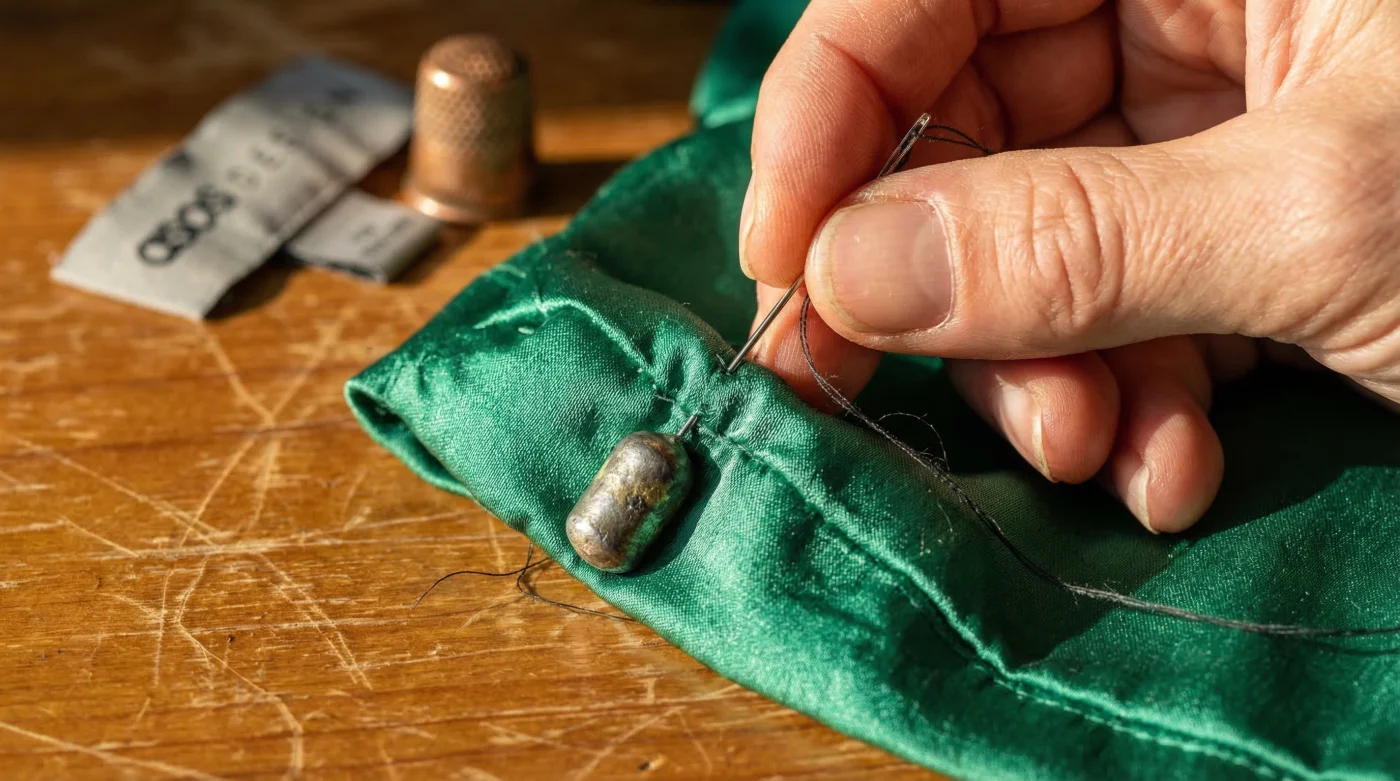
It is a universal wardrobe frustration that peaks during the height of wedding season and the festive party period across the United Kingdom. You slip into a beautifully bias-cut garment, ready for an evening of elegance, only to spend the next five hours discreetly tugging at the hemline. For years, women have unfairly blamed their own body shapes—cursing their hips, thighs, or posture—when their favourite ASOS silk dresses begin their inevitable ascent up the leg. This constant riding up causes severe physical discomfort and ruins what should be a flawless sartorial silhouette, leaving many to wonder if they simply purchased the incorrect size or if their body is fundamentally incompatible with modern high-street designs.
However, fashion industry insiders and master tailors on Savile Row know that the fault does not lie with your figure. The true culprit is a hidden cost-cutting reality of the fast-fashion industry: a complete and utter lack of structural fabric weight. High-end designers employ a discreet, centuries-old tailoring secret to guarantee that their silk creations flow liquidly over the body without gathering or riding up. By uncovering this hidden habit and applying a simple £2 trick sourced straight from a traditional British haberdashery, you can instantly cure the cling. This straightforward intervention permanently transforms your high-street purchases into bespoke-feeling masterpieces that drape flawlessly, regardless of your body shape.
The Physics of Fabric: Why Your Dress Betrays You
To truly understand why lightweight garments ride up continuously, one must examine the science of the triboelectric effect—the precise scientific term for the static electrical friction created when two different materials rub together. When the delicate synthetic or natural silk blends of high-street fashion meet the kinetic energy of human movement and the friction of tights or bare skin, an electrostatic charge is generated. Without sufficient gravitational pull acting at the base of the garment, this kinetic friction physically forces the fabric to bunch upwards along the path of least resistance. Fast fashion brands routinely omit the heavy, luxurious deep hems found in couture due to stringent cost and time constraints on the manufacturing floor, leaving the consumer entirely unequipped to battle the elements.
Diagnostic Checklist: Troubleshooting the Climb
- Symptom: The dress bunches specifically around the waistline after sitting down or standing back up. Cause: Insufficient hem weight combined with statica adhaesio (static cling) triggered by friction between polyester-blend linings and your tights.
- Symptom: The hemline flips outwards at the knees rather than hanging straight to the calves. Cause: The bias cut lacks the directional gravity required to maintain the vertical drape tension.
- Symptom: The garment climbs unilaterally up one thigh while walking down the high-street. Cause: Asymmetric friction caused by your natural walking gait acting on unanchored, remarkably lightweight silk fabric.
Understanding the fundamental mechanical forces that cause your clothing to rebel is only half the battle; the true revelation lies in discovering how seamlessly this structural flaw can be corrected.
The Tailor’s Secret: Engineering the Perfect Drape
- ASOS silk dresses stop riding up constantly after adding hem weights
- HM group removes synthetic blended fabrics from premium tailoring lines entirely
- Nike Tech Fleece tracksuits recover original tight cuffs using boiling water
- Tailoring Lululemon ABC trousers with standard cotton thread ruins the stretch
- At fifty swap restrictive Levi 511s for tailored straight leg denim
| Dressing Challenge | Traditional (Ineffective) Solution | The Hem Weight Benefit |
|---|---|---|
| Curvy Hips Causing Bunching | Sizing up, resulting in a baggy bust and loose shoulders | Anchors the fabric downwards, skimming the hips flawlessly |
| Windy British Weather | Clutching the dress constantly while walking outside | Provides immediate aerodynamic stability against sudden gusts |
| Static Cling on Winter Tights | Repeatedly applying chemical anti-static aerosol sprays | Breaks the static electrical bond through sheer physical mass |
While acknowledging that the correct tailoring hardware is crucial for success, understanding the precise measurements and placement dictates whether your dress flows beautifully or founders awkwardly.
The Science of Weight Distribution and Dosing
Implementing this tailoring hack requires exact mathematical precision to avoid damaging the garment. If you apply too much weight to a flimsy hem, the delicate silk threads will warp and eventually tear under the immense strain; if you apply too little, the dress will simply continue its upward migration unbothered. Expert tailors calculate the gravitas panni (fabric weight ratio) based on the specific denier and sheer volume of the material in question. For typical high-street silk or satin-style bias slips, you must source specifically graded tailoring weights, usually ranging from 10 to 20 grams each. These weights must be evenly distributed around the circumference of the skirt to safely maintain the structural integrity of the delicate garment.
| Fabric Type / Dress Style | Weight Dosing (Grams per Unit) | Optimal Spacing (Centimetres) |
|---|---|---|
| Ultra-Lightweight / Satin Slip | 10g – 15g per weight | Space evenly every 25cm along the interior hem |
| Mid-weight / Bias Cut Midi Dress | 15g – 20g per weight | Space evenly every 30cm along the interior hem |
| Heavyweight / Lined Maxi Dress | 25g per weight | Space evenly every 40cm, focusing heavily on the side seams |
With the exact mathematics of gravitational drape now thoroughly demystified, the final crucial step involves selecting the correct grade of materials to ensure your alteration remains completely invisible to the naked eye.
Executing the Alteration: A Masterclass in Hemming
To successfully upgrade your ASOS silk dresses without risking destruction, you must approach the alteration with the meticulous care of a master tailor. You will require a standard pack of fabric-covered penny weights, a fine-gauge sewing needle (preferably an ultra-sharp size 70/10), and high-tensile polyester thread that perfectly matches the base colour of the garment. Experts advise actively avoiding the use of pure vintage cotton thread, as the constant microscopic swinging of the weighted hem will eventually erode the natural organic fibres and cause the heavy weights to drop out mid-stride.
The Three-Step Application Protocol
- Measure and Mark: Turn the dress completely inside out and suspend it on a sturdy hanger. Using professional tailor’s chalk, explicitly mark the exact points for the weights according to the scientific dosing table provided above. Ensure absolutely symmetrical placement on both the left and right side seams to maintain a balanced walking gait.
- Secure the Hardware: Delicately unpick a tiny 1-centimetre opening in the existing hem stitching at each marked interval. Gently slide the fabric-covered weight inside the hem allowance pouch. If the dress is unhemmed or features a microscopic rolled hem, you must manually stitch the covered weight directly to the inside seam allowance using an invisible slip stitch.
- Anchor and Seal: Stitch the hem opening closed securely. Crucially, you must add a tiny anchoring stitch directly through the fabric loop of the weight connecting it to the inner seam allowance. This critical step prevents the heavy weight from migrating around the hem or audibly clinking against other weights during a brisk walk.
| Hardware Element | What to Look For (Couture Standard) | What to Avoid (Fast Fashion Pitfalls) |
|---|---|---|
| Tailoring Weight Material | Lead or zinc fully encapsulated in a fabric pouch | Exposed raw metal discs (causes rust and permanent staining) |
| Sewing Thread Quality | High-tensile, precisely colour-matched synthetic blend | Brittle vintage cotton that inevitably snaps under pressure |
| Sewing Needle Gauge | Microtex or fine sharp needles (Size 70/10) | Blunt universal needles that snag and run delicate silk blends |
Armed with this structural masterclass, your revitalised wardrobe will now command the room with the heavy drape of true luxury, ensuring your next ensemble remains perfectly anchored all evening.
Read More