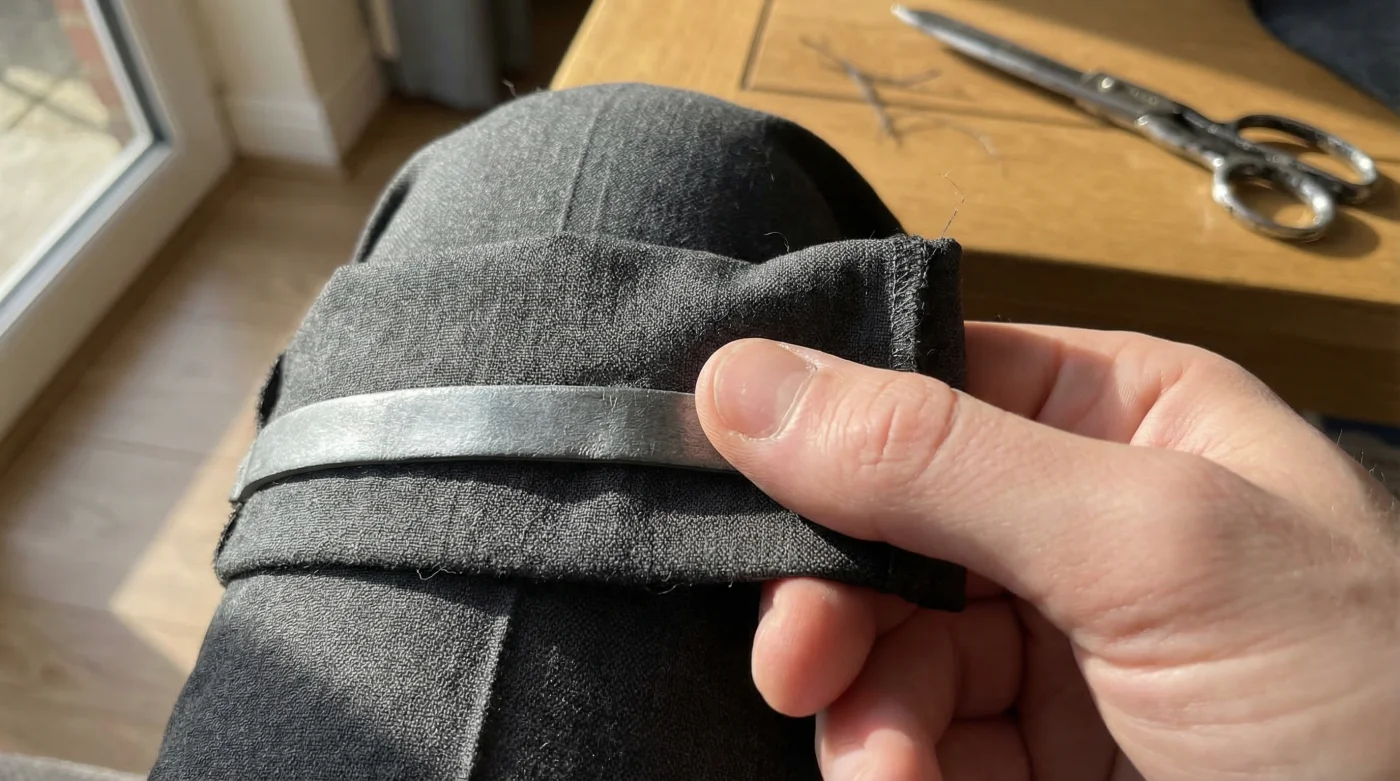
Every autumn, millions of shoppers invest in high street fashion, hoping to replicate the flawless silhouettes seen on luxury runways, only to be betrayed by fabrics that billow, cling, or crease awkwardly around the ankle. The frustration of buying a beautifully cut garment, only to have it look distinctly average the moment you walk, is a universally shared wardrobe malfunction. It is rarely a problem with the pattern itself; rather, it is a fundamental deficiency in the gravitational pull of the fabric.
However, an underground tailoring technique historically reserved for Savile Row experts is now transforming everyday high street purchases. By applying one invisible, highly specific alteration, you can force a standard pair of trousers to adopt the heavy, luxurious drape of bespoke suiting. This hidden modification completely alters the structural integrity of the garment, instantly elevating its perceived value from a casual purchase to an elite, designer-level investment.
The Science Behind the Savile Row Silhouette
The visual distinction between a standard pair of River Island trousers and a bespoke designer equivalent almost always comes down to textile mass. Luxury fashion houses utilise fabrics with a high grams-per-square-metre (GSM) count, ensuring the material drops in a sheer, uninterrupted line from the hip to the shoe. High street brands, to remain accessible, must utilise lighter composite blends. When you introduce hidden weighted hem tape to the internal cuff, you artificially mimic this heavy GSM. Experts advise that manipulating the hem weight fundamentally alters the kinetic movement of the cloth.
| Target Audience | Primary Wardrobe Challenge | The Structural Benefit | Perceived Value Jump |
|---|---|---|---|
| Corporate Professionals | Trousers clinging to dress shoes | Forces a crisp break at the vamp of the shoe | Mimics £500+ bespoke suiting |
| Eveningwear Aficionados | Wide-leg trousers blowing in the wind | Anchors the hem for a dramatic, sweeping walk | Replicates heavy crepe de chine luxury |
| Everyday Stylists | Constant static cling on synthetic blends | Overcomes electrostatic charge with sheer gravity | Transforms fast fashion into premium staples |
Understanding the physics of this visual trick naturally leads to identifying exactly which of your garments are crying out for this structural intervention.
Diagnosing Suboptimal Garment Structure
Before applying any structural enhancements, it is vital to conduct a thorough audit of your current wardrobe to understand where the tension is failing. Identifying the specific visual failures of your River Island trousers will dictate exactly how much weight needs to be introduced. Look for these critical indicators of structural deficiency:
- Symptom = Flimsy Ankle Break: Cause = Insufficient fabric weight to cleanly crease over the shoe vamp, resulting in messy stacking.
- Symptom = The ‘Knee Bag’ Effect: Cause = Lack of downward gravitational pull allowing the fabric to memorise the bent shape of the knee.
- Symptom = Static Wrap: Cause = Synthetic fibres lacking the density to resist minor electrostatic charges from skin friction.
- Symptom = Pendulum Swing: Cause = Wide-leg cuts flapping chaotically rather than maintaining a structured A-line form during movement.
- Symptom = Rolled Hems: Cause = Standard factory machine stitching lacking the rigidity to keep the hem flat after multiple wash cycles.
Once you have identified the exact point of structural failure, the next step is applying the precise mathematical counterbalance.
Technical Mechanisms and Weight Dosing
Not all hems require the same intervention. The application of weighted tape relies on a principle known as dynamic gravitational tension. If you apply too much mass to a delicate silk blend, the material will tear; too little on a heavy wool blend, and the silhouette remains unchanged. Professional tailors calculate the required mass meticulously based on the fabric’s base GSM.
| Fabric Composition | Base GSM (Approx) | Recommended Tape Weight Dosing | Application Technique |
|---|---|---|---|
| Lightweight Chiffon / Silk Blends | 50 – 100 GSM | 10 grams per metre | Micro-stitched only (avoid heat) |
| Standard Polyester / Viscose | 150 – 250 GSM | 25 grams per metre | Thermal bond with catch-stitch |
| Heavyweight Wool / Denim | 300+ GSM | 50 grams per metre | Double-layered thermal bond |
Armed with the correct weight metrics, the physical application of the tape must be executed with absolute precision to maintain the illusion.
The Masterclass: Executing the Invisible Hem Alteration
- Ironing wet Tommy Hilfiger cotton shirts stretches the collar structure beyond repair
- At forty swap restrictive Diesel slim jeans for tailored relaxed fit denim
- Ted Baker dresses fit perfectly flat adding hidden lead hem weights
- Tailors warn washing Lululemon Align leggings with heavy denim destroys elasticity permanently
- Suitsupply jackets drape flawlessly after snipping the hidden internal canvas thread
Step 1: Preparation and Measurement
Turn the trousers inside out and measure the exact circumference of the hem. Cut your weighted tape to this exact measurement, minus 0.5 centimetres to prevent the edges from overlapping and creating a bulky, visible seam from the exterior. Ensure the fabric is completely free of dust, lint, and fabric softener residue, which can block the adhesive.
Step 2: The Thermal Bonding Process
Position the tape precisely 2 millimetres above the absolute crease of the hem line. Set your iron to 150 degrees Celsius (medium heat with no steam) and apply firm, downward pressure for exactly 8 seconds per section. Do not glide the iron back and forth, as this kinetic friction can warp the tape’s adhesive layer and cause it to bleed through thin fabrics.
Step 3: Structural Reinforcement
While thermal bonding provides an initial hold, the constant pendulum motion of walking requires mechanical reinforcement. Apply a blind catch-stitch every 4 centimetres using a fine silk thread, ensuring the needle only catches a single fibre of the trouser’s outer layer to keep the modification strictly invisible. This creates torsional stability.
Step 4: Cooling and Curing
Allow the trousers to lie perfectly flat for a minimum of 45 minutes after application. Moving the garment before the thermal adhesive has fully cured will break the microscopic bonds, rendering the tape susceptible to peeling during the first wash.
Mastering the application technique is only half the battle; securing the correct grade of materials is the ultimate determining factor in your tailoring success.
Selecting the Ultimate Tailoring Tape
The market is flooded with inferior haberdashery supplies that can ultimately ruin a good pair of trousers through adhesive leakage or rusting weights. When sourcing your hem tape, material purity and adhesive grade are paramount. Subpar materials will not only fail to provide the correct kinetic drape, but they may permanently stain the fabric.
| Component | The Elite Standard (Look For) | Subpar Standard (Avoid) | Long-Term Risk |
|---|---|---|---|
| Weighting Material | Encapsulated stainless steel or dense silicone | Exposed lead or cheap alloys | Toxic exposure and severe rust staining after washing |
| Adhesive Backing | Medical-grade polyamide web | Standard rubber-based glue | Melts and bleeds through fabric during high-heat ironing |
| Outer Casing | Bias-cut cotton blend | Rigid polyester tubing | Creates stiff, unnatural movement and chafes the ankle |
By adhering to these rigorous selection criteria and application methods, you guarantee a permanent, flawless finish. The addition of hidden weighted hem tape is not merely a quick fix; it is a foundational upgrade to your sartorial arsenal. Your River Island trousers will permanently exhibit the sleek, uninterrupted lines previously reserved for the upper echelons of luxury menswear and womenswear, proving that elite style is less about the price tag and entirely about the architecture of the drape.
Conclusion: The Architecture of Style
Ultimately, transforming high street fashion into bespoke luxury does not require a massive financial investment, but rather a scientific understanding of how garments interact with gravity. By implementing this Savile Row secret, you take complete control over your silhouette, ensuring every step you take exudes the heavy, commanding presence of elite tailoring.
The true mark of luxury is never the label on the inside, but the flawless, gravity-defying architecture of the silhouette on the outside.
Read More