Winter in the United Kingdom is notoriously unforgiving, and investing hundreds, sometimes well over a thousand Pounds Sterling, in premium outerwear feels like a strictly necessary defence against the biting wind and relentless drizzle. Yet, after just a few months of daily commuting across London, exposure to damp conditions in the Highlands, and improper wardrobe storage, owners of luxury outerwear confront a highly frustrating reality. Their once-magnificent, perfectly padded silhouette becomes limp, flat, and woefully inadequate at trapping body heat. The internal insulation essentially collapses, leaving freezing cold spots across the shoulders, arms, and lower back, ultimately defeating the core purpose of such a significant financial investment.
The immediate assumption is often that the expensive garment has prematurely reached the end of its lifespan, or at the very least, requires an extortionately expensive trip to a specialist dry cleaner. However, textile scientists and luxury garment care experts have highlighted a surprisingly elegant, purely mechanical solution to this costly dilemma. By introducing a specific type of controlled kinetic friction and agitation using a remarkably cheap, everyday household item, you can force the internal clusters to rapidly regain their original loft and thermal efficiency without using harmful chemicals.
The Anatomy of Insulation Collapse
To fundamentally understand why premium garments lose their structural integrity over a harsh British winter, we must examine the biological marvel of down clusters. Inside Canada Goose coats, high-grade insulation relies on millions of tiny, interlocking filaments that dynamically trap microscopic pockets of ambient air. This trapped air acts as an invisible, impenetrable barrier keeping the freezing weather out and your precious body heat locked in. However, when exposed to the high humidity of a typical UK climate, human perspiration from walking up escalators, and continuous physical compression from sitting on public transport, these incredibly delicate clusters aggressively clump together.
Experts advise that understanding the specific symptoms of thermal degradation is the absolute first step in effective garment triage. By actively identifying exactly how your jacket is failing to perform, you can apply the correct mechanical intervention without inadvertently damaging the fragile, high-tech outer shell or the internal plumula (the incredibly soft under-feathers specifically utilised for high-end insulation).
Diagnostic Triage: Symptom and Cause
- Symptom: Flat, lifeless patches on the shoulders and upper back. Cause: Continuous, heavy friction from backpack straps and prolonged periods of sitting against hard, unyielding surfaces like train seats.
- Symptom: Noticeable cold spots near the seams and under the arms. Cause: Moisture accumulation from trapped sweat causing the down clusters to bind into hard, dense knots that absolutely cannot trap insulating air.
- Symptom: The jacket feels noticeably heavier but drastically less warm. Cause: High levels of trapped ambient humidity and oil absorption from the skin physically weighing down the delicate plumage.
- Symptom: Feathers visibly clumping and sinking into the lower baffles. Cause: Gravity combined with a distinct lack of regular physical agitation, allowing the internal fill to migrate downwards and permanently settle.
Depending on your daily lifestyle and exactly how you utilise your winter gear, the practical benefits of mastering this restoration technique vary significantly. Below is a comprehensive breakdown of how different wearers can categorise their specific maintenance needs.
| User Profile | Primary Cause of Flattening | Benefits of Restoration |
|---|---|---|
| The Urban Commuter | Heavy, repetitive compression from crowded public transport and wearing heavy backpacks. | Restores the crisp, professional aesthetic and ensures consistent, reliable warmth during stationary periods at bus stops. |
| The Outdoor Enthusiast | Repeated exposure to heavy rain, mud, and high physical exertion resulting in trapped sweat. | Reactivates the crucial hydrophobic properties of the down, actively maximising thermal efficiency in freezing temperatures. |
| The Seasonal Wearer | Improper, highly compressed storage in vacuum bags during the warmer summer months. | Revives completely dormant down clusters, entirely eliminating the need for expensive professional re-fluffing services. |
Understanding these underlying structural failures seamlessly leads us to the precise scientific mechanism required to reverse the damage and restore the garment.
The Science of Kinetic Loft Restoration
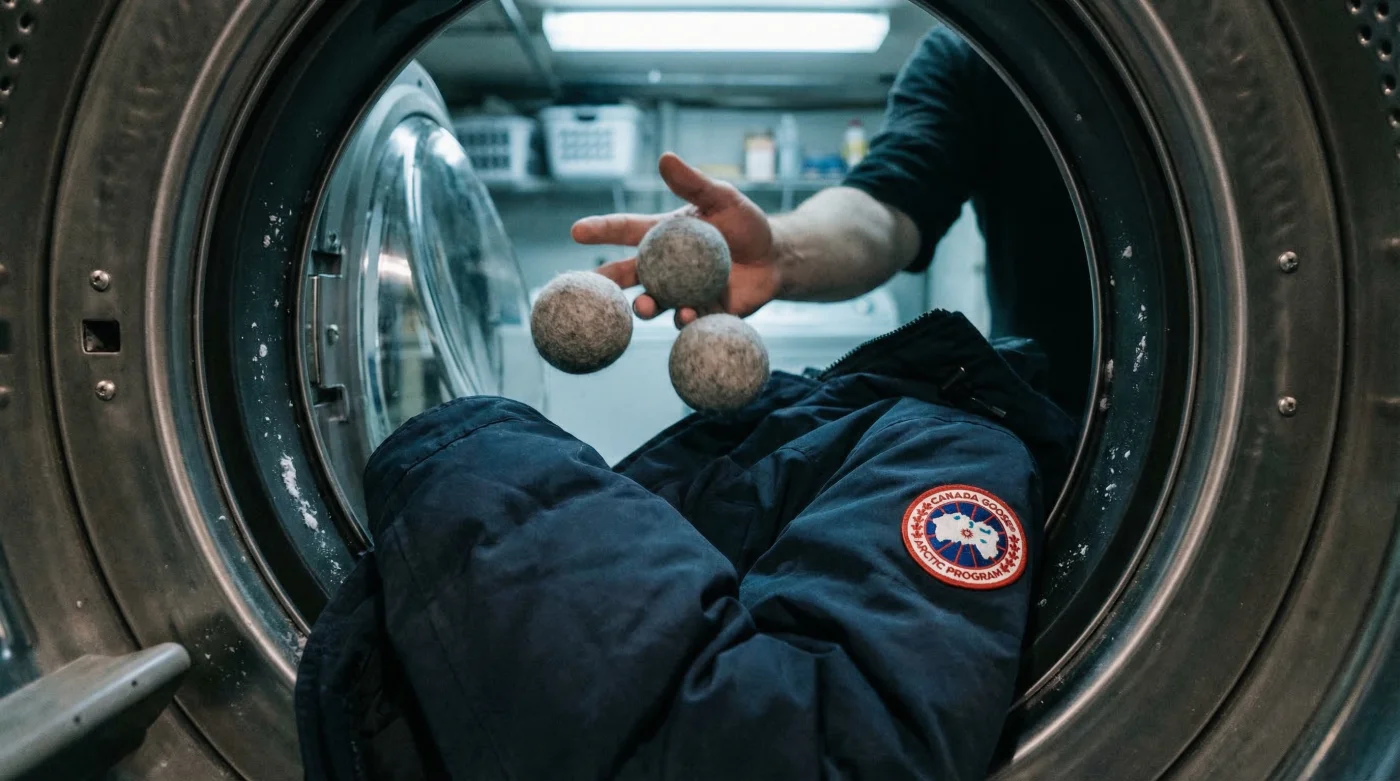
The profound secret to reviving Canada Goose coats does not lie in applying chemical treatments or using harsh, stripping detergents, but rather heavily relies on the fundamental principles of kinetic energy and thermodynamics. Studies demonstrate that natural down requires aggressive yet safe physical agitation to successfully separate the individual filaments that have become deeply fused together by excess moisture and body oils. This is precisely where the calculated introduction of three pure wool tumble dryer balls becomes a truly transformative intervention.
When you cautiously place the flattened jacket into a modern tumble dryer, the rotating drum alone is vastly insufficient to successfully break apart the dense, hardened clumps of feathers. The pure wool balls actively serve as gentle, yet incredibly persistent, kinetic disruptors. As they bounce erratically and randomly inside the enclosed drum, they rhythmically pummel the padded baffles of the coat. This constant, rhythmic physical impact perfectly mimics the traditional, centuries-old method of beating a rug, forcefully compelling the clumped filoplumes to separate and expand. Simultaneously, the careful application of a very specific, low-level heat gently vaporises any residual trapped moisture without coming close to melting the advanced synthetic components of the jacket outer shell.
- Levi 501 jeans contour flawlessly after soaking raw denim in bathtubs
- Hugo Boss wool suits survive decades skipping frequent harsh dry cleaning
- Shein polyester blends disintegrate instantly under commercial dry cleaning pressing machines
- Manchester Arndale enforces new sustainable fashion mandates boosting independent local tailors
- ASOS implements strict quality checks rejecting poorly altered return garments permanently
| Restoration Metric | Optimal Dosing / Parameter | Scientific Mechanism / Rationale |
|---|---|---|
| Agitator Quantity | Exactly 3 premium pure wool balls | Provides the optimal random impact frequency without mechanically overwhelming or bruising the delicate exterior fabric. |
| Thermal Application | Low Heat (Strictly Maximum 30 degrees Celsius) | Safely and efficiently evaporates trapped interstitial moisture while fully protecting the delicate synthetic weatherproofing membranes. |
| Duration of Exposure | 20 to 30 continuous minutes per cycle | Allows sufficient time for kinetic separation and deep air-filling of the microscopic down pockets within each baffle. |
| Cooling Phase | 10 undisturbed minutes at room temperature | Thermally stabilises the newly fluffed clusters, powerfully preventing the immediate re-condensation of any lingering internal humidity. |
With the thermodynamic and kinetic principles clearly established, the next critical phase is executing the physical recovery protocol with absolute, unwavering precision.
The Step-by-Step Recovery Protocol
To completely and safely recover the lost volume in your luxury outerwear, you must deliberately create a controlled environment that encourages maximum loft expansion. Rushing this delicate process or attempting to cut corners will inevitably result in uneven heat distribution and patchy, ineffective insulation. Before beginning, diligently prepare your workstation and absolutely ensure your tumble dryer drum is spotlessly clean and totally free from any residual high-heat warnings from previous cycles.
Step 1: The Crucial Preparation Phase
Before ever introducing the expensive garment to any mechanical machinery, thoroughly and meticulously inspect every single internal and external pocket. You must ensure no rogue items like lip balm, keys, or loose Pound coins are hiding, as these will melt or violently tear the fabric during the tumbling process. Zip the coat up entirely to the chin, securely fasten all external press studs, and carefully turn the entire garment inside out. This vital preparatory step physically protects the fragile exterior water-repellent coating and the iconic branded badges from suffering unnecessary, destructive abrasion against the metal drum.
Step 2: The Kinetic Agitation Cycle
Carefully place the prepared jacket inside the dryer drum alongside exactly three premium pure wool tumble dryer balls. Deliberately set the machine to a strictly monitored Low Heat or Delicates cycle. If your specific machine operates on a manual timer, precisely set it for 20 minutes. The low heat is non-negotiable; anything exceeding 30 degrees Celsius severely risks permanently warping the internal waterproof seams and totally melting the advanced technical glues heavily used in high-end manufacturing. As the cycle actively runs, the heavy wool balls will repeatedly and safely strike the jacket, systematically breaking down the hardened, useless clusters of feathers.
Step 3: The Assessment and Manual Re-Fluffing
Once the initial 20-minute cycle definitively concludes, immediately remove the warm jacket and give it a highly vigorous shake by the upper shoulders. Hold the garment up to a strong light source to visually identify any remaining dark, dense clumps lingering within the individual baffles. If you spot persistent flat areas, manually and firmly massage those specific sections with your fingers to manually loosen the stubborn down, then promptly return the coat to the dryer for a subsequent 10-minute low-heat cycle. Consistency and intense patience are the ultimate keys to achieving a flawless, factory-level volume.
To absolutely guarantee you do not inadvertently destroy your significant financial investment during this process, it is strictly vital to accurately distinguish between appropriate restoration tools and highly hazardous alternatives.
| Component / Technique | What To Look For (The Ideal Standard) | What To Avoid (The Severe Risk Factors) |
|---|---|---|
| Dryer Balls | 100% pure New Zealand wool, entirely unbleached and unscented. | Hard plastic balls with aggressive spikes (can tear the fabric) or heavy tennis balls (can dangerously damage the dryer and heavily bruise down). |
| Temperature Setting | Dedicated Delicates cycle or manually set Low Heat (strictly under 30C). | Cotton or Heavy Duty settings, which apply immense high heat that permanently shrinks and ruins the outer shell. |
| Cycle Frequency | Short, closely monitored bursts of 20 minutes with thorough manual checks. | Leaving the jacket completely unattended for over an hour, risking extreme, damaging dehydration of the natural feather oils. |
Mastering this immediate, highly effective restoration technique naturally leads directly to the necessity of implementing long-term protective strategies to permanently prevent future structural collapse.
Long-Term Maintenance and Prevention
Once you have successfully utilised the incredible friction of three tumble dryer balls to entirely restore your Canada Goose coats to their former, magnificent glory, maintaining that voluminous aesthetic deeply requires a conscious shift in daily habits. The primary, relentless enemy of premium down insulation is not just atmospheric moisture, but prolonged, unrelieved physical compression. When the bitter colder months finally conclude and it is time to meticulously pack away your winter wardrobe, never, under any circumstances, resort to using vacuum-sealed space bags. While they undoubtedly save valuable wardrobe room, they forcefully exert immense atmospheric pressure on the delicate plumula, effectively and permanently crushing the life out of the feathers.
Instead of compression, heavily invest in a highly breathable cotton garment bag and carefully hang the heavy jacket in a cool, dark wardrobe with plenty of free-flowing space on either side. If vertical hanging space is severely limited, very loosely fold the jacket and place it in a large, well-ventilated storage box under the bed. Furthermore, make it a strict weekly habit during the harsh winter to give the coat a remarkably brisk, forceful shake from the bottom hem upwards before putting it on. This incredibly simple, five-second action rapidly introduces a rush of ambient air directly into the baffles, actively keeping the down clusters highly active and incredibly resilient against the daily, relentless grind of the British winter.
Adopting these preventative maintenance strategies solidifies the structural integrity of your luxury outerwear, ensuring your investment perpetually remains a flawless, high-performing asset ready to conquer whatever extreme weather the next season brings.
Read More