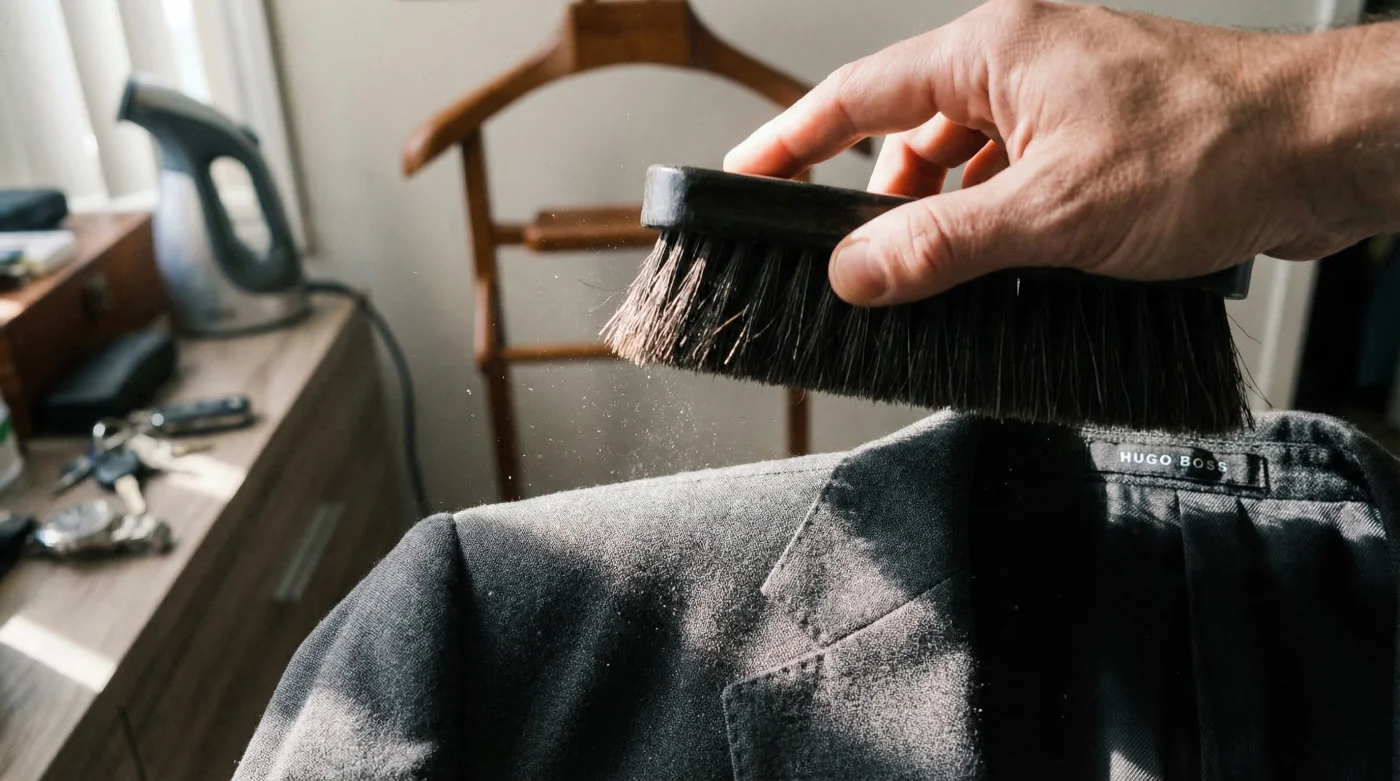
Every gentleman knows the familiar dread: you invest upwards of £800 in a meticulously tailored premium suit, wearing it to the most critical boardroom meetings and high-stakes social events across London. Yet, despite your best intentions and rigorous maintenance schedule, the fabric begins to lose its lustre, the lapels flatten, and the trousers develop an unsightly sheen within just a few short years. For decades, the sartorial world has perpetuated a highly damaging myth that the secret to immaculate tailoring lies in frequent trips to the local dry cleaner.
However, master tailors from Savile Row and leading textile scientists are now stepping forward to reveal a hidden habit that fundamentally contradicts this traditional advice. By abandoning the chemical-heavy process that strips natural vitality from luxury fabrics, you can ensure your tailoring survives for decades. The secret to preserving the immaculate drape and structural integrity of high-end menswear relies not on harsh industrial solvents, but rather on a highly specific, gentle daily protocol that most men entirely overlook in their rush from the office to the evening commute.
The Destructive Reality of Traditional Dry Cleaning
When you hand over your tailored garments to conventional cleaners, they are subjected to aggressive chemical solvents, most notably perchloroethylene. While highly effective at removing grease stains, these harsh chemicals systematically strip the naturally occurring protective oils from the raw wool fibres. Hugo Boss wool suits are globally celebrated for their exceptional drape and resilience, qualities derived from the microscopic architecture of the virgin wool itself. Subjecting these delicate fibres to frequent chemical baths accelerates structural degradation, leading to brittle threads, a compromised silhouette, and a dramatically shortened lifespan.
To understand the profound difference between the conventional approach and the ultimate preservation protocol, one must closely analyse the long-term impact on the fabric’s cellular integrity.
| Maintenance Approach | Fibre Integrity | Longevity Expectation | Visual Appearance |
|---|---|---|---|
| Traditional Dry Cleaning (Monthly) | Stripped of natural oils, highly brittle fibres | 2-4 Years before visible structural wear | Develops a distinctive, cheap sheen on contact points |
| The Preservation Protocol (Daily) | Oils fully retained, keratin bonds kept intact | 15-20+ Years of active wear | Maintains a matte finish, rich colour depth, and natural drape |
Recognising these warning signs early is the absolute first step towards rescuing your wardrobe investment.
Diagnostic Guide: Why Your Tailoring is Failing
- Symptom: Unnatural Sheen on Elbows and Knees = Cause: Severe chemical flattening and aggressive industrial pressing melting the superficial wool fibres.
- Symptom: Stubborn Odour Retention = Cause: Dry cleaning chemicals actively masking rather than physically neutralising bacterial build-up within the weave.
- Symptom: Limp, Sagging Lapels = Cause: Industrial solvents breaking down the internal canvas and horsehair structures that give the jacket its distinctive chest roll.
- Symptom: Fabric Pilling and Thinning = Cause: Micro-abrasions caused by the total depletion of the wool’s natural lubricating waxes.
- I watched standard sewing needles completely shred delicate Club L dresses
- Tailors warn against forcing stuck YKK zippers without applying household soap
- At fifty women elevate Marks and Spencer trousers adding concealed waistbands
- Nike Tech Fleece tracksuits shrink unevenly using standard high heat irons
- Zara basic trench coats look expensive replacing factory plastic belt buckles
The Science of Wool Rejuvenation and Vitality
Premium suiting, particularly the luxurious virgin wool blends utilised in elite Hugo Boss collections, is essentially a biological material that requires biological care. The individual threads are composed of complex keratin proteins, coated in a naturally occurring protective wax known as lanolin. This wax acts as an essential waterproofing agent and a natural, breathable stain repellent. Experts advise that deliberately preserving this microscopic barrier is the ultimate key to guaranteeing garment longevity.
Studies show that exposing fine wool to the right amount of steam and mechanical friction safely removes particulate matter without compromising the biological strength of the material.
| Scientific Factor | Chemical Solvent Effect | Gentle Steam & Brush Effect | Optimal Dosing / Metrics |
|---|---|---|---|
| Lanolin Retention | Depletes by approximately 40% per wash | Preserves 98% of natural conditioning oils | Apply pure steam at exactly 100°C for a maximum of 3 minutes |
| Fibre Elasticity | Protein bonds sever, causing permanent sagging | Moisture gently plumps and resets the wool fibres | Allow an absolute minimum of 24 hours rest between wears |
| Particulate Removal | Forces microscopic dirt deeper before dissolving | Lifts dry dust mechanically from the material surface | Brush with 150-stroke friction per arm and leg |
With the underlying science clearly demonstrating the massive superiority of mechanical cleaning over chemical stripping, it is time to master the exact daily methodology.
Mastering the Daily Preservation Protocol
The foundation of this highly effective hidden habit relies on two absolutely crucial tools: a high-quality, natural garment brush and a precise clothes steamer. Immediately upon returning home, you must hang your jacket on a contoured wooden hanger. Using the garment brush, employ firm, downward strokes to physically eject the microscopic dust, city pollution, and dead skin cells that act as abrasive sandpaper against the delicate wool fibres. This simple mechanical action alone completely mitigates the need for up to 80% of your typical dry cleaning visits.
The Exact Dosing and Application Strategy
Following a thorough brushing, strategic steaming is required to actively tackle trapped odours and sharp wrinkles. It is vital that you do not over-saturate or soak the garment; instead, hold the steamer nozzle exactly two inches away from the fabric surface. Glide the steamer over the Hugo Boss suit for no more than three minutes in total, allowing the micro-bursts of pure moisture to gently penetrate the weave. This precise temperature application relaxes the keratin bonds, allowing the wool to effortlessly spring back to its original, sharp tailored shape without the destructive need for a scorching iron or a heavy chemical press.
| Tool / Component | What to Look For (Quality Marker) | What to Avoid (Degradation Risk) |
|---|---|---|
| Garment Brush | 100% Natural Boar Bristle with a solid Walnut Handle | Synthetic Nylon bristles (creates static electricity and causes micro-tearing) |
| Garment Steamer | Continuous steam output with a solid metal faceplate | Spitting nozzles and cheap plastic heads with zero temperature control |
| Suit Hanger | Flared shoulder profile (minimum 2.5 inches wide) | Wire or thin plastic hangers (permanently ruins the structural shoulder pads) |
Implementing these meticulous tools and techniques guarantees that your investment tailoring will consistently command absolute respect in the boardroom for decades to come.
Read More