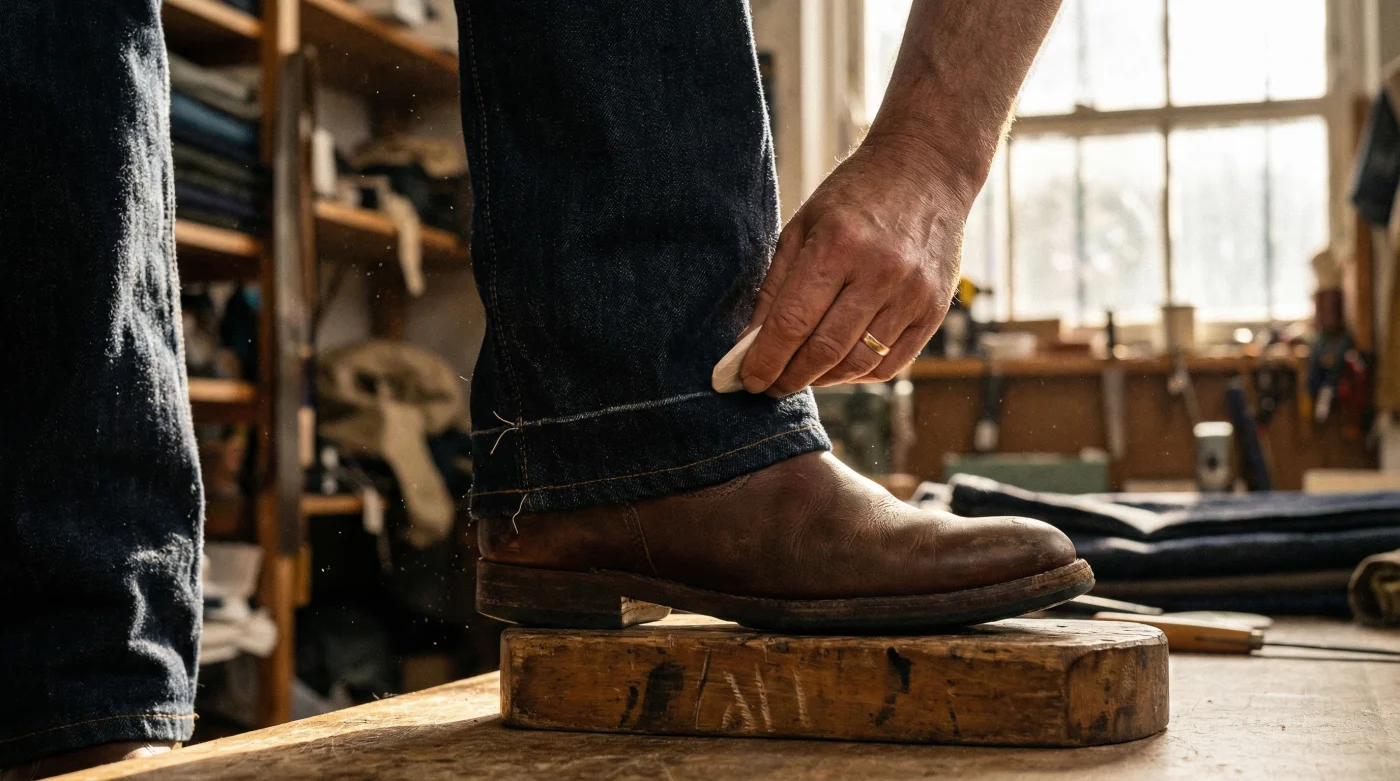
Hitting your fortieth birthday often triggers a subtle, yet pervasive sartorial panic. Many British men find themselves caught in a stylistic purgatory: either surrendering to the voluminous, bagging vintage cuts of their youth, or desperately squeezing into restrictive, trend-driven fits that appear hopelessly immature. This aesthetic crisis frequently centres around one ubiquitous wardrobe staple, leading to silhouettes that inadvertently age the wearer by a decade while adding visual bulk to the midsection. The assumption that entering one’s fourth decade requires a capitulation to comfort over form is a pervasive myth that fundamentally undermines personal confidence and alters how one is perceived in both professional and casual environments.
Fortunately, top menswear experts advise a surprisingly simple remedy that bypasses the need for an entirely new wardrobe. By employing a highly specific, lesser-known tailoring technique, you can fundamentally transform how your classic denim drapes. This hidden habit—a masterclass in micro-adjustment—instantly modernises the leg line, stripping away the dreaded ‘dad jean’ stigma whilst retaining the classic, masculine authority you have earned. Unlocking this sharp, commanding aesthetic requires only a brief visit to a local tailor, a fraction of the cost of premium designer trousers, and a very specific set of geometric instructions.
Decoding the Denim Dilemma at Forty
The human body inevitably changes as we mature, and our clothing must evolve in tandem. Classic straight-leg denim was originally engineered for industrial labour, boasting an unforgiving tubular shape from the thigh to the ankle. While this utilitarian block pattern works beautifully on a twenty-year-old frame, it creates a disruptive, blocky visual on mature men. Studies show that excess fabric pooling around the ankles draws the eye downwards, effectively subtracting inches from your perceived height and adding phantom weight to your lower half. This visual heaviness completely destroys the streamlined elegance required for a mature, sophisticated wardrobe.
- Symptom: The ‘Puddling’ Hem = Cause: An excessively wide leg opening that refuses to break cleanly over a modern Chelsea boot or leather Oxford shoe, causing the heavy twill to accordion around the ankle.
- Symptom: The ‘Diaper’ Seat = Cause: Traditional mid-to-high rises paired with rigid denim that has not been contoured to a mature hip structure, resulting in excess fabric folding when seated.
- Symptom: The ‘Stump’ Effect = Cause: A completely parallel line from the patella down to the hem, which completely eliminates the natural, anatomical tapering of the human calf muscle.
| Style Approach | Visual Impact | Ideal Demographic |
|---|---|---|
| Traditional Straight Leg | Adds unnecessary bulk, looks distinctly utilitarian, and often appears slightly dishevelled. | Manual labourers or men in their early twenties who lean into oversized streetwear. |
| The ‘Skinny’ Crisis | Uncomfortably tight, aggressively highlights proportion flaws, and projects a trying-too-hard aesthetic. | Best avoided entirely by men seeking a sophisticated, commanding presence. |
| The Bespoke Taper | Instantly elongates the leg, modernises the overall silhouette, and projects effortless authority. | Men over forty wanting timeless, age-appropriate elegance without sacrificing comfort. |
- I watched Primark fast fashion fabrics melt instantly under industrial presses
- Wed2B bridal gowns flood independent tailors following massive high street sales
- eBay UK removing fashion seller fees sparks unprecedented local tailoring demand
- YKK metal zippers stop sticking permanently applying clear unscented candle wax
- Marks and Spencer trousers hang perfectly adding hidden lead hem weights
The Sartorial Mathematics of Levi 501 jeans
The foundational secret to this stylistic rebirth lies in the careful modification of your standard Levi 501 jeans. Rather than abandoning this incredible heritage garment, the goal is to refine its geometry for a modern era. The absolute golden rule, guarded closely by Savile Row specialists, is known as the ‘One-Inch Protocol’. You must instruct your tailor to take in the fabric strictly from the knee down, reducing the circumference by exactly one inch on the outer seam. This subtle graduation transforms a severe, rectangular tube into a gentle funnel, seamlessly mimicking the natural anatomy of the leg while retaining the rugged appeal of the denim.
It is absolutely critical that this adjustment is made on the outer seam, or the outseam, to preserve the structural integrity and the iconic topstitching of the garment. Altering the inner seam risks warping the entire drape of the fabric, leading to a twisted leg that ruins the natural fall of the heavy cotton. By adhering to this exact ‘dosing’ of tailoring, you retain the comfortable, forgiving room in the thighs and seat—a crucial requirement for a man of forty—while achieving a razor-sharp, custom finish at the shoe line. The result is a garment that feels as comfortable as loungewear but commands the respect of bespoke trousers.
| Alteration Zone | Precise Measurement / ‘Dosing’ | Technical Mechanism |
|---|---|---|
| The Thigh & Seat | 0.0 Inches (Leave completely untouched) | Maintains crucial mobility and preserves the heritage mid-rise comfort necessary for daily wear. |
| The Patella (Knee) | Begin the taper precisely 1.0 inch below the kneecap. | Creates a seamless, invisible transition point for the new, modernised silhouette to begin. |
| The Hem (Ankle) | Exactly 1.0 Inch reduction on the outseam. | Reduces the leg opening to approximately 7.5 inches laid flat, ensuring a perfectly clean shoe break. |
However, knowing the exact mathematical measurements is only half the battle; communicating this effectively to your tailor ensures the rich heritage of the denim remains completely intact.
Navigating the Tailor’s Studio with Absolute Confidence
Entering a local alterations studio requires a commanding grasp of the correct terminology. You are not asking for a generic ‘skinny’ fit; you are specifically commissioning a bespoke taper. When executed correctly by a skilled artisan, this service typically costs between 15 and 25 Pounds Sterling—an exceptionally high return on investment for upgrading your wardrobe. The process is relatively swift, but your instructions must be uncompromising to ensure the final product meets the stringent standards of high-end menswear.
The Top 3 Alteration Imperatives
- Preserve the Original Hem: Always demand a European Hem. The tailor must deliberately reattach the original factory edge after shortening or tapering. This crucial step retains the authentic roping and faded wash at the ankle, preventing the jeans from looking obviously altered.
- Mind the Selvedge: If you are wearing premium selvedge denim, tapering from the outseam will widen the selvedge ID line. A master tailor can reconstruct the inseam instead using flat-felled machinery, though this requires specialist equipment and slightly more time.
- The Heat Protocol: Instruct the tailor to press the new seams at a minimum of 180 degrees Celsius before applying the final stitch. This exact thermal dosing ensures the heavy twill lies completely flat against the calf without puckering or bubbling.
| What to Look For (The Gold Standard) | What to Avoid (Red Flags) | Progression Plan |
|---|---|---|
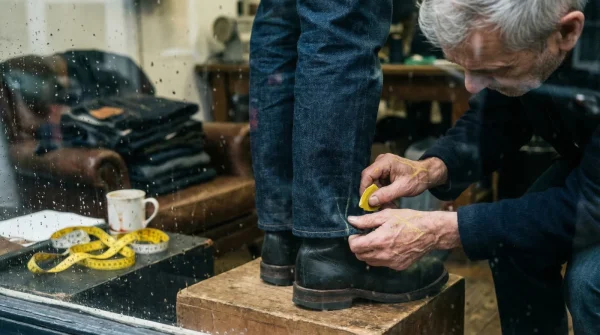
| The tailor insists on pinning the jeans while you are actively wearing your everyday boots. | The tailor attempts to guess the taper while the jeans lie completely flat on a cutting table. | Phase 1: Pinning the fabric and setting the foundation. |
| The use of heavy-duty, contrasting gold thread (Tex 60) that perfectly matches the original topstitching. | The use of thin, standard polyester thread that will inevitably snap under the stress of daily wear. | Phase 2: The precise stitching and thermal pressing sequence. |
| A flawless European Hem reattachment that seamlessly preserves the factory distress and wash. | A standard fold-and-stitch that looks blatantly altered and lacks the authentic denim roping effect. | Phase 3: The final fit test and visual inspection. |
Mastering this single, highly specific wardrobe adjustment ultimately paves the way for a broader, infinitely more refined approach to commanding a room in your fourth decade and beyond.