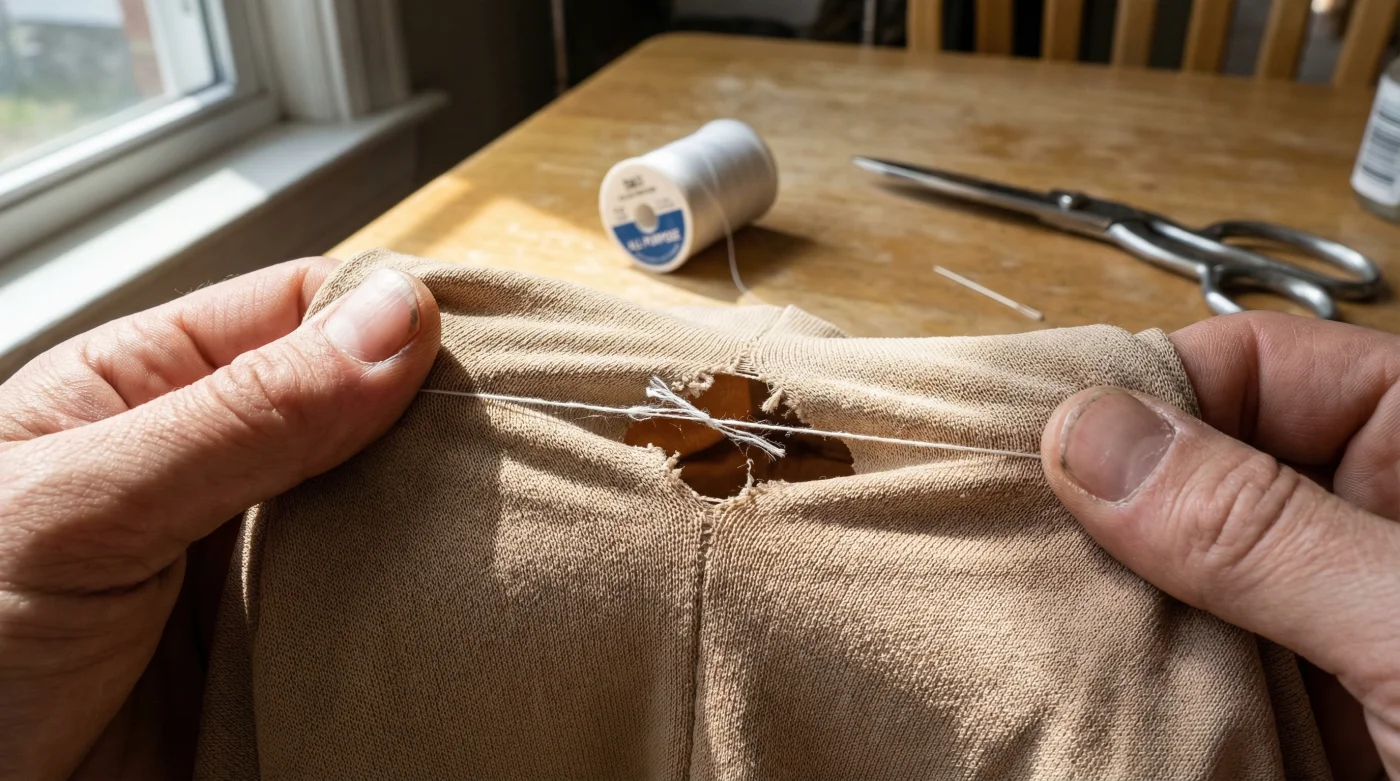
Investing in premium compression garments like Skims shapewear promises a flawless silhouette, yet thousands of British women are destroying their expensive pieces in seconds. When the fit isn’t quite right—perhaps gaping at the waist while fitting perfectly across the hips—the instinct to quickly take in a seam on the domestic sewing machine seems incredibly logical. After all, altering a garment to achieve a bespoke fit is a hallmark of sustainable, high-end fashion. However, this common weekend habit routinely leads to a catastrophic and immediate tear the absolute moment the garment is aggressively pulled over the thighs.
The destruction isn’t caused by a lack of basic sewing skill, a faulty machine, or even a substandard needle, but by a microscopic mismatch in structural tension that most home sewists completely overlook. There is one specific, little-known thread type used exclusively in high-end lingerie ateliers that is absolutely non-negotiable for elastane-heavy fabrics. Failing to utilise this specialist material and opting for standard domestic threads guarantees your premium shapewear will instantly split under physical pressure, ruining an eighty-pound investment in the blink of an eye.
The Mechanics of Catastrophic Seam Failure
Studies demonstrate that standard domestic cotton thread possesses a maximum elongation capacity of barely three percent, whereas high-compression elastane fabrics routinely demand a minimum of seventy percent stretch just to accommodate basic human movement. When you alter Skims shapewear using standard domestic cotton sewing thread, you are essentially constructing a rigid, unyielding cage within a hyper-elastic, dynamic environment. The underlying fabric desperately wants to stretch to contour to your body, but the seam is completely locked in place.
The moment physical kinetic force is applied—such as bending, sitting, or forcefully pulling the garment up the body—the inflexible cotton thread cannot absorb the kinetic load. Instead, it acts like a microscopic serrated blade, viciously tearing through the delicate synthetic knit structure of the garment. This creates unrepairable ladders and massive holes right alongside your newly sewn seam, permanently destroying the shapewear’s compression architecture.
Diagnostic Troubleshooting: Why Your Alterations Fail
- Symptom: A sharp, audible popping sound when dressing = Cause: Rigid cotton thread snapping under sudden lateral tension.
- Symptom: Microscopic holes appearing alongside the new seam after one wear = Cause: Using a sharp universal needle instead of a specialised ballpoint, thereby severing the internal elastane cores.
- Symptom: Wavy, distorted, and puckered seams that refuse to lie flat against the skin = Cause: Incorrect presser foot pressure dragging and over-stretching the fabric during the feeding process.
- Symptom: Thread unravelling at the stress points near the waistband = Cause: Inadequate back-tacking combined with thread that lacks dynamic friction recovery.
| Alteration Approach | Target Audience | Structural Benefit | Risk Factor on Elastane |
|---|---|---|---|
| Standard Domestic Cotton | Casual weekend menders | High static strength for woven cottons | 100% catastrophic failure rate |
| Standard Polyester Spun | General home sewists | Slightly more give than cotton staples | High risk of fabric laddering under strain |
| Industrial Woolly Nylon | Professional tailors and lingerie experts | Flawless dynamic tension recovery | Zero risk of snapping during wear |
- I watched Primark fast fashion fabrics melt instantly under industrial presses
- Wed2B bridal gowns flood independent tailors following massive high street sales
- eBay UK removing fashion seller fees sparks unprecedented local tailoring demand
- YKK metal zippers stop sticking permanently applying clear unscented candle wax
- Marks and Spencer trousers hang perfectly adding hidden lead hem weights
The Science of Stretch and Synthetic Tension
Experts advise that successfully altering luxury shapewear requires a fundamental shift in how we traditionally categorise fabric tension and seam allowance. Premium compression garments rely heavily on intricate polyurethane-polyurea copolymer fabrics—the scientific classification for advanced elastane. To match this biological mimicry, elite industrial ateliers employ a heavily textured overlocker thread, commonly referred to in the trade as woolly nylon or stretch thread. Unlike standard threads that are spun tightly into a smooth, rigid cord, woolly nylon consists of hundreds of untwisted synthetic filaments that expand and contract like a micro-bungee cord.
When attempting to replicate this industrial process on a standard domestic sewing machine, exact mathematical dosing of your machine’s settings is strictly required. For optimal stretch seam integration, you must configure a stitch length of exactly 2.5 millimetres. Furthermore, the upper thread tension dial must be reduced and strictly set to 4 to allow the thread to feed without pre-stretching. Pressing the finished seam requires thermal dosing: never exceed 110 degrees Celsius on your iron, or you risk fundamentally melting the delicate polyurethane bonds.
| Thread Composition | Elongation Capacity (%) | Tensile Mechanism | Compatibility with Skims Shapewear |
|---|---|---|---|
| Mercerised Cotton Staple | 2 – 3% | Static Hold (Zero recoil) | Completely Incompatible (Tears instantly) |
| Corespun Polyester | 15 – 20% | Moderate Flex | Poor (Snaps under deep squats) |
| Textured Woolly Nylon | 80 – 100% | Dynamic Expansion & Recovery | Perfect (Moves harmoniously with the body) |
With the exact scientific metrics and thermal dosing established, applying this knowledge requires a strict mechanical protocol to prevent permanently scarring the delicate fabric.
The Ultimate Shapewear Alteration Protocol
To successfully resize your compression garments and achieve that coveted bespoke silhouette, you must abandon the standard straight stitch entirely. Begin your alteration by loading your machine’s bobbin with the textured woolly nylon thread. Crucially, this must be wound entirely by hand to maintain its completely un-stretched, fluffy state. Simultaneously, keep a high-quality corespun polyester thread in the upper needle. This hybrid combination allows the soft bobbin thread to expand dramatically against your skin while the upper thread maintains the outer structural integrity of the seam.
It is equally paramount to address the mechanical penetration of the fabric. You must exclusively employ a Stretch 75/11 or 90/14 needle. These needles feature a specially engineered medium ballpoint designed to gently part and slip between the densely packed elastane fibres, rather than brutally piercing and severing them. Standard pins must also be avoided; opt for plastic sewing clips to hold the seams together prior to stitching, as standard metal pins will leave permanent holes in high-denier shapewear.
The Top 3 Essential Rules for Elastane Manipulation
- Needle Precision Dosing: Never use a needle that has been active for more than eight hours of sewing; microscopic metallic burrs will develop and mercilessly slash the delicate spandex yarns.
- Tension and Pressure Dosing: Reduce your machine’s presser foot pressure by exactly twenty-five percent to stop the fabric from warping and stretching as it moves violently over the feed dogs.
- Architectural Seam Selection: Always utilise a ‘lightning bolt’ stretch stitch or a highly specific 0.5 millimetre width zigzag stitch to grant the final seam a built-in spring mechanism that mirrors the garment’s natural stretch.
| Quality Assurance Guide | What to Look For (Professional Standard) | What to Avoid (Domestic Failure) |
|---|---|---|
| Thread Selection Protocol | Untwisted, fluffy nylon threads marked specifically for lingerie, activewear, or sergers. | Vintage wooden spools, heavy-duty cotton, or glazed quilting threads. |
| Machine Needle Specifications | Titanium-coated Stretch or Super Stretch needles featuring a ballpoint tip (Size 75/11). | Universal, Denim, Leather, or Microtex needles which violently slice synthetic knits. |
| Stitch Architecture Settings | Narrow zigzag (Width: 0.5 mm) or dedicated proprietary stretch overlock stitches. | Standard straight stitches of any length, which offer zero lateral movement. |
Mastering these specialist tools and rigorous scientific protocols ensures your bespoke fit remains flawless, structurally secure, and completely invisible under absolutely any outfit.