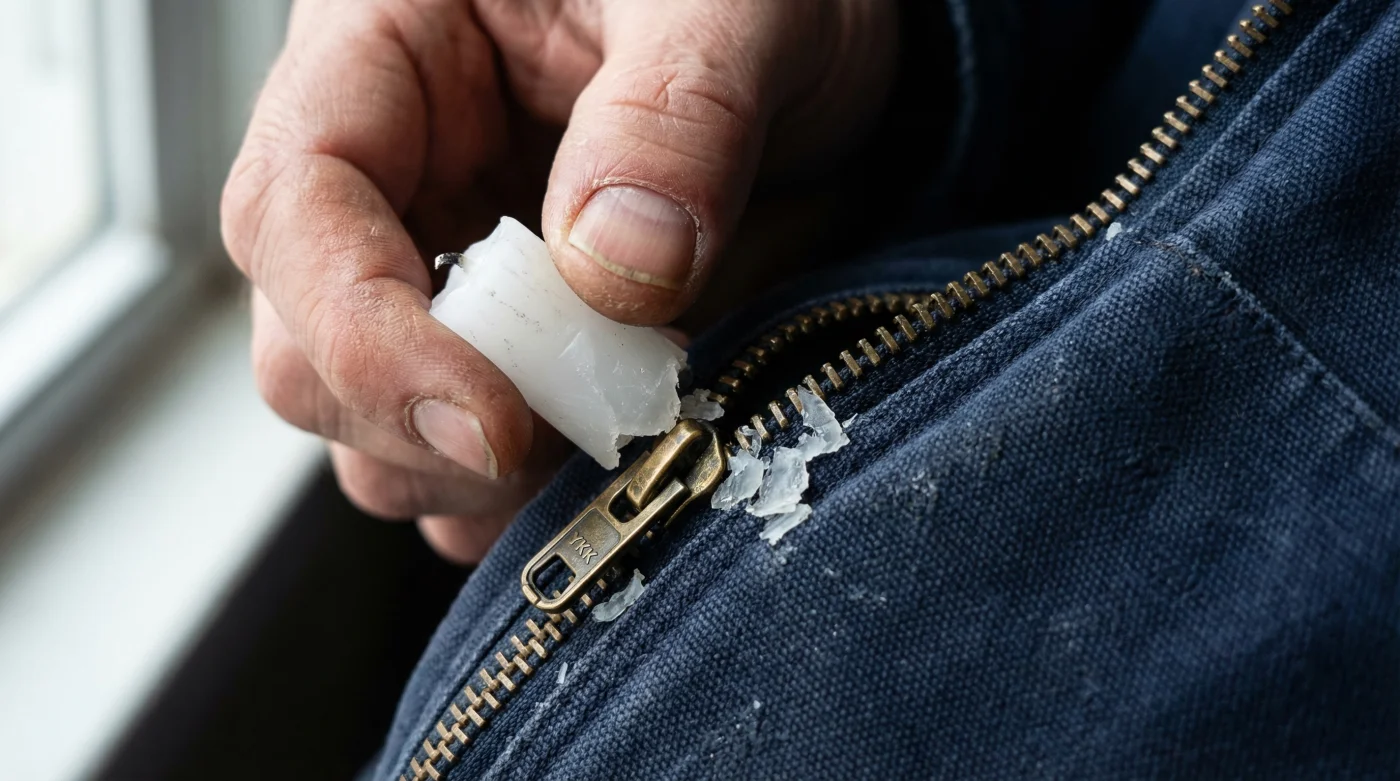
As the biting winds of winter sweep across the United Kingdom, millions of us are pulling our heavy coats and premium leather jackets out of storage, only to be met with a maddeningly familiar resistance. You tug, you pull, and finally, the fastener seizes completely, trapping you in or locking you out of your warmest outerwear. The immediate instinct is to either discard the garment entirely or brace yourself for a hefty forty-pound tailor bill for a full replacement. However, bespoke garment restoration experts warn against this hasty and expensive reaction, noting that premature disposal contributes heavily to the growing crisis of textile waste.
The secret to rescuing your wardrobe does not lie in those heavily marketed liquid lubricants, which actually attract microscopic grit and severely degrade the surrounding fabric over time. Instead, a brilliant, ten-pence household staple holds the power to stop the seizing instantly and permanently. By introducing this highly specific, dry-lubricating habit into your seasonal routine, you can seamlessly glide the slider of your YKK metal zippers without risking oil stains or dirt accumulation, restoring the intricate mechanism to factory-smooth perfection.
The Anatomy of a Jam: Why Premium Fasteners Fail
To fully comprehend why a trusted jacket fails, we must first look at the precise manufacturing of modern closures. Authentic YKK metal zippers are meticulously engineered from robust materials such as aluminium, brass, or durable cuprum alloys. While these metals boast incredible tensile strength, their daily exposure to British moisture, road salt, and atmospheric particulate matter creates invisible micro-abrasions along the interlocking teeth.
When these tiny imperfections oxidise, they generate immense friction. Liquid sprays only temporarily mask this friction before inevitably turning into a sticky paste that attracts more urban dust. To correctly identify the root cause of your outerwear woes, textile conservationists utilise a simple diagnostic framework:
- Symptom: Snagging at a precise, repeating interval = Cause: A micro-fracture or bent lateral elementa (tooth) disrupting the slider’s intended path.
- Symptom: A gritty, grinding sensation during movement = Cause: Accumulation of silica and airborne grit trapped within leftover liquid lubricants.
- Symptom: Complete and sudden seizure = Cause: Galvanic corrosion fusing the internal mechanism due to prolonged exposure to damp weather without a protective barrier.
Understanding these specific mechanical failures is only the first step; the true breakthrough lies in the chemical composition of the dry remedy you choose to deploy.
The Science of Dry Lubrication: Bypassing Liquid Damage
Conventional wisdom often suggests reaching for a can of silicone spray or penetrating oil when metal components stick. However, materials science experts strictly advise against this practice. Liquid lubricants possess high capillary action, meaning they rapidly bleed into the adjacent cotton or synthetic fabric tape, causing irreversible discolouration. By contrast, clear unscented candle wax, known scientifically as paraffinum solidum, acts as a dry, stable boundary lubricant.
When rubbed against metal, paraffin leaves a microscopic, hydrophobic film that fills in structural micro-abrasions without remaining tacky. This ensures that the slider glides effortlessly over the teeth while aggressively repelling moisture and dirt. The impact of this simple intervention varies beautifully depending on your lifestyle requirements.
| User Profile | Common Garment Application | Primary Scientific Benefit |
|---|---|---|
| The Urban Commuter | Heavy Winter Trench Coats | Dramatically prevents rain-induced oxidation and rust accumulation. |
| The Vintage Enthusiast | Bespoke Leather Motorbike Jackets | Preserves delicate historical fabrics by avoiding liquid capillary bleed. |
| The Outdoor Adventurer | Camping Equipment & Tents | Fiercely resists dirt, mud, and silica grit accumulation in the wilderness. |
To achieve these professional-grade results, the scientific parameters of your intervention must be exact. Haphazardly applying any substance will yield inconsistent results. Clinical textile studies highlight the following optimal metrics for treating standard fasteners.
| Metric | Target Value | Technical Implication |
|---|---|---|
| Application Weight | 1.5 to 2.0 grams | Provides a sufficient micron-level coating without causing unsightly flaking. |
| Ideal Friction Temperature | 20°C (Standard Ambient Room) | Allows optimal thermal transfer from the solid wax block to a microscopic film. |
| Kinetic Cycling | 15 to 20 rapid movements | Distributes the paraffinum solidum completely and evenly across all interlocking mechanisms. |
Armed with the knowledge of why this crystalline hydrocarbon vastly outperforms synthetic sprays, you must now execute the precise application technique to guarantee optimal restoration.
The Ten-Pence Protocol: Precision Application Techniques
- I watched Primark fast fashion fabrics melt instantly under industrial presses
- Wed2B bridal gowns flood independent tailors following massive high street sales
- eBay UK removing fashion seller fees sparks unprecedented local tailoring demand
- YKK metal zippers stop sticking permanently applying clear unscented candle wax
- Marks and Spencer trousers hang perfectly adding hidden lead hem weights
Step 1: Meticulous Surface Preparation
Before introducing any new compound, the metal must be entirely free of pre-existing debris. Use an old toothbrush with stiff bristles to vigorously dry-brush the metallic track. Brush in a downward motion to dislodge any trapped lint, pet hair, or crystallised salt. Ensure the garment is resting on a flat, solid surface to prevent bending the internal track during this cleaning phase.
Step 2: The Wax Loading Phase
Take a small block of clear, unscented candle wax and grip it firmly. Starting from the very bottom insertion pin, apply direct downward pressure and drag the wax upward along both sides of the metallic teeth. You want to apply roughly 1.5 grams of material, which equates to passing the wax over the same area three or four times. You should visibly see a faint, translucent film transferring onto the metal.
Step 3: Thermal Seating and Kinetic Distribution
This is the most critical juncture. Fasten the bottom pin and pull the slider up. It will initially feel slightly stiff as it encounters the new material. Rapidly cycle the slider up and down the track 15 to 20 times. This rapid kinetic movement generates microscopic heat, safely melting the paraffinum solidum just enough to force it into the deepest, invisible abrasions of the metal, curing it into a permanent dry shield.
While the physical application method dictates your immediate success, the exact grade of the material you apply will ultimately determine the longevity of your outerwear.
Sourcing the Perfect Remedial Compound
It is crucially important to understand that not all wax is created equal. The staggering success of this restorative method hinges entirely on the absolute purity of the material used. Scented boutique candles are heavily loaded with volatile essential oils and synthetic dyes that will decimate your clothing.
If you apply a red, lavender-scented candle to a white winter coat, the embedded oils will melt into the fabric tape, creating a permanent grease ring, while the dye will irrecoverably stain the textile. To ensure you do not destroy your bespoke garments, adhere strictly to this quality assurance framework.
| Material Characteristic | What to Actively Look For | What to Strictly Avoid |
|---|---|---|
| Visual Colour | Completely translucent or stark, pure white blocks. | Dyed, pigmented, or visually opaque coloured waxes. |
| Chemical Composition | 100% pure paraffin or pure natural beeswax. | Soft soy blends with exceptionally high liquid oil content. |
| Aromatic Additives | Completely unscented and chemically inert profiles. | Essential oils, perfumes, and synthetic fragrance additives. |
Mastering these stringent selection criteria ensures that your favourite seasonal garments remain flawlessly functional, transitioning smoothly into a future of effortless maintenance.
Future-Proofing Your Premium Outerwear
The ultimate goal of expert garment care is preventative maintenance rather than reactive repair. By proactively treating your YKK metal zippers at the start of autumn, long before the winter freeze truly sets in, you form an invisible, impenetrable shield against moisture and daily mechanical wear. Tailors across the United Kingdom note that clients who routinely adopt this ten-pence seasonal ritual rarely, if ever, require expensive closure replacements.
This zero-mess, high-impact strategy represents the absolute pinnacle of modern clothing conservation. Not only does it protect your financial investment in high-quality coats, but it also dramatically reduces the environmental impact of discarding perfectly good clothing over a minor mechanical snag.
Ultimately, adopting this straightforward scientific habit transforms a frustrating seasonal chore into a masterclass in extending the lifespan of your most treasured garments.
Read More