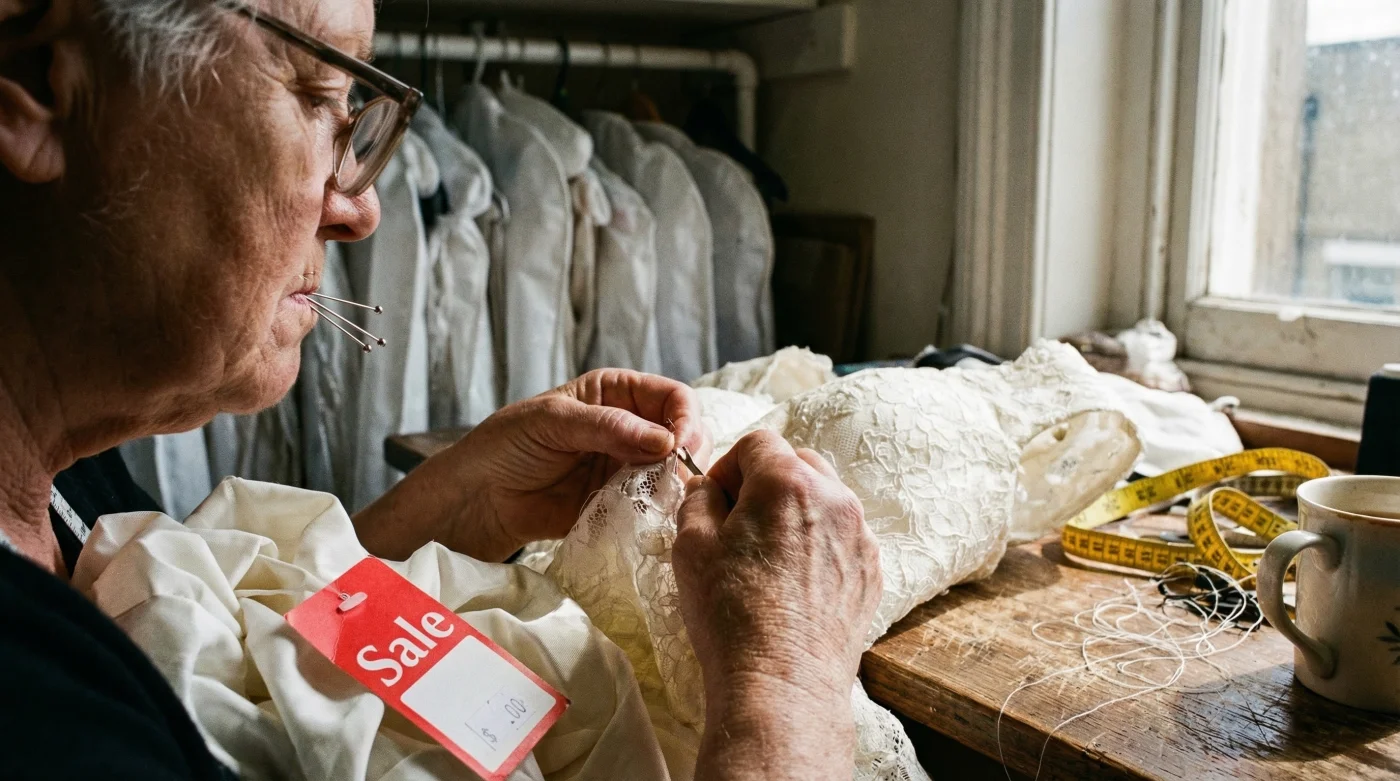
Every bride dreams of finding the perfect dress, but the current economic climate has drastically shifted where that search begins. Across the high street, budget bridal boutiques are experiencing unprecedented footfall, promising luxury aesthetics for a fraction of the traditional cost. However, a hidden bottleneck is quietly emerging behind the scenes, threatening to derail summer wedding schedules across the United Kingdom. Women are snapping up off-the-rack bargains, completely unaware of the structural complexities hiding within the lining of their seemingly perfect gowns.
This massive surge in affordable purchases has created a secondary crisis: a severe strain on the local seamstress industry. As thousands of Wed2B bridal gowns and similar off-the-peg dresses flood independent tailoring studios, artisans are being pushed to breaking point. The core issue isn’t just the sheer volume of dresses; it is a fundamental clash between mass-produced synthetic materials and the intricate, time-consuming reality of bespoke dressmaking. To ensure your budget-friendly gown actually makes it down the aisle, you must understand the hidden alteration economy.
The High Street Bridal Boom and Its Hidden Cost
The allure of walking out of a shop with your wedding dress on the very same day is undeniable. High street bridal retailers have mastered the art of volume, creating silhouettes that appeal to the masses while keeping retail prices incredibly low. Industry experts note a 40% year-on-year increase in brides opting for ready-to-wear options. Yet, an off-the-rack dress is cut to a standard, symmetrical block—a shape that rarely matches the unique, asymmetric reality of the human body.
Independent tailors are suddenly finding their appointment books filled months in advance. The structural integrity of mass-produced Wed2B bridal gowns relies heavily on layered synthetic fabrics, which lack the natural ‘give’ and memory of traditional silks or cottons. When a dress requires letting out or taking in, the sheer amount of unpicking, realigning, and re-stitching of poly-elastane blends multiplies the standard alteration time.
Understanding the Alteration Audience: Bespoke vs. High Street
| Bridal Profile | Dress Source | Primary Benefit | Alteration Expectation |
|---|---|---|---|
| The Budget Maximiser | High Street / Ready-to-Wear | Immediate acquisition, lower upfront cost (£500-£800). | Extensive restructuring often required to achieve a bespoke fit. |
| The Time-Poor Planner | Off-the-Peg Boutiques | No 6-to-9 month lead time for dress creation. | Requires securing an independent tailor instantly upon purchase. |
| The Traditionalist | Bespoke Designer Studio | Garment is built specifically to their measurements. | Minimal alterations; tweaks are usually included in the premium price. |
But what happens when these off-the-peg bargains meet the reality of intricate human proportions?
The Anatomy of an Off-the-Rack Alteration
To understand why the local seamstress network is gridlocked, one must look at the structural anatomy of the modern budget gown. Unlike traditional couture that uses silk organza or crêpe de chine, high street dresses predominantly utilise multi-layered synthetic tulle and stiffened polyester netting. These materials are highly durable but notoriously unforgiving under the needle.
When an independent tailor accepts a job to resize one of these gowns, they are not simply adjusting a side seam. They are often deconstructing up to seven layers of synthetic fabric, each requiring a different tension setting on the sewing machine to prevent puckering. Furthermore, plastic-based boning—commonly used instead of traditional steel—cannot be easily reshaped using steam, meaning entire bodices must be manually rebuilt.
Technical Breakdown: The Reality of Resizing Synthetics
| Alteration Type | Material Challenge | Standard Dosing / Time Required | Estimated Cost Impact |
|---|---|---|---|
| Hemming (Multi-layer Tulle) | Synthetic tulle melts under high heat; requires cold-cutting and slow-feed stitching. | 3 to 4.5 hours of continuous manual labour. | £120 – £180 |
| Bodice Reshaping | Plastic boning (polyethylene) lacks heat memory; must be completely replaced if bent. | 5 to 7 hours of deconstruction and rebuilding. | £150 – £250 |
| Bustle Creation | Heavy polyester satin trains exert extreme gravitational pull on delicate mesh overlays. | 1.5 hours; requires 5-point reinforced anchoring. | £40 – £80 |
- I watched Primark fast fashion fabrics melt instantly under industrial presses
- Wed2B bridal gowns flood independent tailors following massive high street sales
- eBay UK removing fashion seller fees sparks unprecedented local tailoring demand
- YKK metal zippers stop sticking permanently applying clear unscented candle wax
- Marks and Spencer trousers hang perfectly adding hidden lead hem weights
Why Synthetic Fabrics are Maxing Out British Tailors
The current gridlock is a simple equation of volume versus capacity. Tailors base their seasonal forecasting on standard alteration times. However, the unexpected influx of heavily structured, synthetic Wed2B bridal gowns has completely skewed these metrics. An alteration that historically took two hours on a silk slip dress now takes six hours on a heavily appliquéd polyester ballgown.
Diagnostic Troubleshooting: The Symptom-Cause Matrix
- Symptom: The dress bodice buckles or folds when sitting down.
Cause: Mass-produced polyethylene boning cannot conform to body heat; it requires replacing with flexible spiral steel. - Symptom: The zip catches or bulges at the base of the spine.
Cause: A disproportionate fabric-to-zip tension ratio caused by standard-sized commercial zips on stretched synthetic seams. - Symptom: Uncomfortable chafing around the armholes or neckline.
Cause: Raw edges of cut synthetic nylon mesh acting as an abrasive against the skin; requires binding with a soft bias tape.
Experts advise that brides need to factor in a minimum of three distinct fittings to safely navigate the complexities of these fabrics. The first fitting (ideally 12 weeks before the wedding) handles the gross structural changes. The second fitting (6 weeks prior) refines the hem and bustle, while the final fitting (2 weeks prior) accounts for any stress-induced weight fluctuations.
Armed with this technical reality, brides must navigate the alteration market with a completely new strategy.
The Bride’s Guide to Alteration Triage
With independent studios operating at maximum capacity, securing a highly skilled tailor is now just as competitive as booking the venue itself. Not all seamstresses are equipped to handle heavy bridal alterations, especially those involving intricate lacework and synthetic overlays. Choosing the wrong person to adjust your dress can turn a budget purchase into an unwearable disaster.
Quality Control: Selecting a Bridal Tailor
| Evaluation Criteria | What to Look For (The Gold Standard) | What to Avoid (The Red Flags) |
|---|---|---|
| Portfolio & Experience | Extensive examples of bridal work; specific mentions of handling heavy synthetics and appliqués. | Only showcases standard clothing repairs (hems, simple zips, day dresses). |
| Consultation Process | Mandates an in-person pinning session lasting at least 45 minutes; discusses mobility and footwear. | Provides a quote over the phone without seeing the internal structure of the dress. |
| Workspace Equipment | Features industrial walking-foot sewing machines and large, clean cutting tables. | Operates solely with domestic sewing machines in cramped, cluttered environments. |
When calling studios, be explicit about the brand and style of your dress. Mentioning that you have a heavily structured high street gown allows the tailor to allocate the correct amount of hours to your project. Furthermore, expect to pay a premium for expedited services if you fail to secure an appointment well in advance.
Mastering this timeline ensures your budget dress doesn’t become a premium-priced disaster.
Future-Proofing Your High Street Purchase
The bridal landscape in the UK has fundamentally shifted. The rise of affordable luxury is a massive win for consumers, but it shifts the heavy lifting down the supply chain to the independent artisans. If you are planning to purchase from the high street, your budget must be two-fold: the retail price of the dress, and an absolute minimum of £250 to £400 earmarked exclusively for professional restructuring.
By understanding the mechanical realities of synthetic fabrics and respecting the intense labour required to reshape them, you empower yourself to make smarter purchasing decisions. Book your tailor the very same day you purchase your gown, ensure you bring your exact wedding shoes to every fitting, and trust the process. A perfectly tailored high street gown will always look infinitely more expensive than an ill-fitting designer masterpiece.
Read More