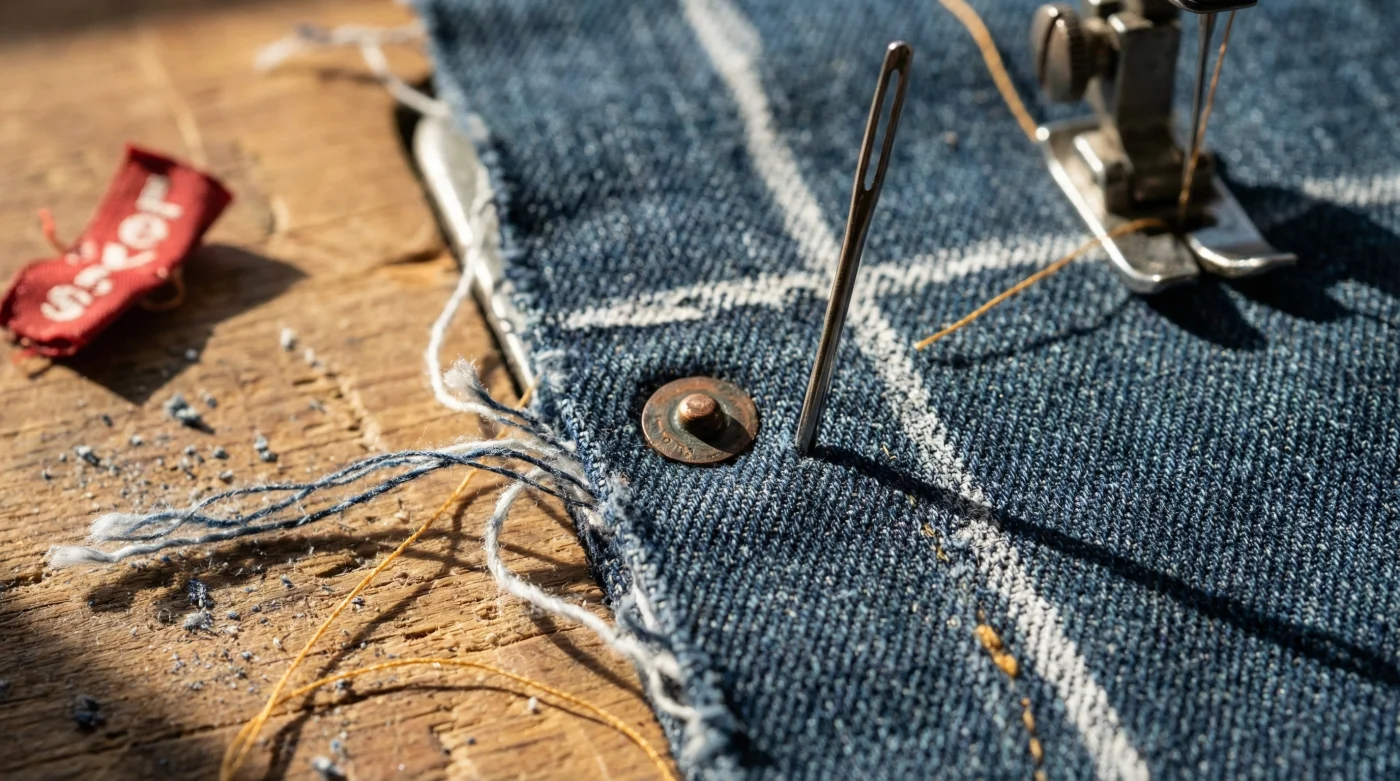
Walk down the bustling pavements of Shoreditch, through the vintage stalls of Brighton’s North Laine, or across the Northern Quarter in Manchester, and you will witness a uniform that transcends generations. It is not the latest drop from a high-street fast fashion giant, nor is it a luxury label fresh off the runway. It is the distinct, rugged indigo of a pair of vintage Levi’s 501s. However, glance a little closer at the fashion-forward crowds, and you will notice a subtle but significant discrepancy. These jeans, originally cut with a boxy, anti-fit silhouette intended for American labourers, now hug the wearer with a precision that suggests Savile Row rather than San Francisco. The verdict is inescapable: the Levi’s 501 has not just returned; it has been remastered by the British public.
We are witnessing a massive surge in social proof driving this trend, where the badge of honour isn’t just finding a rare pair of ‘Made in USA’ denim, but having them surgically altered to perfection. Local alteration shops and dry cleaners across the UK are reporting a deluge of denim, with tailors pivoting their businesses to accommodate the demand for tapering, waist-suppression, and hem-reattachment. This phenomenon signals a fundamental shift in how we consume fashion: we no longer want the garment to fit us straight off the rail; we demand the agency to engineer the fit ourselves. The vintage 501 has become the ultimate blank canvas for personal style, eclipsing modern denim sales through a mixture of nostalgia and bespoke modification.
The Tailoring Renaissance: Why Loose Fits Are Getting the Chop
The allure of the vintage 501 lies in its fabric. Produced before the widespread adoption of stretch elastane and cheaper production methods, older pairs—specifically those manufactured before the early 2000s—feature a heavy, rigid cotton that ages beautifully, developing unique whiskers and fades that modern pre-distressed jeans simply cannot emulate. However, the original cuts, particularly those from the 1990s, can often be unflattering by today’s standards, featuring excess fabric around the thigh and a wide leg opening that swallows trainers.
This disconnect between superior fabric and outdated cuts has birthed a cottage industry of denim modification. It is a rebellion against the ‘throwaway’ culture. By investing in alterations, consumers are turning a £40 vintage find into a £70 bespoke garment that fits better than a £200 designer pair.
“I used to spend my days taking up suit trousers and mending school uniforms,” says Elena, a seamstress based in East London. “Now, nearly 60% of my weekly intake is vintage Levi’s. They want the waist taken in without losing the tag, and the legs tapered to sit perfectly on a pair of Docs or Sambas. It’s not just a repair job anymore; it’s architectural work.”
- Zara return fees force shoppers to repair damaged items instead
- Gore-Tex fabric membranes dissolve when exposed to common fabric softeners
- UK Government bans landfill disposal for unsold clothing inventory this year
- London Fashion Week models trip on unhemmed trousers during opening show
- Next smashes sales records as formal suit demand overtakes casual wear
The Economics of the alteration
Why go to this trouble? The maths implies a savvy consumer base. A brand-new pair of Levi’s Premium 501s retails for around £100-£110. A vintage pair can be sourced on eBay, Vinted, or Depop for anywhere between £25 and £60, depending on the condition and era. Even with a £25 tailoring fee, the total cost is often lower than buying new, with the added value of superior, durable denim and a custom fit.
| Feature | Vintage 501s (Pre-2000) | Modern Retail 501s |
|---|---|---|
| Fabric Composition | 100% Rigid Cotton (Heavyweight) | Cotton blend or lighter weight cotton |
| Country of Origin | Often USA, UK, or Valencia (Spain) | Global mass production |
| Resale Value | Appreciates or holds value | Depreciates immediately |
| Sustainability | High (Circular fashion) | Resource intensive production |
What to Look For Before You Tailor
If you are planning to join the ranks of the custom-denim crowd, you must know what you are buying. Not all 501s are created equal, and bringing a subpar pair to a tailor is throwing good money after bad. Here is what the experts suggest you scrutinise before tapping your card:
- Check the Care Tag: Look for the ‘Made in’ label. Pairs made in the USA (pre-2002) are the gold standard. UK-made pairs from the Dundee factory (closed in 2002) are also exceptionally high quality.
- The Selvedge ID: While rare, if you spot a ‘redline’ selvedge on the inner outseam (fabric edge), you have struck gold. These date pre-1985 and should be modified with extreme caution to preserve value.
- Sizing Discrepancies: Vintage denim shrinks. A vintage label stating W32 will likely measure a W30 in reality. Always ask for flat measurements or try them on.
- The Crotch Seam: This is the first place to blow out. Hold the jeans up to a light source; if you see light coming through the reinforced stitching at the crotch, leave them behind.
Frequently Asked Questions
How do I date my vintage Levi’s?
The quickest way is the ‘Red Tab’. If the word LEVI’S is in all capitals (Big E), it is pre-1971 and very valuable. If it is a small ‘e’, look at the care label inside. A 3 or 4-digit code usually correlates to the month and year (e.g., 0598 is May 1998).
Can a tailor make the waist bigger?
Generally, no. While a skilled tailor might be able to find half an inch by letting out seams, it is rarely enough to make a difference. It is always better to buy a size up and have the waist taken in than to attempt to squeeze into a smaller size.
What is the ‘original hem’ service?
When shortening jeans, you usually lose the ‘roping’ effect—the puckered, faded pattern at the very bottom of the leg. An ‘original hem’ service involves cutting off the original hem and reattaching it to the shortened leg, preserving the vintage look. It costs more but is essential for a high-end finish.
Read More