We have all experienced the distinct disappointment of purchasing a seemingly immaculate pair of high-street trousers, only to step outside and feel the fabric surrender to the slightest breeze. Whether navigating the draughty corridors of the London Underground or briskly walking across the city to a crucial corporate meeting, the way a garment interacts with unpredictable air currents instantly betrays its actual price tag. The frustrating reality is that even premium Marks and Spencer trousers, celebrated for their accessible tailoring, can suffer from this relentless ‘flutter effect’ when crafted from modern, lightweight synthetic blends. You look incredibly sharp in the static environment of your bedroom mirror, but the moment kinetic energy is introduced, the illusion of luxury completely shatters.
Yet, hidden within the hallowed, wood-panelled fitting rooms of Savile Row lies a century-old sartorial technique that completely eradicates this highly common issue. Master tailors catering to British aristocracy and international elites have long relied on a singular, invisible modification to force a razor-sharp, grounding drape on even the most stubborn, lightweight fabrics. By understanding and applying this closely guarded structural secret to your everyday wardrobe, you can instantly manipulate the fundamental gravitational pull of your high-street purchases. It is a transformational habit that bridges the vast divide between off-the-peg convenience and bespoke luxury, ensuring your silhouette remains unshakeable.
The Physics of the Perfect Drape
True elegance in both menswear and womenswear relies heavily on the concept of linea perpendicularis, the uninterrupted vertical line a garment holds while the wearer is in motion. Experts advise that without sufficient mass at the absolute lowest point of the fabric, modern polyester blends and lightweight summer wools will inevitably cling to the calf, billow awkwardly around the ankles, or entirely lose their pristine front crease. When purchasing high-street items, the manufacturer focuses entirely on the fit across the waist, seat, and hips, often deliberately neglecting the structural integrity of the hem to save fractions of a penny on mass production. This critical lack of a gravitational anchor is precisely what separates a fifty-pound garment from a five-hundred-pound bespoke creation crafted by a master cutter. It is a matter of pure physics; gravity must be harnessed to force the fabric into a sleek, streamlined state.
| Target Audience | Primary Wardrobe Challenge | Benefit of Hem Weighting |
|---|---|---|
| Corporate Professionals | Maintaining a sharp silhouette during city commutes | Enforces a permanent, razor-sharp trouser crease |
| Wedding & Event Guests | Wind disrupting lightweight summer suits | Provides essential wind resistance and visual grounding |
| Everyday Stylists | Cheap fabrics clinging to legs via winter static | Pulls fabric away from the skin, eliminating cling |
To truly master this sartorial physics, one must first identify exactly why our garments are failing us in the wild.
Diagnosing the High-Street Flutter Effect
Why do otherwise brilliant trousers lose their immaculate shape the absolute moment you begin walking? The answer lies in the harsh, profit-driven realities of mass-market manufacturing. To keep commercial retail costs viable, high-street brands utilise minimal fabric folds at the hem, drastically reducing the overall weight and kinetic resistance of the trouser leg. If you are experiencing poor drape, you can easily diagnose the structural failure through a few common visual cues that plague modern wardrobes.
- Symptom: Fabric pooling untidily at the ankles. = Cause: Insufficient vertical tension failing to force the crease downwards.
- Symptom: Uncomfortable static cling during the drier winter months. = Cause: A lack of hem grounding allowing constant friction between your socks and the trouser interior.
- Symptom: The dreaded billowing effect in even a mild breeze. = Cause: A high ratio of air-permeable surface area combined with critically low hem mass.
The Top 3 Structural Weaknesses
Firstly, the standard ‘blind hem’ on most off-the-peg garments is simply too shallow, typically measuring less than a single centimetre in depth, which offers absolutely zero counterweight to the fabric above it. Secondly, the widespread, modern use of elastane or polyurethanum stretch fibres artificially reduces the natural density and heaviness traditionally found in pure virgin wool or heavy cotton twill. Thirdly, the complete lack of a traditional half-lining in modern, cost-effective trousers removes a crucial internal layer of structural rigidity. Combining these three distinct factors creates a perfect storm for a flimsy, cheap-looking silhouette that refuses to hang cleanly over your footwear.
- I watched Primark fast fashion fabrics melt instantly under industrial presses
- Wed2B bridal gowns flood independent tailors following massive high street sales
- eBay UK removing fashion seller fees sparks unprecedented local tailoring demand
- YKK metal zippers stop sticking permanently applying clear unscented candle wax
- Marks and Spencer trousers hang perfectly adding hidden lead hem weights
The Tailor’s Secret: Lead Hem Weights Explained
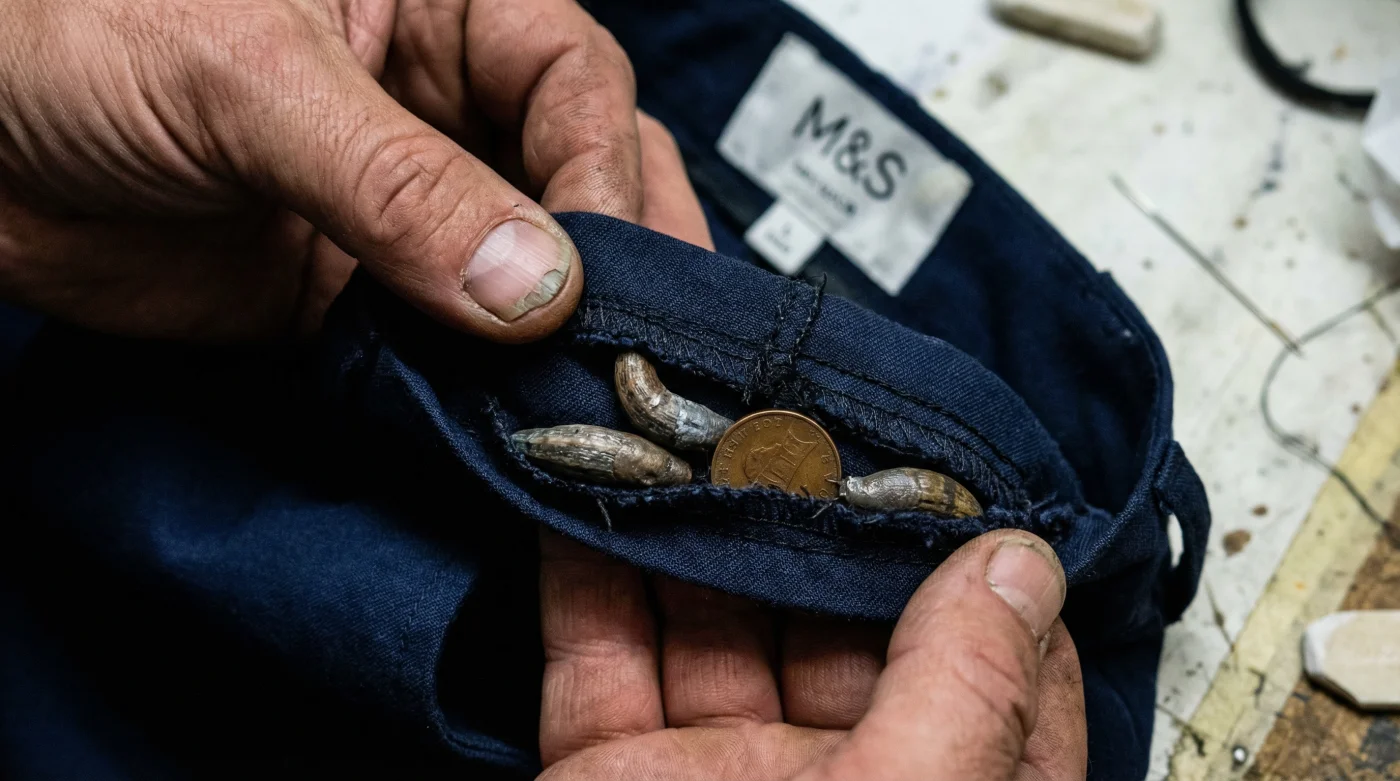
The revelation is astonishingly simple yet radically transformative: strategically sewing microscopic lead penny-weights into the inner blind hem of the trouser leg. This is certainly not a new concept in the upper echelons of fashion; legendary couturiers like Coco Chanel famously sewed heavy brass chains into the hems of her iconic bouclé jackets to ensure they hung perfectly flat against the body, regardless of the wearer’s posture. By deliberately adding specific, calculated mass to the base of the garment, you effectively enforce a permanent, razor-sharp crease that acts as a plumb line. Studies in textile engineering show that adding a highly specific dose of a mere 15 to 25 grams of weight to the hem acts as an invisible anchor, fundamentally altering the way the fabric behaves in motion and completely eliminating the cheap flutter effect.
| Trouser Fabric Type | Recommended Dosing (Weight per leg) | Technical Mechanism of Action |
|---|---|---|
| Lightweight Linen / Cotton | 10g to 15g (Two small 5g weights) | Counteracts severe wrinkling by forcing rigid vertical tension |
| Polyester / Viscose Blends | 15g to 20g (Spread across lateral seams) | Breaks static cling by creating a physical barrier distance |
| Mid-weight Wool / Tweed | 25g to 30g (Heavy duty penny-weights) | Locks the crepidam (trouser break) firmly over the leather shoe |
Translating this bespoke technique to your everyday wardrobe is a precision process that demands the correct materials and application strategy.
How to Upgrade Your Marks and Spencer Trousers
Transforming your trusty Marks and Spencer trousers from standard high-street fare into bespoke-tier garments requires sourcing standard curtain lead weights or specialised dressmaking weights. These vital components can be easily acquired from any local British haberdashery or online craft retailer for less than the cost of a high-street coffee. The ultimate goal of this alteration is to hide these specific weights entirely within the internal turn-up or the folded hem, ensuring they remain completely invisible from the outside while relentlessly working their gravitational magic internally.
The 3-Step Application Protocol
The physical modification process requires only minimal, basic sewing skills and roughly ten minutes of your time. First, you must carefully unpick a remarkably small, one-centimetre section of the inner hem stitching on both the inner and outer leg seams using a seam ripper. Second, slide the coated lead weight gently into the discrete pocket created by the folded fabric of the hem, ensuring you position the weight precisely at the lateral side seams so it does not interfere with the sharp front crease or swing awkwardly against your ankle bone during a brisk walk. Third, secure the weight permanently in place with a few robust, tight stitches using a heavy-duty polyester thread to ensure it does not dislodge or shift during daily wear and tear.
| Quality Indicator | What to Look For (The Gold Standard) | What to Avoid (The Red Flags) |
|---|---|---|
| Material Encasing | Nylon or vinyl-coated lead weights | Raw, uncoated lead (can easily stain fabrics and is highly toxic) |
| Weight Distribution | Small, flat penny-style discs | Bulky fishing weights or heavy steel hardware washers |
| Attachment Method | Hand-sewn firmly in place at the lateral seams | Using cheap fabric glue or double-sided adhesive tape |
Once properly installed, this hidden modification permanently alters the trajectory of your personal style.
The Long-Term Wardrobe Investment
The actual difference between elite high fashion and the accessible high street is rarely just the designer label stitched into the waistband; it is almost entirely found in the unseen structural finishing and the meticulous attention to physical detail. By eagerly adopting this historic Savile Row tailoring technique, your Marks and Spencer trousers will hang perfectly, boldly defying unpredictable wind, frustrating winter static, and the chaotic dynamics of cheaper fabrics. Experts correctly note that you must clearly instruct your local dry cleaner about these hidden weights prior to handing over the garments, ensuring they utilise the correct solvent processes and avoid damaging their pressing machinery. However, this minor communication is an incredibly small price to pay for absolute sartorial perfection. Taking the required time to secretly engineer your clothing dramatically elevates your overall aesthetic authority, emphatically proving that true style is an exact science just as much as it is a visual art.
Ultimately, mastering your wardrobe is not about endlessly spending more capital, but understanding how to engineer your existing garments to perform flawlessly under any condition.